
The history of Silicon Valley is often sanitized into a polite myth of “two guys in a garage,” but Apple’s real story is far more deliciously subversive. Founded on April Fool’s Day in 1976, the company began as an act of high-tech heresy. From its counter-culture origins to its current status as a $3 trillion titan, Apple’s trajectory has been defined not by corporate spreadsheets, but by a prankster’s spirit and a series of calculated risks that shouldn’t have worked.
The Prank That Started It All: The “Blue Box”
Before Apple was a computer company, it was a partnership based on illegal hardware. In 1971, mutual friend Bill Fernandez introduced a 21-year-old electronics genius named Steve Wozniak to a 16-year-old high schooler named Steve Jobs. Their first business venture involved “Blue Boxes”—digital devices that emitted specific tones to manipulate the telephone network and place free long-distance calls.
Wozniak famously used one to call the Vatican, pretending to be Henry Kissinger in an attempt to speak to the Pope. While Wozniak provided the engineering wizardry, Jobs saw the commercial potential, managing to sell about 200 of the illegal boxes for $150 each. It was a pivotal moment of realization: Wozniak could build the impossible, and Jobs could find a way to make it a business.
“If it hadn’t been for Wozniak’s blue boxes, there wouldn’t have been an Apple.”
The Devil in the Details? The $666.66 Apple I
When the duo officially launched Apple on April 1, 1976, their first product, the Apple I, hit the market with a sinister-looking retail price: $666.66. Despite the “Mark of the Beast” theories that followed, the reason was purely practical—Wozniak simply liked repeating digits and felt the price was a fair markup from the $500 wholesale cost.
The Apple I represented a radical transition from the hobbyist “play toys” of the era. Unlike other microcomputers that were sold as kits of loose parts, the Apple I was sold as a fully assembled circuit board. However, it still lacked what we would recognize today as a “computer”: there was no keyboard, no monitor, and no housing (case) whatsoever. Hardware limitations were stark; while it utilized a TV for display, the text moved at a glacial 60 characters per second—faster than the teleprinters of the time, but lightyears away from the fluid interfaces to come.
The Macintosh Savior: The $150 Million Microsoft Deal
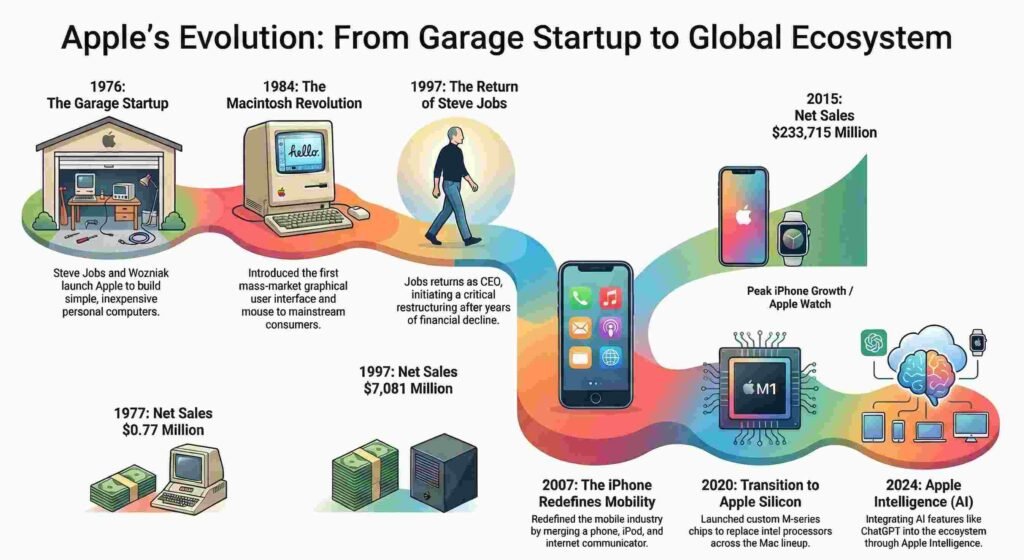
By the mid-1990s, Apple was a corporate tragedy. Ousted in 1985, Steve Jobs returned in 1997 to find a company just weeks away from bankruptcy, having flirted with acquisitions by rivals like Sun Microsystems. To survive, Jobs orchestrated the ultimate high-stakes truce with Apple’s arch-nemesis: Microsoft.
During the 1997 Macworld Expo, Jobs announced a partnership that included a $150 million investment from Microsoft. In a masterclass of irony, the cash injection was largely symbolic; Apple already had $1.2 billion in cash reserves. The deal was actually about optics—a public “peace treaty” that ensured Microsoft Office would stay on the Mac and Internet Explorer would become the default browser. It was a radical shift in mindset, moving away from the “David vs. Goliath” warfare that had nearly destroyed the company.
“We have to let go of this notion that for Apple to win, Microsoft has to lose. We have to embrace a notion that for Apple to win, Apple has to do a really good job… the era of setting this up as a competition between Apple and Microsoft is over as far as I’m concerned.”
From “ROKR” Failure to iPhone Phenomenon
The iPhone’s origins were fueled by the frustration of a bad partnership. In 2005, Apple collaborated with Motorola on the ROKR E1, the first phone to support iTunes. It was a disaster; the device was limited to only 100 songs and couldn’t download music wirelessly. Frustrated by the inability to control the user experience, Jobs pivoted to “Project Purple,” a top-secret internal development that sought to create the ultimate integrated device.
The confidence Jobs gained from the illegal “Blue Box” days came full circle here. By 2007, he was no longer just manipulating the network; he was taming the cellular giants. The iPhone blew up the wireless industry so thoroughly that the carriers were initially overwhelmed by the data usage. This chaos was famously captured by the digital culture journalist and early adopter iJustine, whose viral “300-page bill” (delivered in a box) became a lasting symbol of the iPhone’s disruptive power.
Beyond the Computer: The 2007 Identity Shift
On January 9, 2007, Steve Jobs announced that “Apple Computer, Inc.” would officially drop the word “Computer” from its name. This wasn’t just marketing—it was an admission that Apple had transformed into a digital distributor and a lifestyle brand. Fueled by the iTunes Store’s success in selling billions of songs, the company had moved far beyond the desktop.
By 2007, the company’s future was anchored by three core product lines:
- iPhone: A revolutionary internet communicator.
- iPod: The dominant portable media player.
- Apple TV: A foray into living room media distribution.
Conclusion: The Next Era of Intelligence
Apple’s current trajectory continues this shift from hardware to high-level integration. With the transition to Apple Silicon (M-series chips), the company has seized total control of its hardware stack, while the 2024 launch of “Apple Intelligence” signals a future where the OS itself is the primary value.
As we look at a titan with a market cap exceeding $3 trillion, it is worth reflecting on the cyclical nature of innovation. The “David” of 1976 is now the ultimate “Goliath.” One has to wonder: does the spirit of the teenager who prank-called the Pope still exist within the world’s most valuable corporate machine? Or has the prankster finally become the institution?
❓ తరచుగా అడిగే ప్రశ్నలు (FAQs)
ఈ వార్త లేదా కథనంలో ముఖ్యమైన అంశం ఏమిటి?
From Pranking the Pope to a $3 Trillion Empire: The DNA of Apple’s Success గురించిన పూర్తి సమాచారం మరియు తాజా ముఖ్యాంశాలు ఈ కథనంలో సమగ్రంగా వివరించబడ్డాయి.
ఈ తాజా పరిణామం ఎందుకు ప్రాధాన్యత సంతరించుకుంది?
ప్రజా ప్రయోజనాలు, సంబంధిత వర్గాలు మరియు ప్రస్తుత పరిస్థితుల దృష్ట్యా ఈ పరిణామం అత్యంత కీలకమైనదిగా మారింది.
ఈ అంశంపై అధికారిక వివరాలు మరియు తాజా అప్డేట్స్ ఎక్కడ తెలుసుకోవచ్చు?
సంబంధిత అధికారిక వర్గాలు వెల్లడించే తదుపరి సమాచారం మరియు ప్రత్యక్ష అప్డేట్స్ కోసం మా వెబ్సైట్ను నిరంతరం ఫాలో అవ్వండి.