
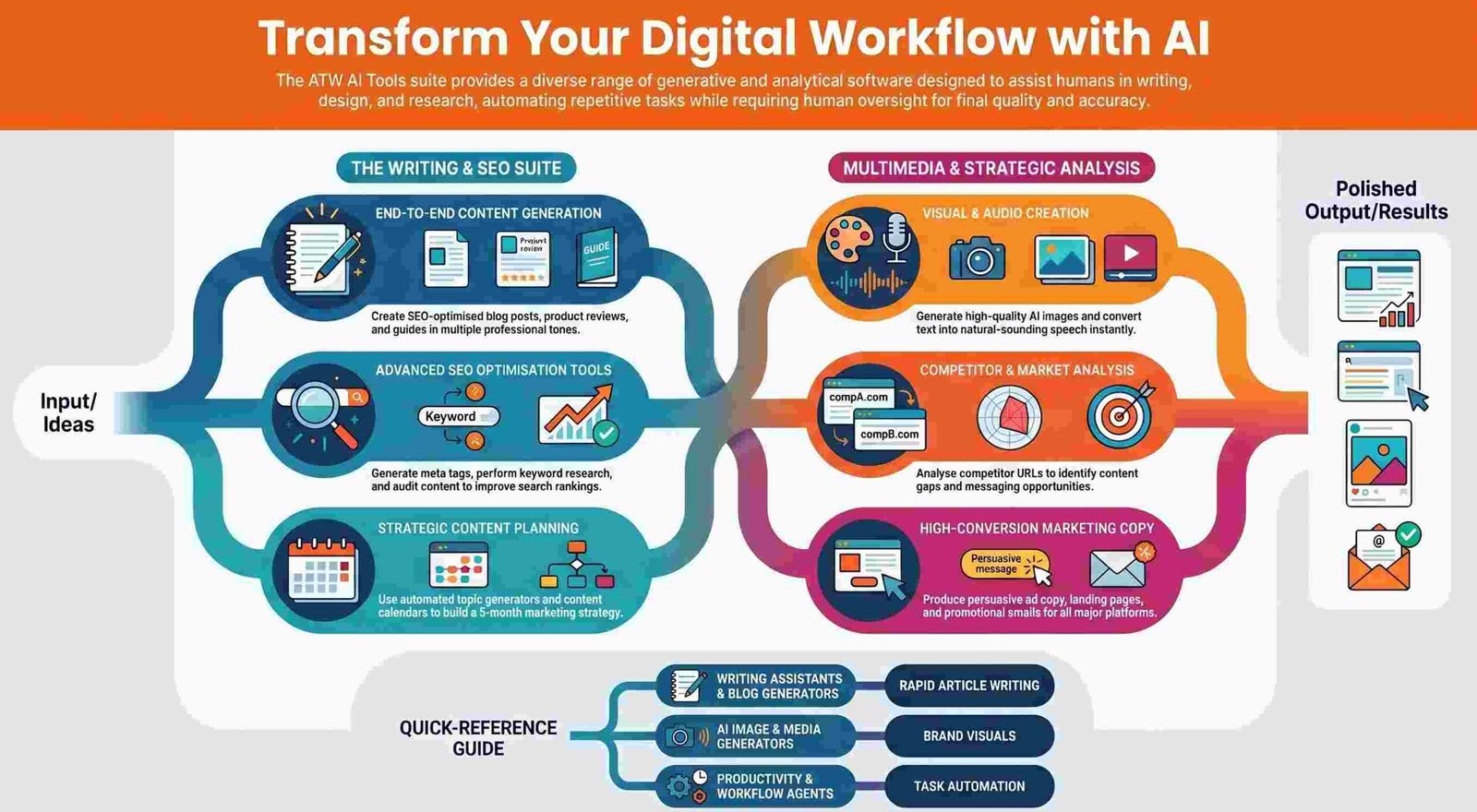
✅ What are “AI tools”
- AI tools are software — often powered by machine learning or “generative AI” — that automate, assist, or speed up tasks usually done by humans. (OnBoard)
- They can help with writing, coding, design, research, automation, content creation, and a lot more. (Synthesia)
- The idea: instead of doing everything manually (e.g. writing code from scratch, designing graphics by hand, summarizing long reports), you leverage AI to do the heavy lifting — then you review or refine as needed.
🛠️ Some Popular AI Tools by Use-Case (2026)
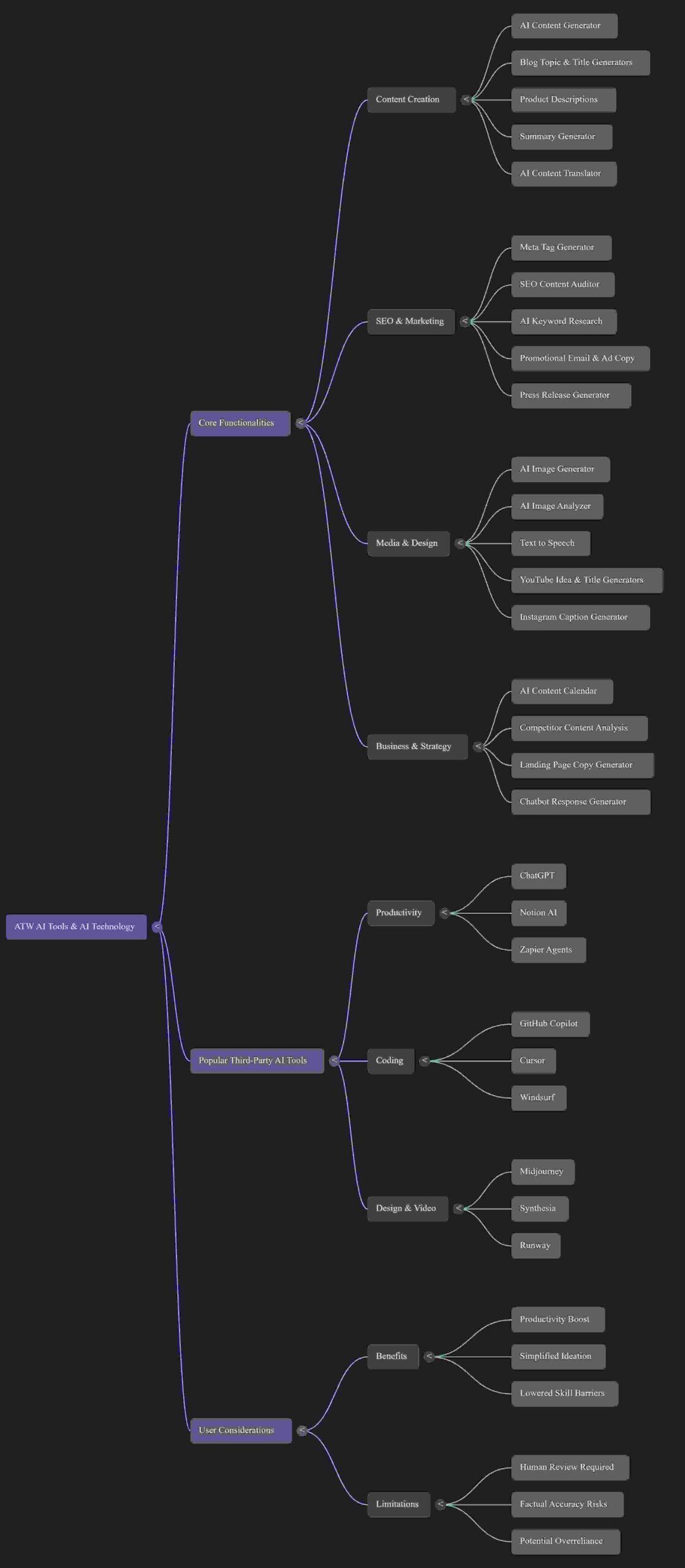
Here are widely used AI tools — grouped by what they help you achieve.
🔹 General-purpose & Productivity
- ChatGPT — A conversational AI assistant that can draft text, answer questions, brainstorm ideas, help with research, and more. (Medium)
- Notion AI, ClickUp, Reclaim AI — Productivity tools with AI-powered planning, note-taking, scheduling, and task-management features. (Angular Minds)
- Zapier Agents / Automation tools — Automate repetitive workflows across apps (emails, notifications, file transfers), saving manual work. (Zapier)
🎨 Content, Design & Creativity
- Midjourney, Nano Banana — AI tools for generating images, artwork, or creative visuals from text prompts. (Synthesia)
- Synthesia, Runway — Tools for video creation/editing, AI-driven animations, or multimedia content. (Prismetric)
- AI-powered writing assistants (e.g. Jasper, Wordtune etc.) — Help with writing blog posts, marketing copy, social media posts, rewriting text, grammar, etc. (Angular Minds)
💻 Coding / Developer Tools
- GitHub Copilot — An AI “pair programmer” that suggests code, helps you write functions faster, and often speeds up development. (pieces.app)
- Cursor, Aider, Windsurf, Qodo — Tools that assist with code generation, review, error detection, test-generation, and improving code quality. (Pragmatic Coders)
- AI-powered design-to-code tools (e.g. AI tools that transform UI/UX designs into front-end code) — great for designers/developers working together. (EchoAPI)
📚 Research, Learning & Knowledge Work
- AI research assistants & knowledge-management tools — help summarise academic articles, extract key insights, organise notes, etc. (Georgetown Library Guides)
- Tools for data analytics, pattern recognition, and insights generation — helpful in analytics-heavy work or research fields. (ibm.com)
⚠️ What to Keep in Mind (Benefits & Limitations)
Benefits:
- Big productivity boost — many tools can do in minutes what might take hours manually.
- Creativity, ideation and experimentation become easier (e.g. quick mockups, drafts, code prototypes).
- They lower the barrier — even non-experts can leverage powerful AI for writing, design, or basic coding.
Limitations / Cautions:
- AI output often needs human review — especially for code quality, design consistency, factual accuracy.
- Some tasks or domains (complex architecture design, domain-specific logic, nuanced writing) may not get perfect results from AI. (arXiv)
- Overreliance can reduce learning if you skip understanding fundamentals (e.g. if you always accept AI-generated code without reviewing thoroughly).
🎯 Which Tools Work Best for What You Might Need
| Your Need / Task | Useful AI Tool Types |
|---|---|
| Write an article, email, blog post, or copy quickly | ChatGPT, Jasper, Wordtune, writing assistants |
| Create images, visuals, or design mockups fast | Midjourney, Nano Banana, Synthesia, design-AI tools |
| Automate repetitive tasks / workflows (e.g. file handling, scheduling) | Zapier Agents / automation tools, productivity-AI tools |
| Develop software faster (coding, code review, generation) | GitHub Copilot, Cursor, Aider, Windsurf, coding-AI assistants |
| Manage projects / plan tasks / organise notes & ideas | Notion AI, ClickUp, Reclaim AI, automation & productivity tools |
| Conduct research, summarise documents or data | AI-powered research assistants, knowledge-management tools |
From Manual Labor to AI-Assisted Mastery: The 2026 Workflow Revolution
1. Introduction: The End of the “Blank Page” Era
The “blinking cursor” on a white screen used to be the most daunting obstacle in professional life. For decades, the “heavy lifting”—writing complex code from scratch, designing layouts by hand, or drafting multi-page reports—was a manual tax we all had to pay. That era is officially over.
In 2025, AI tools have redefined the baseline of productivity. As defined in our current landscape, these are software applications powered by machine learning and generative AI designed to automate, assist, or radically accelerate tasks. Whether it is OnBoard streamlining onboarding or Synthesia revolutionizing video creation, the goal is clear: transition from a “starting from zero” mindset to a “starting from a structured foundation.” We are no longer laborers; we are architects using AI to handle the initial friction of creation.
2. The Rise of the Hyper-Specialized Assistant
While general-purpose chatbots were the gateway, the real strategic advantage now lies in hyper-specialization. A general prompt to a chat interface is often too blunt a tool for high-stakes business needs. Today’s ecosystem, exemplified by the ATW AI Tools suite, provides surgical precision by using pre-configured parameters tailored to specific outcomes.
The shift toward niche-specific functionality allows for a level of depth general AI cannot match:
- YouTube Idea Generator: Goes beyond simple “topics” to identify trending concepts tailored to specific channel niches.
- SEO Content Auditor: Analyzes existing text against target keywords to provide a quantitative SEO Score.
- AI Keyword Research: Allows users to filter by Search Intent (Informational, Commercial, Transactional) and Keyword Difficulty Preference, providing a strategic roadmap rather than just a list of words.
- Instagram Caption Generator: Offers specialized Caption Styles ranging from “Humorous” to “Storytelling” to ensure brand voice consistency.
- Press Release Generator: Formats announcements specifically for corporate or tech-innovative tones, ensuring the output meets industry standards immediately.
This hyper-specialization is impactful because it understands context—knowing the difference between a “Casual” blog post and a “Formal/Corporate” announcement before the first word is even generated.
3. The “Reviewer-in-Chief” Responsibility
With massive productivity boosts comes a new professional mandate: the Human-in-the-loop. As a technology evangelist, my warning is simple: a leader who accepts AI output without interrogation is not curating; they are gambling.
The source material defines the modern relationship with technology perfectly:
“The idea: instead of doing everything manually… you leverage AI to do the heavy lifting — then you review or refine as needed.”
The risk of overreliance is real. AI can still struggle with nuanced writing, complex domain-specific logic, and maintaining design consistency. If you bypass the review of code quality or factual accuracy, you risk a slow degradation of your own fundamental skills. In 2025, your value is not in the “doing,” but in the “verifying.” You are the Reviewer-in-Chief, the final arbiter of quality.
4. Democratizing the “Expert” Barrier
Perhaps the most disruptive shift is the Democratization of Expertise. The “gatekeeper” effect—where only those with years of technical training could produce high-end assets—has evaporated.
Creativity and experimentation have been liberated. A non-designer can now use Midjourney or Nano Banana to generate world-class visuals from a simple text prompt. More importantly, the wall between design and development has crumbled. AI-powered design-to-code tools can now transform UI/UX mockups directly into front-end code. This allows designers and developers to collaborate in the same “language” of functional prototypes, moving from idea to deployment in a fraction of the time it once took.
5. Multi-Modal Mastery: Coding, Content, and Beyond
True mastery in 2025 isn’t about using one tool; it’s about orchestrating a comprehensive digital ecosystem. A modern, multi-modal workflow looks like a relay race where AI tools pass the baton:
- Ideation & Strategy: Use ChatGPT or Notion AI to brainstorm the core strategy.
- Content Creation: Deploy Jasper for the marketing copy and Synthesia for an accompanying AI-driven video.
- Visual Identity: Utilize Midjourney for high-fidelity assets.
- Technical Deployment: For those building the platform, tools like GitHub Copilot provide the “pair programmer” experience, while Aider, Windsurf, and Qodo handle the critical technical tasks of error detection and test-generation.
- Distribution & Automation: Finally, Zapier Agents act as the connective tissue, automating the notifications, file transfers, and workflows across the entire stack.
This isn’t just a list of software; it is a unified engine of production that allows a single professional to operate with the output of an entire agency.
6. Conclusion: The Human Edge in an Automated World
The transition from “creator” to “curator” is not a loss of agency; it is an upgrade of influence. As we automate the repetitive “heavy lifting,” judgment becomes the most valuable currency in the global market. AI provides the speed and the volume, but human intuition provides the “why.”
In this automated world, the Human Edge is your ability to steer these powerful tools toward goals that matter. The tools are ready; the question is, are you ready to lead them?