
The IPL 2026 season has transitioned from a cricket tournament into a high-definition courtroom drama where the jury is out and the fans are fuming. As the race for the playoffs reaches a fever pitch, the stakes have transformed every delivery into a potential litigation. While the IPL Governing Committee has tried to tighten the screws with rigorous protocols, controversy remains the league’s permanent shadow. In a spectacle of this magnitude, where 4K cameras scrutinize every blade of grass, the “human element” and technological interpretation have sparked debates that no rulebook seems capable of settling..
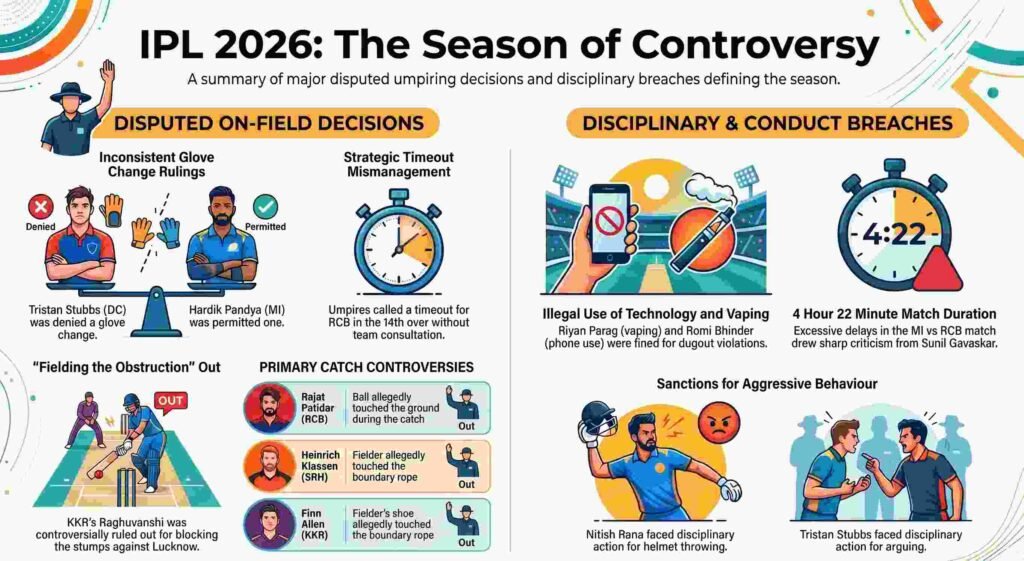
Here are the five most controversial takeaways from a season that has left the “gentleman’s game” feeling a little less than gentlemanly.
1. Pixels vs. Reality: The Boundary Line Crisis
Boundary line catches have become the primary source of player heartbreak and digital vitriol this season. While technology is marketed as the ultimate arbiter of truth, several high-profile dismissals have highlighted a glaring discrepancy between grainy video evidence and the Third Umpire’s finality.
The most explosive debate centered on Royal Challengers Bengaluru (RCB) batter Rajat Patidar. When Jason Holder claimed a catch near the rope, the Bangalore camp was convinced the ball had grazed the turf. The fallout was immediate: Virat Kohli and the RCB squad were seen in a heated exchange with match officials, a sentiment later echoed by veteran campaigner Bhuvneshwar Kumar, who noted that officials needed to be far more meticulous in such game-changing moments.
“The ball appeared to touch the grass as the catch was completed,” was the sharp stance from the Bangalore camp. “The officials needed to examine the footage with much greater scrutiny before sending a set batter back.”
This wasn’t a solitary glitch in the matrix. The season opener saw Phil Salt’s catch of Heinrich Klaasen draw fire after replays suggested Salt’s heel had kissed the boundary rope. KKR’s Finn Allen suffered a similar fate against Lucknow when Digvesh Rathi’s shoe appeared to graze the foam. Even Abhishek Sharma’s dismissal against KKR left Sunrisers Hyderabad (SRH) fans livid, arguing the ball had clearly touched the ground before settling in Varun Chakravarthy’s hands.
2. The Great Glove Divide: A Case of Double Standards
Officiating consistency is the bedrock of any sport, yet 2026 has exposed what critics are calling a “VIP chapter” in the IPL rulebook.
In a high-stakes clash against Chennai Super Kings, Delhi Capitals’ Tristan Stubbs requested a glove change in the 19th over, pleading that his gear was soaked through and losing grip. The field umpires flatly denied him. Adding insult to injury, Stubbs was dismissed the very next ball, leading to a viral moment where he hurled his helmet in the dugout in pure frustration. The situation turned toxic when Nitish Rana—who wasn’t even in the XI or an Impact Sub—engaged in a fiery spat with officials over the denial, earning himself a massive disciplinary hammer from the Governing Body.
The controversy turned into a full-blown scandal when, later in the season, Mumbai Indians captain Hardik Pandya was permitted to change his gloves in the middle of an over against RCB. This perceived double standard has left fans wondering if the rules are written in ink for some and pencil for others.
3. Vaping Captains and Forbidden Phones: A Protocol Meltdown
While the action on the pitch was heated, the conduct in the dugouts suggested a total breakdown of discipline. The Rajasthan Royals, in particular, found themselves in the crosshairs of the anti-corruption and disciplinary units.
In a shocking lapse of leadership, Captain Riyan Parag was caught on camera vaping in the dressing room during a match against Punjab Kings. The irony was hard to miss: the leader of the franchise was indulging in an e-cigarette while sitting right next to the league’s youngest prodigy, Vaibhav Suryavanshi. The IPL Governing Council acted swiftly, slashing 25% of Parag’s match fee.
The Royals’ headache worsened when Manager Romi Bhinder was spotted using a smartphone in the dugout—a cardinal sin in the league’s anti-corruption protocol. These aren’t just minor infractions; they represent a “Protocol Meltdown” that threatens the integrity of the dugout environment.
4. The Obstruction and the Clock: Technical Pedantry vs. Game Flow
The 2026 season has seen the rulebook used as a weapon, often at the expense of the game’s natural rhythm.
One of the rarest dismissals in T20 history occurred during the KKR vs. Lucknow match when batter Raghuvanshi was ruled out for “Obstructing the Field.” After a botched run, Raghuvanshi veered into the path of the stumps, effectively shielding them from Shami’s throw. While technically correct, the decision ignited a firestorm over whether the “spirit of the game” was being sacrificed for technical pedantry.
This obsession with technicalities hit a breaking point during the RCB vs. CSK clash, where field umpires unilaterally called a strategic timeout in the 14th over. The rules state the second timeout belongs to the teams between the 14th and 16th overs; by forcing the break early without consulting the side, the umpires triggered visible mid-pitch fury from the Bangalore camp.
Legend Sunil Gavaskar didn’t mince words after a Mumbai vs. Bangalore marathon lasted a staggering 4 hours and 22 minutes. Gavaskar slammed the “unnecessary” invasion of support staff during timeouts, demanding that the field be restricted to one or two people to prevent the T20 format from diluting into a slow-motion circus.
5. Conclusion: Tech Overhaul or a Soul Search?
As we head toward the business end of the season, a provocative question lingers: Is the IPL’s pursuit of “perfect technology” actually the very thing killing the spirit of the game?
We were promised that high-tech intervention would eliminate human error, yet in 2026, it has only provided more fuel for the fire. The “blurry lines” aren’t just on the boundary rope; they are in the inconsistent application of the rules and the erosion of dugout discipline. Does the league need a total tech overhaul, or is it time to realize that the human element—controversy and all—is the only thing that keeps this multi-billion dollar narrative alive? One thing is certain: in the IPL, the drama beyond the boundary is now just as clinical, and twice as loud, as the cricket itself.
❓ తరచుగా అడిగే ప్రశ్నలు (FAQs)
ఈ వార్త లేదా కథనంలో ముఖ్యమైన అంశం ఏమిటి?
The 5 Most Controversial Takeaways from IPL 2026 గురించిన పూర్తి సమాచారం మరియు తాజా ముఖ్యాంశాలు ఈ కథనంలో సమగ్రంగా వివరించబడ్డాయి.
ఈ తాజా పరిణామం ఎందుకు ప్రాధాన్యత సంతరించుకుంది?
ప్రజా ప్రయోజనాలు, సంబంధిత వర్గాలు మరియు ప్రస్తుత పరిస్థితుల దృష్ట్యా ఈ పరిణామం అత్యంత కీలకమైనదిగా మారింది.
ఈ అంశంపై అధికారిక వివరాలు మరియు తాజా అప్డేట్స్ ఎక్కడ తెలుసుకోవచ్చు?
సంబంధిత అధికారిక వర్గాలు వెల్లడించే తదుపరి సమాచారం మరియు ప్రత్యక్ష అప్డేట్స్ కోసం మా వెబ్సైట్ను నిరంతరం ఫాలో అవ్వండి.