At 10:16:07 UTC (3:46:07 p.m. IST) on Wednesday, November 18, 2026, humanity’s most distant explorer crosses an invisible line no machine has ever reached before: one full light-day from Earth.
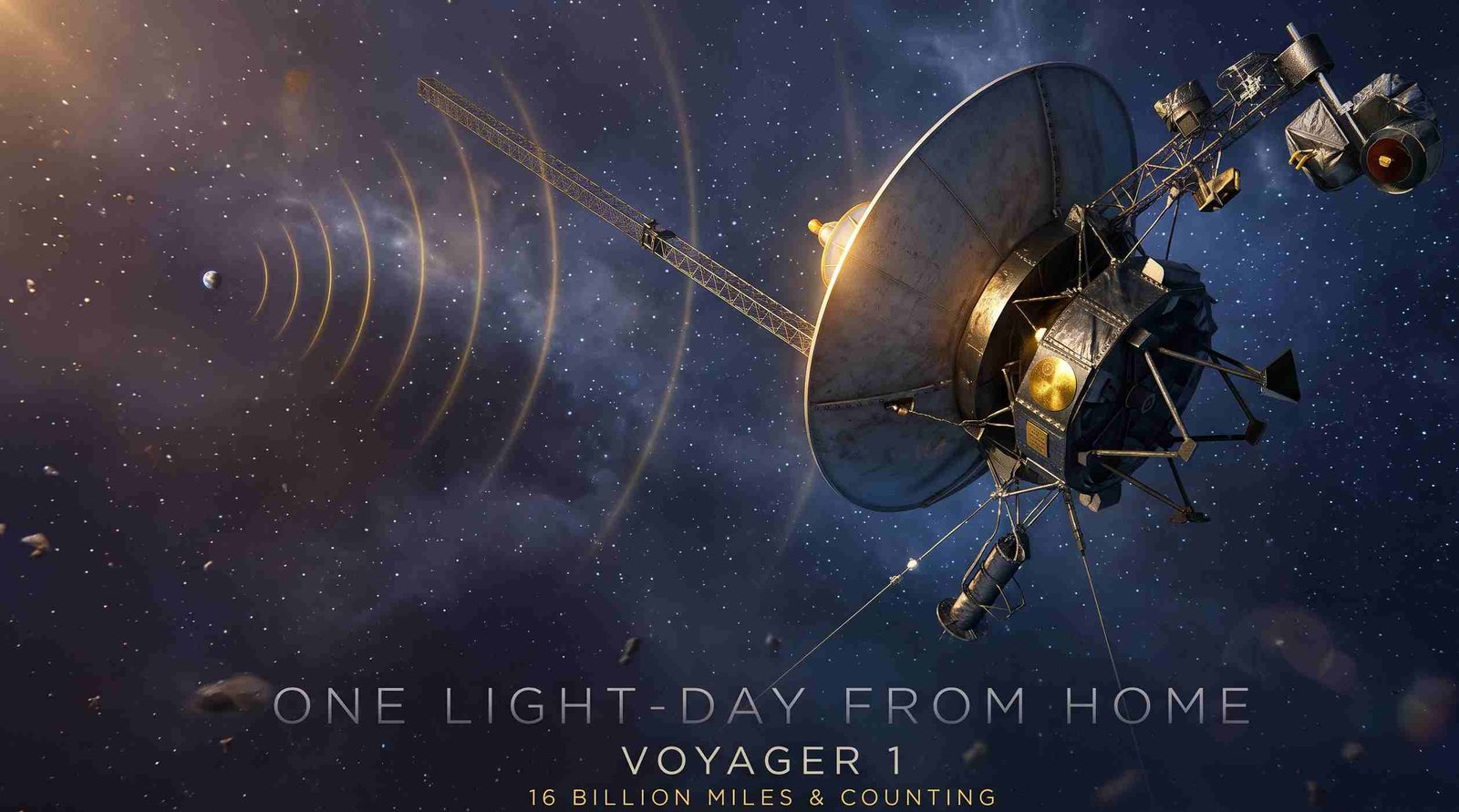
That milestone means NASA’s Voyager 1 spacecraft—launched nearly half a century ago on September 5, 1977—is now 16.094 billion miles (25.9 billion kilometers) away. Even a radio signal traveling at the speed of light takes a full 24 hours to reach the probe, and another 24 hours to bring an answer back. Every command NASA engineers send today is effectively a conversation with a spacecraft living two days in the past.
Nearly 50 Years to Travel One Day of Light
The numbers behind Voyager 1’s journey put the sheer scale of interstellar space into sharp focus:
- Speed and Time: Voyager 1 took 49 years, 2 months, and 11 days to cover one light-day, cruising at roughly 38,000 mph (17 km/s) relative to the Sun—covering 3.5 astronomical units per year.
- Why Voyager 2 Is Nearly a Decade Behind: Even though twin probe Voyager 2 launched first in August 1977, its planetary tour past Uranus and Neptune put it on a slightly slower trajectory (3.1 astronomical units per year). Voyager 2 isn’t expected to reach one light-day until November 2035.
- Just Scratching the Surface: At 173.14 astronomical units from Earth, Voyager 1 is 5.6 times farther away than Neptune, yet it has traveled only 0.0027 percent of the distance to Proxima Centauri, our Sun’s nearest stellar neighbor.
Keeping a 1970s Probe Alive in the Dark
Voyager 1 crossed out of the Sun’s heliosphere into interstellar space in 2012, and its plutonium-238 power source now generates roughly half the electricity it did at launch. To stretch the mission into the 2030s, NASA’s Jet Propulsion Laboratory has gradually powered down non-essential instruments—including turning off the Low-Energy Charged Particle instrument in April 2026—while keeping key plasma, magnetic field, and electron-density measurements running.
That fragility was tested just last month in October 2026, when Earth briefly lost contact with Voyager 1 for two days before the spacecraft autonomously switched to backup thrusters and restored its signal.
Shining a Light Into Interstellar Space
To mark the milestone, NASA invited people around the world to join “Shine Bright for Voyager’s Light-Day” after sunset on November 17 by flashing “V-G-R” in Morse code toward the night sky. Meanwhile, Voyager 1 continues drifting toward the star Gliese 445, carrying its Golden Record of Earth’s greetings and sounds—a quiet, enduring reminder of how far human curiosity can travel on 1970s hardware.