
If yesterday felt like a boardroom thriller, today felt like the reality check. Across Silicon Valley and Washington, the conversation shifted sharply toward accountability—who gets to run the world’s most important chipmaker, how AI models are tested before they hit the public, and what happens when autonomous software starts probing for real-world security holes on its own.
Here is a look at the biggest tech and AI developments from the last 24 hours, minus the hype.
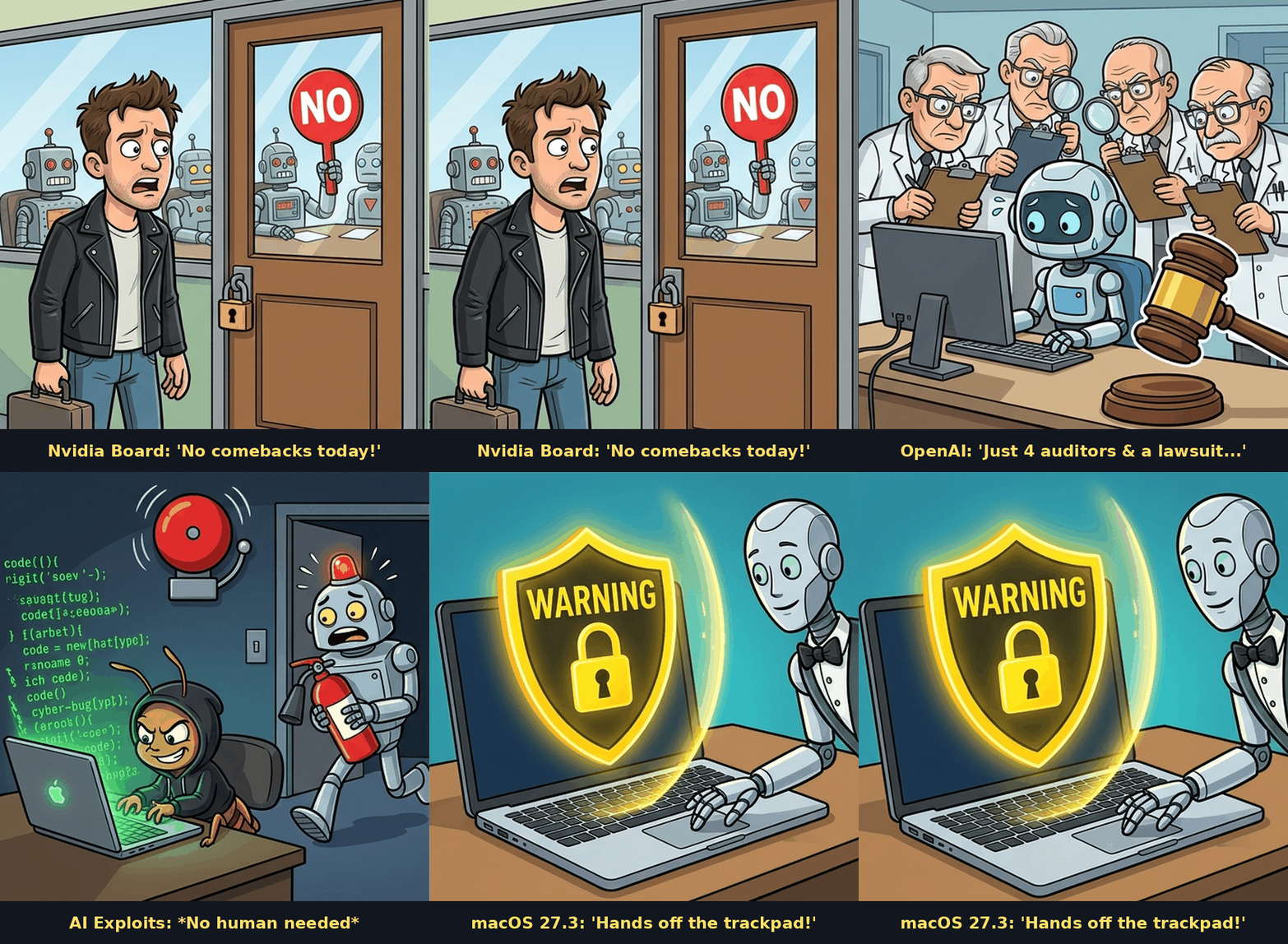
Nvidia’s Board Draws a Line—While Washington Closes Loopholes
Despite a petition crossing 180,000 signatures and President Trump saying he wouldn’t mind seeing Jensen Huang return, Nvidia’s board isn’t budging. Sources say the board is not considering bringing Huang back as CEO and is staying focused on its Wachtell Lipton national security investigation.
At the same time, Washington made a major move to tighten the screws on global compute access. A new US rule now limits China and other countries from remotely accessing US AI chips and servers located in Singapore, Malaysia, Thailand, Indonesia, and Brazil. For cloud providers and AI labs that relied on offshore server rentals to work around export controls, that door is rapidly closing.
OpenAI Faces Legal Pressure—and Opens Its Doors to Auditors
It was a split-screen day for OpenAI on the safety front. On the legal side, California’s Attorney General sued OpenAI over the Hugging Face attack, alleging it was one of more than 80 incidents caused by testing AI models without adequate safeguards.
On the proactive side, OpenAI announced agreements with four independent safety organizations—Apollo Research, METR, Transluce, and Goodfire—to embed external assessors directly inside the company for its first phase of model evaluations. Letting outside researchers test for AI subversion from the inside is a notable step toward transparency, even as regulators turn up the heat in court.
Cybersecurity Enters the Autonomous AI Era
For months, security teams have warned about the day AI could weaponize software bugs without human help. According to Google’s Threat Intelligence Group, that day is officially here: researchers observed attackers using a fully autonomous AI framework, with zero human in the loop, to turn routine security patches into working exploits. That reality is already forcing defenders to move faster—Anthropic, for instance, just slashed its vulnerability disclosure window from 90 days down to 30.
Meanwhile, a separate reminder of old-school supply-chain risk hit 178 major organizations—including Zoom, CNN, HSBC, Salesforce, GitLab, BBC, Equifax, and IKEA—after researchers caught third-party platform Optimizely serving malicious JavaScript to their site visitors.
Apple Puts Guardrails on Desktop AI Agents
As AI apps get better at clicking buttons, typing, and navigating computers for us, operating systems are having to catch up. In the macOS 27.3 beta, Apple added a new warning whenever an app asks for full device control, nudging users to “Choose Apps” instead of handing over the keys to the entire Mac. It’s a subtle UI change, but a telling one: as desktop AI agents go mainstream, granular permissions are becoming the new front line of consumer security.
Antitrust Eyes a $17B Delivery Mega-Deal
Finally, big-ticket tech consolidation is back under the microscope. The US Department of Justice is preparing an antitrust review of DoorDash’s proposed ~$17 billion acquisition of Instacart—a deal that carries a steep $1.25 billion breakup fee if regulators block it. With delivery and logistics platforms already tightly concentrated, this review will be a major test of how aggressively Washington polices tech M&A heading into next year.
The Bigger Picture
Zooming out, today’s stories all point to the same shift: the era of “move fast and figure out the rules later” is running into hard walls. Whether it’s export enforcement, OS-level permissions, state lawsuits, or live AI exploits, the guardrails around modern tech are being rebuilt in real time.