
There’s a quiet revolution happening in India that doesn’t always make the front pages the way elections or cricket do. It’s not flashy. It doesn’t come with billion-dollar valuations or Silicon Valley hype. But it has changed how more than a billion people prove who they are, send money, store documents, and access services.
It’s called Digital Public Infrastructure — or DPI for short. And India has built one of the most ambitious versions of it the world has ever seen.
What Exactly Is Digital Public Infrastructure?
Think of it this way: instead of every company or government department building its own closed system, India decided to create shared digital rails that anyone can use. These rails are open, interoperable, and designed as public goods.
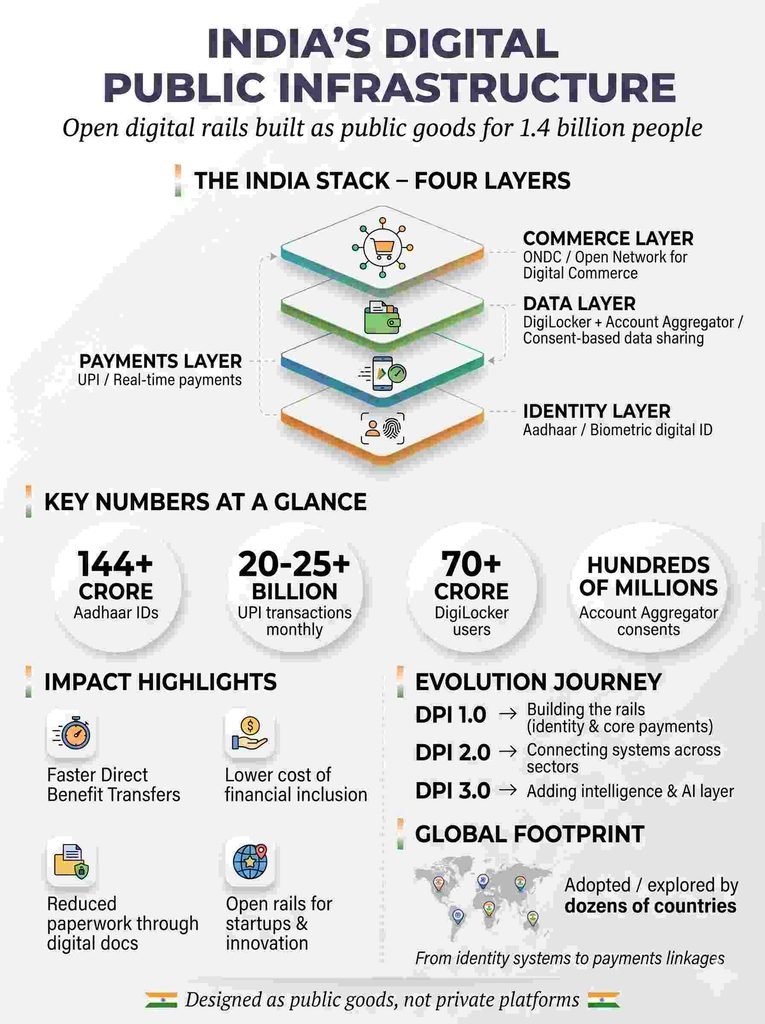
The result is what we call India Stack — a layered set of systems that work together:
- An identity layer so people can prove who they are
- A payments layer so money can move instantly and cheaply
- A data layer so people can share their information with consent
- A commerce layer so buyers and sellers can connect without being locked into one big platform
This approach is different from the usual tech model. Most digital systems are owned by private companies. India’s DPI treats digital identity, payments, and data sharing as basic infrastructure — closer to roads or electricity than to apps.
The Building Blocks That Actually Work
Aadhaar came first. It’s the world’s largest biometric digital identity system, with around 144 crore IDs issued. For millions of people, especially in rural areas, it was the first formal identity they ever had. That single number unlocked bank accounts, welfare payments, SIM cards, and government schemes.
Then came UPI. What started as a way to transfer money between bank accounts has become one of the most used real-time payment systems on the planet. On busy days, it handles hundreds of millions of transactions. Street vendors, small shops, and large businesses all use the same rails. Person-to-person transfers are free, and the system works across hundreds of banks.
DigiLocker quietly solved another everyday headache. Instead of carrying physical documents or dealing with endless photocopies, people can store and share verified digital versions of their certificates, licences, and records. Over 70 crore people now use it.
The Account Aggregator framework takes it further. With consent, you can share your financial data with a lender or service provider in a controlled way. This has made credit faster and more accessible, especially for people and small businesses who previously struggled with paperwork.
And then there’s ONDC — an attempt to open up digital commerce so small sellers aren’t forced to live under the high commissions of big platforms. It’s still growing, but the idea is powerful: create a network, not another marketplace.
What Changed in Everyday Life
The real impact shows up in small, practical ways.
Direct Benefit Transfers started reaching people more reliably because the government could verify identity and send money straight into accounts. During the pandemic, systems built on these rails helped distribute vaccines and relief at a scale that would have been nearly impossible otherwise.
Opening a bank account, getting a loan, or verifying documents became faster and cheaper. Startups didn’t have to reinvent identity or payments from scratch — they could build on top of the existing rails. That lowered the barrier for innovation.
For many Indians, digital services stopped feeling like something only city people used. With Common Service Centres and simpler interfaces, even those without smartphones or high digital literacy could access basic services.
The Road Ahead: From Rails to Intelligence
India is now moving into the next phase. The first stage was building the foundational systems. The current stage is connecting them — so identity, payments, health records, education data, and commerce can work together more smoothly.
Looking further ahead, there’s talk of adding an intelligence layer: using AI carefully so the systems can anticipate needs, personalise services, and become more proactive, while still keeping public purpose and data protection in mind.
Regulators and institutions are also exploring how AI itself can sit inside this public infrastructure, rather than relying entirely on private models.
Going Global
What India built has started travelling. Dozens of countries have signed agreements to learn from or adapt parts of the model. Open-source versions of the identity system (like MOSIP) are being used in parts of Africa and Asia. Payments linkages with UPI are expanding. During its G20 presidency, India helped put Digital Public Infrastructure on the global development agenda.
It’s not a perfect export. Other countries have different political systems, privacy cultures, and technical capacity. But the core idea — that digital systems can be designed as public goods rather than private monopolies — has clearly struck a chord.
The Honest Challenges
No system this large is without problems.
Privacy remains a live concern. Centralised identity systems always carry risks of misuse or surveillance. India has been working on stronger data protection rules, but implementation and trust take time.
Exclusion is another real issue. Biometric failures, poor connectivity, and digital literacy gaps still leave some people out. Offline and assisted models help, but the last mile is hard.
There’s also the question of long-term sustainability. Running free or very low-cost public infrastructure at this scale costs money. Who pays, and how, is still being sorted out.
Why It Matters
India’s Digital Public Infrastructure is not just a technology story. It’s a governance experiment. It asks a simple but radical question: can we build digital systems that serve the public interest at population scale without handing control to a handful of private platforms?
For a country of India’s size and diversity, the answer so far has been a cautious but ambitious yes. The systems are imperfect. The debates around privacy and inclusion are necessary. But the scale of what has already been delivered is hard to ignore.
In a world where digital power is increasingly concentrated, India has shown another path is possible — one that treats identity, payments, and data not as products to be monetised, but as infrastructure to be shared.
