
Enterprise leaders originally expected artificial intelligence to function primarily as a high-speed automation engine for simple, routine tasks. Instead, AI is dismantling and rewriting the structural playbook of modern software business models, enterprise workflows, and underlying physical infrastructure.
While mainstream headlines remain fixated on consumer chatbots and text generators, the most consequential shifts are occurring quietly behind the scenes. They are unfolding across enterprise data centers, corporate financial models, cloud control planes, and core operational supply chains.
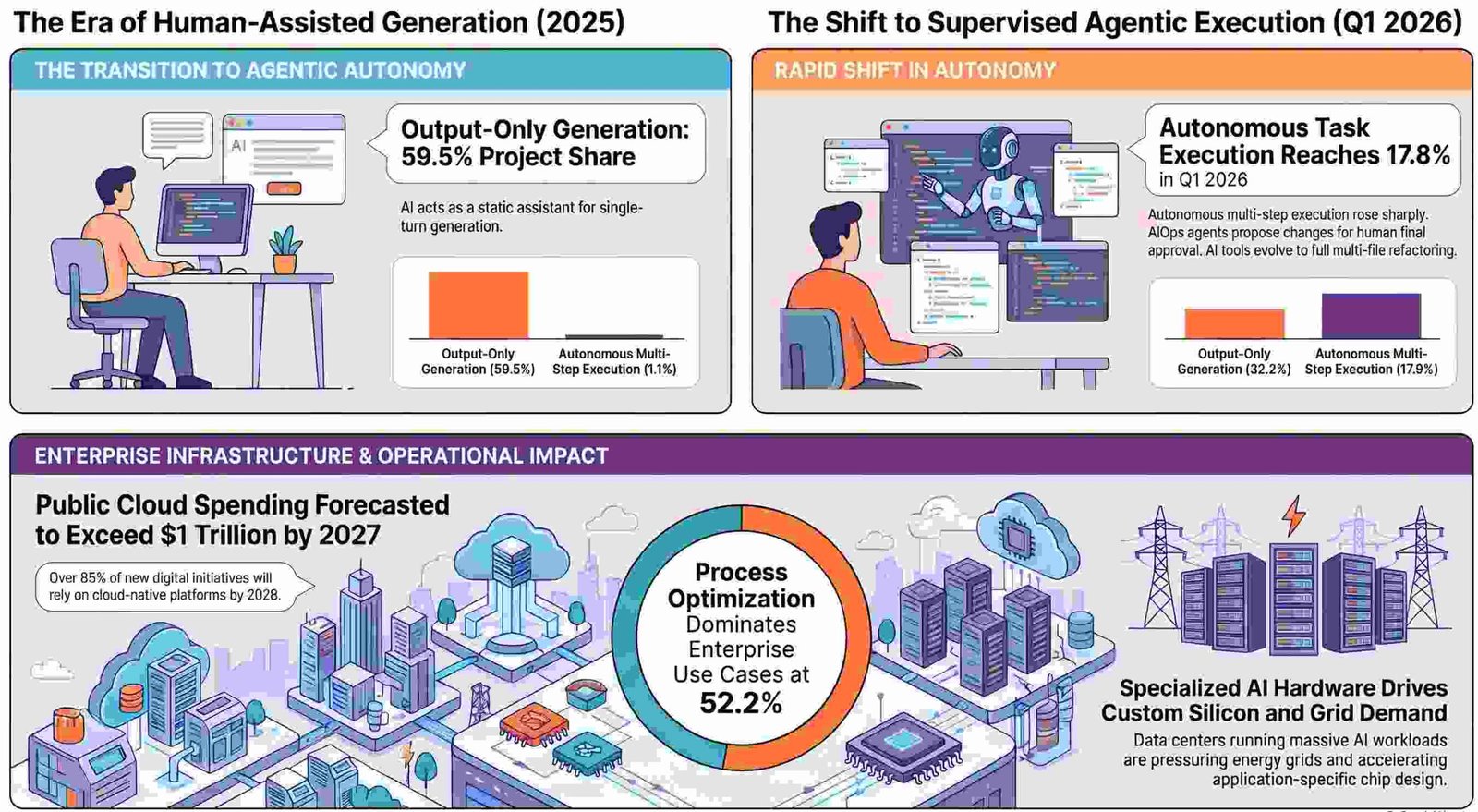
By synthesizing benchmark 2026 enterprise research from J.P. Morgan, McKinsey, IoT Analytics, Pulumi, and Cyber Magazine, this report distills five counter-intuitive trends reshaping competitive advantage across the digital economy.
1. The Per-Seat SaaS Model is Officially Dying
For two decades, software-as-a-service (SaaS) expanded on a simple economic premise: charge a recurring subscription fee for every human seat. That model is now collapsing under the weight of artificial intelligence. When AI agents perform the work of multiple human users in seconds, charging per user login penalizes software vendors for delivering higher efficiency.
In response, software monetization is undergoing a massive shift toward consumption-, usage-, and outcome-based pricing structures. Rather than licensing static seats, forward-thinking software vendors are capturing value based on automated throughput, compute usage, and delivered business results.
This structural pivot has created a sharp bifurcation in software equity and venture capital markets. Investors are aggressively rewarding AI-native platforms capable of monetizing compute and automated execution, while discounting legacy non-AI software companies struggling to defend revenue as human seat counts contract.
“Traditional seat-based SaaS monetization is giving way to usage- and outcome-based pricing models, with enterprises increasingly purchasing AI solutions rather than building them internally—creating a clear separation between AI-native and non-AI software companies.” — J.P. Morgan 2026 Software Market Trends Report
This monetization pivot is directly linked to where AI is being deployed across the modern enterprise. Software pricing is changing because AI is moving out of peripheral employee tools and directly into core operational workflows, where human user counts decrease while work volume explodes.
2. ROI Has Moved From Marketing Content to Core Operations
The initial era of generative AI adoption was defined by creative experimentation—drafting ad copy, generating marketing imagery, and summarizing documents. In 2026, enterprise investment has decisively shifted to core operational processes. According to data from IoT Analytics tracking 1,533 real-world enterprise AI deployments, operational process optimization jumped to 52.2% of all enterprise AI projects in 2025 and Q1 2026 (up from 30% in prior years), establishing itself as the single largest driver of enterprise AI ROI.
At the same time, implementations are evolving from simple text outputs toward multi-step task autonomy. Enterprise projects executing multi-step tasks autonomously surged from 1.1% in 2025 to 17.8% in Q1 2026, while output-only generation projects fell from 59.5% down to 32.2%.
A prime illustration of this operational shift is market research firm NielsenIQ (NIQ). The company transformed its global item-coding pipeline—converting physical product packaging images into structured database records across 220 million products—by deploying an AI system on Microsoft Foundry and Azure OpenAI. In a benchmark deployment, NIQ coded 32,000 products in just 10 hours, a process that previously required 300 hours of manual work, achieving a 90% reduction in item-coding time.
“It was a labor-intensive process that required deep market knowledge and meticulous attention to detail. We saw an opportunity to eliminate the manual steps by using language models to automate the entire pipeline.” — Gabriel Harris, Principal Data Scientist, NIQ
As enterprises embed autonomous systems into these core operational pipelines, however, they immediately encounter a complex governance dilemma: how much autonomy can software agents actually be granted when live production environments are on the line?
3. The Enterprise Paradox: We Trust AI Agents, But Won’t Let Them Run
In cloud infrastructure and platform engineering, workflows are moving from static code suggestions to agentic operations—where AI directly manages cloud resources rather than merely writing configuration templates. Yet research from Pulumi’s survey of 510 infrastructure engineers reveals a profound tension between engineering sentiment and actual deployment practices.
While 82% of engineers agree that AI agents will fundamentally alter how infrastructure is managed within 12 months, and 63% state they trust AI agents to execute live production changes, operational practices tell a different story. A striking 62% of engineering organizations still gate agent-proposed production changes behind manual human approvals, leaving only 19% of enterprises that permit autonomous execution.
This gap demonstrates that engineering confidence in AI capabilities is currently running far ahead of organizational governance frameworks. Until policy-as-code guardrails, real-time validation, and automated rollback systems fully mature, human-in-the-loop oversight remains a necessary safeguard to preserve production stability and accountability.
4. The Real Wall for AI Scaling is Made of Power Lines, Not Silicon
This tension over autonomous agent governance forms just one element of a broader enterprise “scale trilemma.” As organizations push to scale AI-driven operations, they are running headlong into physical bottlenecks that software innovation alone cannot overcome. Cloud demand remains immense—highlighted by Microsoft Azure passing $100 billion in full fiscal-year revenue—and cloud hyperscalers are making unprecedented physical capital investments, with Alphabet raising its full-year CapEx guidance to 195B–205B. Yet this aggressive infrastructure buildup is colliding directly with electrical grid capacity.
Research from McKinsey’s Technology Trends Outlook 2026 indicates that the primary bottleneck for AI expansion has shifted from silicon supply chains to electrical power delivery. By 2030, US data centers running AI workloads are projected to consume as much electricity as the entire state of California consumes today.
Getting that energy to data centers has become a severe physical choke point. Core electrical grid components like industrial transformers now carry supply chain lead times exceeding two years, while over 2,500 gigawatts of energy projects worldwide are currently stalled in grid interconnection queues waiting for power access. As a result, securing long-term access to reliable power infrastructure is becoming as vital a competitive moat as acquiring top engineering talent or specialized compute clusters.
5. The Cybersecurity Buffer Has Compressed to Zero
The final leg of the enterprise scale trilemma is security. As software development speeds up and infrastructure scales, the time available to defend corporate networks has effectively collapsed. Historically, security teams operated with a buffer of days or weeks between the discovery of a software flaw and its active exploitation. AI has permanently eliminated that window by enabling automated, machine-speed vulnerability discovery for malicious actors.
Data from McKinsey and Cyber Magazine underscores this high-risk environment: more than 75% of all cybersecurity vulnerabilities are now classified as “zero-day” at the exact moment of public disclosure, meaning functional exploits exist before patches can be manually applied. The global average cost of a data breach has reached **4.44 million** (10.22 million in the US). However, organizations that extensively deploy AI and automated security architectures save an average of $1.9 million per breach by identifying and containing incidents at machine speed.
This compressed threat environment is driving novel security defense models. A prime example is Anthropic’s Project Glasswing, a security initiative created to grant a select group of defenders gated access to specialized Claude models to identify, validate, and patch thousands of software flaws across critical systems prior to broader disclosure.
Conclusion: Navigating the Agentic Reality
Navigating the digital economy in 2026 requires enterprise leaders to move beyond superficial AI experiments and focus on core operational realities. Winning in this environment is not about launching novelty chatbots, but about adapting underlying business mechanics: shifting software revenue structures away from per-seat limitations, integrating AI directly into high-volume operational workflows, securing power resilience, and enforcing policy guardrails over autonomous execution.
As software transitions from offering static recommendations to executing live, multi-step actions across cloud platforms and physical supply chains, executives must confront a fundamental operational question:
Is your enterprise architecture built to supervise, govern, and power autonomous execution at scale, or are legacy manual frameworks holding your operational capabilities back?