
For decades, the Strait of Hormuz has been described as the world’s most sensitive carotid artery. This narrow ribbon of water, separating the Persian Gulf from the open ocean, facilitates the passage of nearly one-fifth of the planet’s oil and gas. Until recently, the international community operated under a fragile but functional consensus: the Strait was a “freedom of navigation” zone, a neutral highway essential to the global pulse.
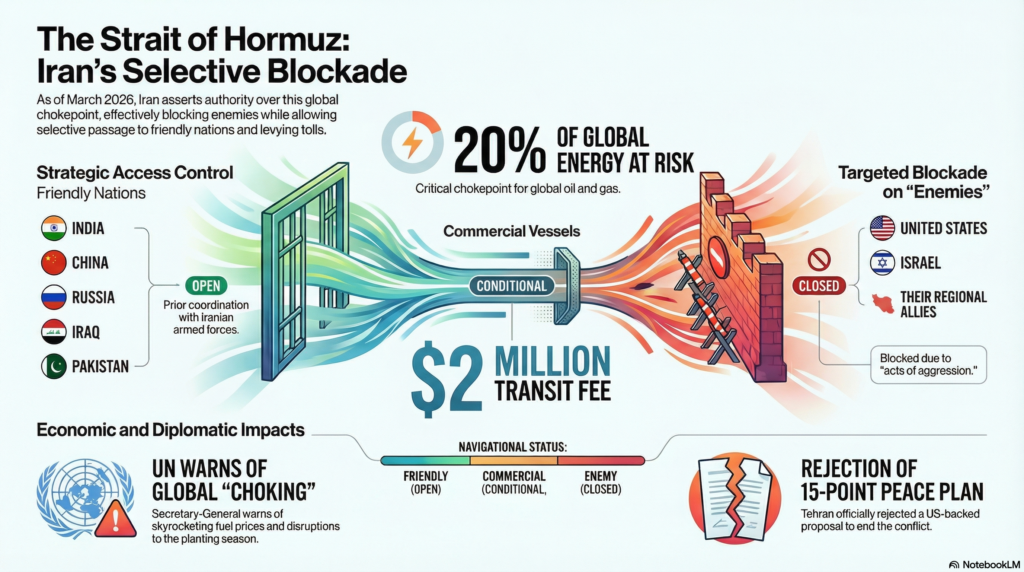
That consensus has just been incinerated. Tehran has effectively transformed the waterway from a public thoroughfare into a “gated community” for global trade. By leveraging its geographic geography, Iran is no longer merely threatening a blockade; it is actively curating a “friends-only” club, deciding who thrives and who is left to drift in the dark.
This is more than a regional skirmish; it is a fundamental rewriting of maritime law. What happens to the global economy when its most vital artery becomes a curated boutique? As ships are forced to negotiate entry, we are witnessing the birth of a dangerous precedent where the high seas are no longer free, but “coordinated.”
The “Friendly Nations” VIP List
Iran’s strategy is not a blunt-force blockade, but a surgical policy of selective access. Foreign Minister Abbas Araghchi has clarified that while the Strait is restricted, a “VIP list” of nations has been granted green-light status. This list includes China, Russia, Iraq, Pakistan, and India—which recently saw two of its vessels pass through with Iranian blessing. Crucially, even Bangladesh has successfully coordinated for passage.
This is not merely a diplomatic gesture; it is a military operation. Araghchi has explicitly stated that shipowners are contacting Tehran to request safety, with the Iranian armed forces providing the actual escorts and coordination. This “wedge” strategy is a masterstroke. By granting passage to the world’s two most populous nations, India and China, Iran has effectively paralyzed a unified UN response. If the major engines of the global economy have a “green light,” the incentive to join a US-led task force to break the blockade vanishes.
“The Strait of Hormuz, from our perspective, is not completely closed — it is closed only to enemies. There is no reason to allow the ships of our enemies and their allies to pass,” Araghchi stated.
The “Pay and Pass” System: A $2 Million Toll
Friendship with the Revolution is the first hurdle, but even for those not on the “enemies” list, the price of admission is steep. Industry giants Lloyd’s List Intelligence and Bloomberg have begun reporting a grim new reality: the institutionalization of a “pay and pass” system. According to these reports, commercial vessels are being levied “transit fees” of up to $2 million per voyage to ensure safe passage.
The transition of the Strait from a free-access zone to a revenue-generating cash cow is a tectonic shift in maritime norms. Iranian lawmaker Alaeddin Boroujerdi has defended this “new sovereign regime,” justifying the fees as a necessary measure to offset “war costs.” In this new era, the waterway is no longer a public good; it is a high-stakes toll corridor.
Navigational Access Under the New Sovereign Regime:
- The Escorted: Vessels from India, China, Russia, Pakistan, Iraq, and Bangladesh that have coordinated with Iranian military authorities.
- The Taxed: Commercial ships from “non-hostile” states that pay the ad-hoc $2 million transit fee.
- The Blocked: Any nation “playing a role in the prevailing Middle East conflict,” specifically targeting the United States, Israel, and their regional allies.
Defiance of the Superpowers
The global response has been a mix of desperate diplomacy and military posturing. UN Secretary-General Antonio Guterres has issued a haunting warning that the “prolonged closure” is choking the movement of life-sustaining supplies. Yet, Tehran remains unmoved, recently rejecting a US-backed 15-point peace proposal in favor of concluding the war on its own terms.
“The prolonged closure of the Strait of Hormuz is choking the movement of oil, gas, & fertilizer at a critical moment in the global planting season… civilians are enduring serious harm & living under profound insecurity,” Guterres warned.
The confidence radiating from Tehran is palpable. Araghchi boasted that the world thought Iran was “bluffing” about its ability to command the Strait, only to find that the West “mobilized all their abilities to stop it, but they failed.” Even as 2,000 U.S. troops from the 82nd Airborne Division deploy to the region, Iran’s grip remains firm. However, this outward “authority” masks a deeper tension. Former U.S. President Donald Trump has suggested that Iranian representatives are privately “eager to strike a deal,” fearing internal collapse and the prospect of “being killed by their own people” if the economic pressure isn’t relieved.
Tectonic Shifts in Global Caloric Security
While the world fixates on oil prices climbing above $100 per barrel, the more dangerous “lagging fuse” is the disruption to the global food-energy nexus. The Strait is a primary artery for fertilizer. By choking these shipments during the “global planting season,” Iran isn’t just raising the price of gas; it is guaranteeing a food crisis six months from now.
This is a counter-intuitive strike at the global agricultural supply chain. If the fertilizer doesn’t move today, the harvest fails tomorrow. By controlling the timing of these shipments, Iran is holding the world’s caloric security hostage, proving that in modern geopolitics, the ability to stop a shipment of potash can be just as lethal as a ballistic missile.
The Final Thought: A New “Sovereign Regime”?
We are no longer discussing a temporary disruption; we are witnessing the emergence of a “new sovereign regime” over one of the world’s most vital chokepoints. By blending military control, a selective VIP list, and a million-dollar toll system, Iran has created a blueprint for how a regional power can monetize and manipulate global trade.
The precedent is profound. If the international community allows the “pay and pass” model to stand, the long-standing principle of “freedom of navigation” will become a relic of the 20th century. As the world watches oil prices surge and fertilizer supplies vanish, the existential question for the maritime order remains: Can the high seas ever return to “normal” once a $2 million price tag has been placed on the right to exist in international waters?
❓ తరచుగా అడిగే ప్రశ్నలు (FAQs)
ఈ వార్త లేదా కథనంలో ముఖ్యమైన అంశం ఏమిటి?
The $2 Million Toll: How Iran is Rewriting the Rules of the World’s Most Vital Chokepoint గురించిన పూర్తి సమాచారం మరియు తాజా ముఖ్యాంశాలు ఈ కథనంలో సమగ్రంగా వివరించబడ్డాయి.
ఈ తాజా పరిణామం ఎందుకు ప్రాధాన్యత సంతరించుకుంది?
ప్రజా ప్రయోజనాలు, సంబంధిత వర్గాలు మరియు ప్రస్తుత పరిస్థితుల దృష్ట్యా ఈ పరిణామం అత్యంత కీలకమైనదిగా మారింది.
ఈ అంశంపై అధికారిక వివరాలు మరియు తాజా అప్డేట్స్ ఎక్కడ తెలుసుకోవచ్చు?
సంబంధిత అధికారిక వర్గాలు వెల్లడించే తదుపరి సమాచారం మరియు ప్రత్యక్ష అప్డేట్స్ కోసం మా వెబ్సైట్ను నిరంతరం ఫాలో అవ్వండి.