
1. Introduction: The Ultimatum That Shook the Markets
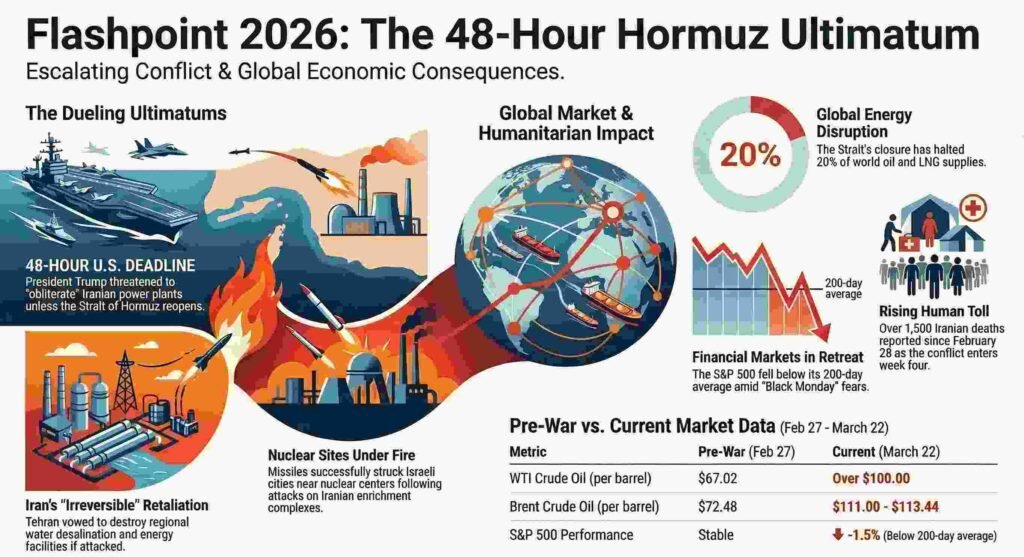
The global economy is currently staring down a 48-hour ticking timebomb. On Saturday, March 21, 2026, President Trump—speaking from the White House lawn before departing for Florida with Secretary of State Marco Rubio—delivered a stark ultimatum to Tehran: fully reopen the Strait of Hormuz by midnight GMT on Monday, or face the “obliteration” of Iran’s domestic power grid.
This is no longer a regional skirmish; it has mutated into a global economic crisis characterized by “elevated uncertainty.” For the macro strategist, the signal is clear: we are witnessing the weaponization of the very arteries of global commerce. What began as a localized conflict is now a direct assault on the technical support levels of the global order. We aren’t just watching a war; we are watching the dismantling of the old world’s liquidity and safety.
2. The “Obliteration” Directive: Trump’s High-Stakes Power Play
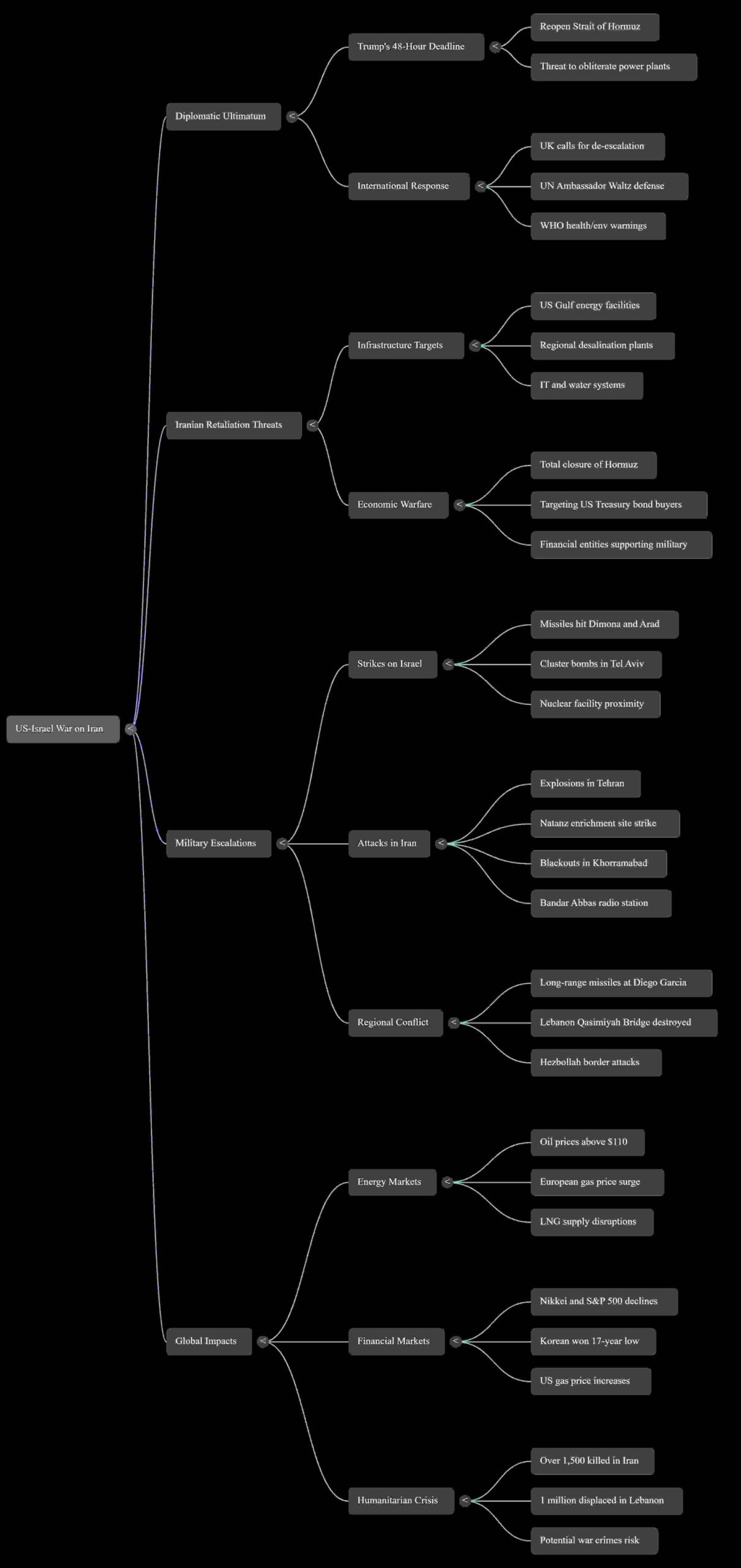
The White House, operating from a Florida-based “war cabinet,” has set a zero-sum demand: the immediate and total reopening of the Strait of Hormuz. Failure to comply will result in U.S. strikes designed to “hit and obliterate” Iranian power plants, with the President explicitly stating the military would start “with the biggest one first.”
This marks a significant escalation in strategic doctrine. By targeting civilian power infrastructure—rather than traditional military-to-military assets—the U.S. is signaling that the era of proportional response is over. This is a “total infrastructure war” meant to de-industrialize an adversary in real-time.
“The IRGC [Islamic Revolutionary Guard Corps] controls much of the country’s infrastructure and uses it to power its war effort… the president is not messing around.” — U.S. Ambassador to the UN, Mike Waltz
3. Beyond Oil: The Surprising Threat to the Region’s Water
While markets are fixated on crude, the most existential threat is the “survival war” now targeting the Gulf’s water supply. Tehran has vowed to “irreversibly destroy” desalination facilities across the Middle East. For states like the UAE and Saudi Arabia, this isn’t just an energy crisis—it’s a biological one.
This move effectively threatens the unraveling of the Abraham Accords and regional stability at large. If desalination plants fall, the humanitarian cost becomes the primary lever of warfare. The human toll is already staggering: 1,407 civilians have been killed since February 28, including 214 children. By labeling water as a legitimate target, the combatants are crossing a threshold that leads toward a regional “total war.”
“Iran will strike all energy, information technology and desalination infrastructure belonging to the U.S. and Israel in the region… the strait of Hormuz will be completely closed, and will not be reopened until our destroyed power plants are rebuilt.” — Khatam al-Anbiya (Iranian Military Operational Command)
4. Financial Targets: The “Ultimate Risk-Off Event”
In a move that strikes at the heart of the Eurodollar system and global liquidity, Mohammad Bagher Ghalibaf, Speaker of the Iranian Parliament, has declared purchasers of U.S. Treasury bonds to be military targets. Ghalibaf’s rhetoric—claiming that buying U.S. debt is effectively purchasing “a strike on your HQ and assets”—is an attempt to weaponize global capital markets.
This is the Ultimate Risk-Off Event. If the world’s “safe haven” asset is used as a justification for physical strikes on the financial institutions that hold it, the very “trust” underlying global finance evaporates. We are seeing a direct assault on the sovereign risk profiles of the West, turning the global bond market into a literal battlefield.
Key Takeaway: The battlefield has expanded from the desert to the Eurodollar system. Sovereign debt is no longer just a financial instrument; it is being redefined as a military liability, threatening a permanent fracture in global capital flows.
5. Worse Than the 70s: The Great Energy Bottleneck
The International Energy Agency (IEA) has warned that the current disruption is “worse than the two energy crises in the 1970s put together.” With only 5% of pre-war volume moving through the Strait—and only then for “friendly” nations like China and India—the global supply chain is being strangled.
The contagion is spreading through every major asset class, as evidenced by these emergency red flags:
- Global Oil Surge: Brent crude has rocketed to $111 per barrel, a staggering 54% spike from its $72 pre-war baseline.
- Equities in Turmoil: The S&P 500 has fallen below its 200-day moving average for the first time since May, a critical technical breakdown signaling a shift to a bear market.
- The UK Response: Prime Minister Keir Starmer has convened an emergency COBRA meeting with the Bank of England to address the “fragile finances” of a nation facing 35% weekly surges in gas prices.
- Currency Collapse: The South Korean won has hit a 17-year low (1,510 per dollar), while the Japanese yen trades at near-historic lows of 159.5.
6. The Nuclear Shadow: Reaching the “Unthinkable”
The strategic landscape shifted permanently this weekend when Iranian missiles successfully penetrated Israeli air defenses near the Dimona and Arad nuclear research sites. This was not merely a barrage; it was a demonstration that the “gatekeepers” of Israel’s nuclear deterrent are vulnerable.
Simultaneously, Iran proved its “Macro” reach by firing 2,500-mile (4,000km) range ballistic missiles at the Diego Garcia logistics hub in the Indian Ocean. This confirms that Tehran can now strike critical Western supply nodes thousands of miles from the front lines. The war has moved into a “perilous stage” where environmental and public health catastrophes are no longer theoretical.
“Attacks targeting nuclear sites create an escalating threat to public health and environmental safety.” — Tedros Adhanom Ghebreyesus, WHO Director-General
7. Conclusion: The Looming “Black Monday”
As the 48-hour clock winds down, the world is bracing for a potential “Black Monday.” The global order is facing a trifecta of systemic shocks: a total energy bottleneck, the weaponization of sovereign debt, and the failure of high-tier missile defense.
The transition from a “ticking timebomb” to a permanent dismantling of the old global order appears to be in its final seconds. Investors and citizens alike must confront a grim reality: In a world where energy, water, and even the bonds in your portfolio are targets, is there any way back to the status quo, or are we witnessing the birth of a new, fractured era through fire?
❓ తరచుగా అడిగే ప్రశ్నలు (FAQs)
ఈ వార్త లేదా కథనంలో ముఖ్యమైన అంశం ఏమిటి?
48 Hours to Midnight: 5 Surprising Realities of the New Middle East Energy War గురించిన పూర్తి సమాచారం మరియు తాజా ముఖ్యాంశాలు ఈ కథనంలో సమగ్రంగా వివరించబడ్డాయి.
ఈ తాజా పరిణామం ఎందుకు ప్రాధాన్యత సంతరించుకుంది?
ప్రజా ప్రయోజనాలు, సంబంధిత వర్గాలు మరియు ప్రస్తుత పరిస్థితుల దృష్ట్యా ఈ పరిణామం అత్యంత కీలకమైనదిగా మారింది.
ఈ అంశంపై అధికారిక వివరాలు మరియు తాజా అప్డేట్స్ ఎక్కడ తెలుసుకోవచ్చు?
సంబంధిత అధికారిక వర్గాలు వెల్లడించే తదుపరి సమాచారం మరియు ప్రత్యక్ష అప్డేట్స్ కోసం మా వెబ్సైట్ను నిరంతరం ఫాలో అవ్వండి.