
1. A New Year Aligned with the Pulse of the Earth
While the standard Gregorian New Year arrives amidst the mid-winter chill of January 1st, Gudi Padwa—falling on March 19, 2026—offers a more resonant beginning. It is a New Year that breathes with the planet, marking the arrival of Vasant Ritu (Spring) and the successful reaping of the Rabi harvest. For Marathi and Konkani communities, this isn’t just a change of the date; it is a spiritual and biological “refresh button.”
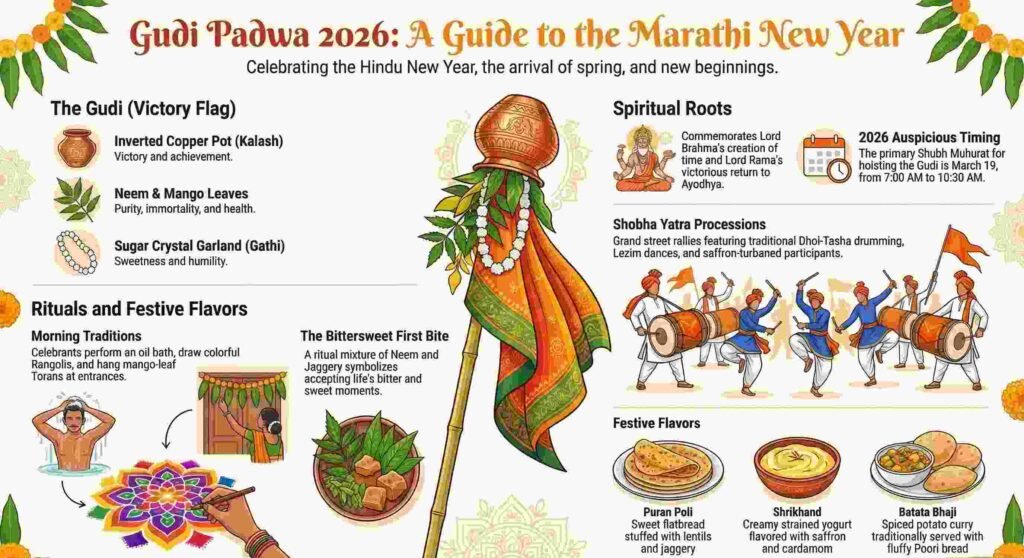
To start the year with the highest alignment, practitioners observe the Shubh Muhurat, the window of auspicious timing. In 2026, the ideal time for the placement of the Gudi is in the early morning between 6:53 AM and 7:57 AM, though the broader puja window extends from 7:00 AM to 10:30 AM. It is a moment where the thrum of the dhol-tasha (traditional drums) meets the crisp morning air, signaling a transition from the old to the new.
2. The Bittersweet “Life Hack” on a Plate
Long before the concept of “resilience training” entered the modern lexicon, Gudi Padwa introduced a sophisticated psychological and physical tool: the ritualistic consumption of a unique, multi-flavored prasad. This mixture is a potent concoction of bitter neem leaves, sweet jaggery, sour tamarind, pungent carom seeds (Ajwain), and astringent coriander or cumin seeds.
This sensory experience is intentionally complex, serving as a reminder that the human experience is never one-dimensional.
“The bitterness of neem symbolizes sadness, while the jaggery represents happiness. Eating them together is a prayer to accept both joy and sorrow with equanimity in the coming year.” — Outlook India
Beyond the philosophy, there is a “life hack” for the body. Neem acts as a powerful blood purifier and immunity booster, preparing the system for the rising heat of the Indian summer. By starting the year with a forced taste of bitterness, the tradition builds the psychological stamina required to face life’s inevitable ebbs and flows with a steady heart.
3. More Than a Flag: The Anatomy of a Victory Symbol
The Gudhi is the central victory flag of the festival, hoisted high on the right side of home entrances to ward off evil and invite prosperity. Its assembly is a precise ritual, involving specific items that transform a simple bamboo staff into a sacred symbol of achievement.
To assemble a traditional Gudhi for 2026, you will need:
- A tall, resilient bamboo staff: Serving as the sturdy foundation.
- A vibrant Silk or Paithani cloth: Typically in auspicious yellow or orange, tied to the tip.
- Neem and Mango boughs: Symbols of purity, growth, and seasonal health.
- A garland of marigolds: Bringing the bright, earthy scent of the harvest.
- The Gathi: A distinctive string of sugar crystals signifying the sweetness of life.
- An upturned copper or silver vessel: Positioned at the very top to signify a “crown” of victory and achievement.
The placement of the Kalash (pot) upside down is the most significant detail; it represents a banner of triumph and the successful completion of a cycle, signaling to the world that the household is ready to conquer the year ahead.
4. The Day Time Began: A Cosmic Origin Story
Gudi Padwa is anchored by profound legends that elevate it from a regional holiday to a “Universal Anniversary.” According to the Brahma Purana, this is the day Lord Brahma created the universe and time itself. This makes the festival the literal “birthday” of our existence, a moment when the cosmic clock was first set in motion.
Historically, the day also commemorates the historic coronation of Lord Rama in Ayodhya following his epic victory over Ravana and his return from 14 years of exile. Whether viewed through the lens of the creation of the cosmos or the restoration of dharma (righteousness) on earth, the festival represents the ultimate fresh start—a total reset of the world’s energy.
5. Empowerment on Two Wheels: The Modern Shobha Yatra
While Gudi Padwa is rooted in the Brahma Purana, its modern expression in Mumbai is a masterclass in cultural evolution. The Shobha Yatras (grand processions) of Girgaon and the cultural capital of Dombivli have become legendary for their high-energy displays.
The most striking image of the 2026 celebrations will be the women’s bike rally. On the morning of March 19, hundreds of women will navigate the narrow, historic streets of Girgaon dressed in traditional, shimmering Nauvari (nine-yard) sarees and saffron turbans, riding heavy Royal Enfields. This powerful contrast—the 18th-century saree style meeting the roar of modern machinery—perfectly captures the spirit of the modern Maharashtrian woman: grounded in deep heritage, yet fully empowered to lead the charge into the future.
6. The New Year That Moves
It is a common misconception that this day marks the New Year for all Hindus. The Hindu calendar is “Lunisolar,” meaning it accounts for both the moon’s phases and the sun’s position. Because a lunar year is roughly 11 days shorter than a solar year, the date of Gudi Padwa shifts annually on the Gregorian calendar.
While it is the New Year for Marathi and Konkani speakers—who may also call it Sausāra Pāḍavo—and for Telugu and Kannada communities (Ugadi and Yugadi), other communities follow different rhythms:
- The Solar New Year: Communities following the solar cycle, such as those celebrating Vaisakhi, mark their beginning in mid-April.
- The Gujarati New Year: Celebrated during Diwali (Bestu Varas).
This distinction highlights the incredible diversity of the Indian subcontinent, where “new beginnings” are celebrated through multiple, equally valid cosmic cycles.
7. Conclusion: The Spirit of Renewal
Gudi Padwa 2026 is an invitation to align your personal rhythm with the wisdom of tradition. From the science-backed health benefits of neem—acting as a natural summer tonic—to the spiritual symbolism of the hoisted Gudhi, the festival offers a blueprint for holistic renewal.
As you step into this new cycle, remember that a meaningful beginning requires a willingness to embrace the whole of life.
Final Thought: In your own modern life, how will you choose to balance the “bitter and the sweet” to ensure your inner victory flag flies high this year?
❓ తరచుగా అడిగే ప్రశ్నలు (FAQs)
ఈ వార్త లేదా కథనంలో ముఖ్యమైన అంశం ఏమిటి?
5 Truths About Gudi Padwa 2026 You Didn’t Know గురించిన పూర్తి సమాచారం మరియు తాజా ముఖ్యాంశాలు ఈ కథనంలో సమగ్రంగా వివరించబడ్డాయి.
ఈ తాజా పరిణామం ఎందుకు ప్రాధాన్యత సంతరించుకుంది?
ప్రజా ప్రయోజనాలు, సంబంధిత వర్గాలు మరియు ప్రస్తుత పరిస్థితుల దృష్ట్యా ఈ పరిణామం అత్యంత కీలకమైనదిగా మారింది.
ఈ అంశంపై అధికారిక వివరాలు మరియు తాజా అప్డేట్స్ ఎక్కడ తెలుసుకోవచ్చు?
సంబంధిత అధికారిక వర్గాలు వెల్లడించే తదుపరి సమాచారం మరియు ప్రత్యక్ష అప్డేట్స్ కోసం మా వెబ్సైట్ను నిరంతరం ఫాలో అవ్వండి.