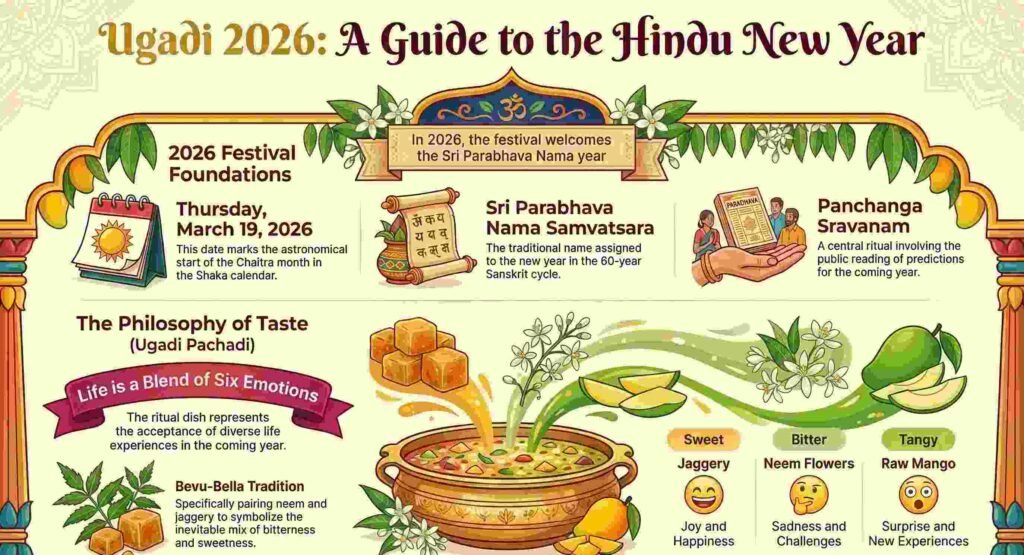
While much of the world has already tucked away its January 1st resolutions, a far more ancient and nature-aligned cycle is quietly preparing to bloom. On March 19, 2026, the air across the Deccan plateau will thicken with the heady scent of jasmine and the earthy aroma of fresh dung-purified doorsteps. This is the start of the Hindu New Year, according to the Shalivahana Shaka calendar.
Unlike the champagne-soaked, midnight countdowns of the Gregorian calendar, this New Year—celebrated as Ugadi in the South and Gudi Padwa in Maharashtra—is a moment of profound alignment. It is a day when time is measured not by a clock, but by the biological rhythm of the Earth and the precise movement of the stars. In this tradition, the New Year is a “cosmological reset,” grounding us in the reality of change.
The Year of “Parabhava”: A Fresh Cosmic Cycle
The year 2026 ushers in a significant “vibe shift” as we transition from the outgoing Vishwavasu year into Sri Parabhava Nama Samvatsara. In our tradition, time is cyclical, operating on a 60-year Samvatsara cycle where every year possesses its own specific “character.” To step into Parabhava is to revisit a cosmic energy last felt in 1966, reminding us that while we move forward, we also dance in circles.
The term Ugadi itself is a portmanteau of Uga (star movement) and Adi (beginning), literally translating to the “New Year of the Stars.” This astronomical moment—Chaitra Shukla Pratipada—is heavy with mythic weight. It is believed to be the exact second Lord Brahma began the creation of the universe and the day Lord Vishnu, in his Matsya avatar, recovered the stolen Vedas from the demon Somaka. On March 19, we aren’t just flipping a calendar page; we are participating in the anniversary of existence itself.
More Than a Meal: The Stoic Wisdom of Ugadi Pachadi
At the heart of every household is the preparation of the Ugadi Pachadi (or Bevu-Bella). In a world obsessed with curated, “sweet” success, this dish is a radical act of spiritual honesty. It is a “divine medicine” designed to prepare the body for the summer heat and the soul for the year’s trials. It is not a dish for pleasure, but a ritual declaration of readiness.
The Pachadi maps six distinct ingredients to the six emotional flavors of the human experience:
- Neem Flowers (Bitterness): Represents the sadness and inevitable challenges that provide the necessary contrast to life’s beauty.
- Jaggery (Sweetness): Represents the fleeting moments of joy and happiness.
- Green Chilli (Spiciness): Represents anger and the heat of our tempers.
- Salt (Saltiness): Represents the fear of the unknown and the “salt” of interest.
- Tamarind (Sourness): Represents disgust or the unpleasant, “sour” moments that test our health and patience.
- Raw Mango (Tanginess): Represents surprise and the zest of new, unexpected experiences.
As we consume this mixture, we practice Nirvedam—a state of stable detachment.
“We must consider Ugadi Pachadi as a symbol of life and accept it as Mother’s Prasadam. Whatever taste life gives in this year, we must decide to consider it a gift of Mother.”
Same Root, Different Dialects: Gudi Padwa vs. Ugadi
While the astronomical root is identical, the visual language of 2026 will look remarkably different depending on where you stand.
In the bustling streets of Pune, the festival is a public, triumphant declaration: Gudi Padwa. Here, you will see the Gudi—a decorated bamboo staff topped with an inverted copper or silver pot, a vibrant silk cloth, and neem leaves—raised high outside homes at sunrise. Men in Puneri pagdis and women draped in elegant Nauvari sarees celebrate a history of victory and prosperity.
Travel south to the neighborhoods of Bengaluru or Hyderabad, and the celebration—Ugadi—feels more community-centric and interior. Intricate muggulu (rangoli) patterns bloom at doorsteps, and the mango leaf torana serves as nature’s own festive bunting. The soul of the day here is the Panchanga Sravanam, where people gather to hear the reading of the new year’s almanac, deciphering the stars’ predictions for rainfall, harvests, and auspicious beginnings.
The “75% Rule”: Unexpected Spiritual Discipline for 2026
The Guruvani tradition offers a counter-intuitive set of “remedies” for the Parabhava year. These aren’t just rituals; they are a rigorous spiritual math designed to cure the “fickle-mindedness” of the modern age.
- Disciplined Food: We are encouraged to eat in proper measure. Overindulgence is seen as a gateway to disease, while mindful eating preserves the subtle body.
- Sacrificing a Favorite: To gain control over the senses, one is asked to voluntarily give up a beloved food item—practicing the art of letting go.
- The “Talk Less” Rule: This is perhaps the most challenging. Ancient wisdom suggests that 75% of our energy is wasted in talk. Specifically, the “98/2 rule” observes that 98% of our conversation is about the external world, while only 2% is about the self. By limiting speech, we conserve energy for introspection.
- Bhoosayanam: Sleeping on a mat on the floor (Bhoosayanam) serves as a humbling reminder of our non-egoistic nature at birth.
“One mantra of Guru is enough, why have thousands of other mantras!”
In an era of endless options, this call for focus over variety is the ultimate antidote to spiritual exhaustion.
Nature’s Calendar: Why the Spring Equinox Matters
Ugadi is inextricably tied to the Vasanta Ritu (Spring). This isn’t a festival hidden in a temple; it is visible in every mango tree sprouting tender, copper-hued leaves. The Earth is hanging its own toranas. This period also marks the beginning of Vasanta Navaratri, a nine-day window where the divine manifests in the blooming of nature. By aligning our New Year with the spring equinox, we acknowledge that we are part of a living, regenerating system.
Conclusion: Walking into the “Parabhava” Year
The transition into Sri Parabhava Nama Samvatsara is a call to renewal—not through shallow resolutions, but through deep, grounded readiness. It is a year that demands we find our center amidst the inevitable mix of the bitter and the sweet.
As we step into this new cosmic cycle, ask yourself: In a world obsessed with “sweet” success, are you brave enough to swallow the bitterness of Parabhava to find your center? Which of the six tastes are you most prepared to accept as a gift?
❓ తరచుగా అడిగే ప్రశ్నలు (FAQs)
ఈ వార్త లేదా కథనంలో ముఖ్యమైన అంశం ఏమిటి?
The 2026 Reset: Why the Bittersweet Flavor of ‘Parabhava’ is the Wisdom We Need Now గురించిన పూర్తి సమాచారం మరియు తాజా ముఖ్యాంశాలు ఈ కథనంలో సమగ్రంగా వివరించబడ్డాయి.
ఈ తాజా పరిణామం ఎందుకు ప్రాధాన్యత సంతరించుకుంది?
ప్రజా ప్రయోజనాలు, సంబంధిత వర్గాలు మరియు ప్రస్తుత పరిస్థితుల దృష్ట్యా ఈ పరిణామం అత్యంత కీలకమైనదిగా మారింది.
ఈ అంశంపై అధికారిక వివరాలు మరియు తాజా అప్డేట్స్ ఎక్కడ తెలుసుకోవచ్చు?
సంబంధిత అధికారిక వర్గాలు వెల్లడించే తదుపరి సమాచారం మరియు ప్రత్యక్ష అప్డేట్స్ కోసం మా వెబ్సైట్ను నిరంతరం ఫాలో అవ్వండి.