
The rivalry between the New Zealand All Blacks and the South African Springboks is often described as the greatest in world sports, a collision of two rugby cultures that have dominated the global game for over a century. Yet, to view this fixture strictly through the lens of points and tries is to overlook a history defined by political upheaval, social revolution, and a relationship so profound it once brought a nation to the brink of civil war.
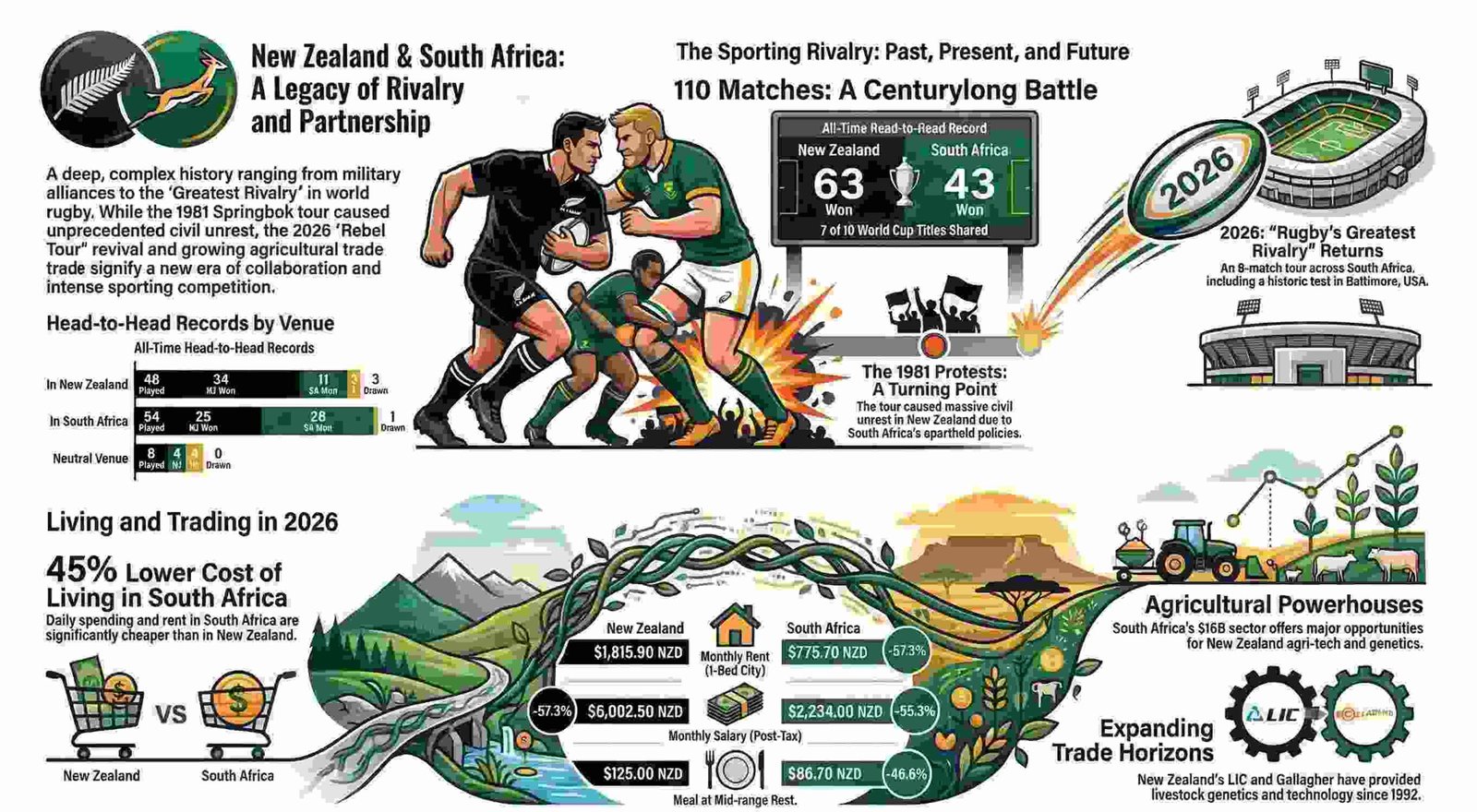
In 1981, a Springbok tour of New Zealand sparked “the largest mass civil unrest” in Kiwi history—a period of barbed wire, batons, and flour bombs. Today, that same rivalry is so commercially potent that it has forced a total restructuring of the professional global calendar to accommodate the 2026 “Greatest Rivalry” tour. As we look toward this upcoming super-series, the evolution from international pariah status to a multi-million-dollar “premier export” reveals five truths that define the enduring bond between these two tectonic forces of the Southern Hemisphere.
1. The “Secret” American Chapter: From Hiding to Rebranding
While the 1981 tour is remembered for the chaos on the streets of New Zealand, its American leg remains a surreal, nearly forgotten footnote. In an era where anti-apartheid sentiment had turned South Africa into an international pariah, the Springboks were forced into a “clandestine strategy” to even take the field.
In the U.S. Midwest, a match against a Midwest selection was secretly moved to Racine, Wisconsin, to evade protesters. The low point of this underground tour occurred in Glenville, New York, where the Springboks played the U.S. National Team (the Eagles) before just 30 spectators—the lowest attendance ever recorded for an international rugby match. The tension of the era was underscored by a pipe bomb that ripped through the Eastern Rugby Union headquarters in Albany, causing $50,000 in damage. At the time, the U.S. was a place to hide.
Fast forward to 2026, and the landscape has undergone a total inversion. The “Greatest Rivalry” tour will conclude with a high-profile fourth test at M&T Bank Stadium in Baltimore, Maryland. No longer a secret refuge, the United States is now being used as a neutral, high-capacity battleground to rebrand the rivalry for a global audience. The transition from the shadows of Racine to the floodlights of an NFL stadium symbolizes rugby’s move from a political liability to a premier commercial export.
“I abhor everything about apartheid… [but there is a] right to publicly espouse an unpopular cause.” — Erastus Corning, Mayor of Albany, during the 1981 protests.
2. The Tournament Sacrifice: Scrapping the Annual Cycle
To accommodate the return of traditional long-form tours, the very foundations of professional Southern Hemisphere rugby are being dismantled. Since 1996, the annual Tri-Nations (now The Rugby Championship) has been the cornerstone of the season. However, the 2026 season will see this annual tradition “scrapped” to make room for an eight-match New Zealand tour of South Africa.
The new biennial model for the championship signals a pivot away from modern tournament consistency and a return to the sport’s historic touring roots. The 2026 itinerary is a throwback to the era of “extended bilateral tours,” featuring:
- Three primary test matches in South Africa.
- One neutral-site test at M&T Bank Stadium in Baltimore.
- Five matches against South African United Rugby Championship (URC) provincial teams: the Bulls, Lions, Sharks, and Stormers, plus a fixture against South Africa A.
This “four-year reciprocal cycle” is a massive financial and structural gamble. It suggests that both unions believe the historic weight of this specific rivalry—a “super-series” model—holds more value than the stability of an annual four-nation championship.
3. Statistical Kryptonite: A Narrative of Ruthless Dominance
The intensity of this rivalry is fueled by a unique statistical reality: these are the only two nations capable of inflicting total humiliation upon the other. In a sport where the All Blacks have a winning record against every other nation, the Springboks remain their “statistical kryptonite.”
- The Head-to-Head: Across 110 encounters, the All Blacks hold the advantage with 63 wins to South Africa’s 43, with 4 draws.
- The Win Percentage: South Africa holds the highest win percentage of any nation in the world against New Zealand.
- Cycles of Ruthlessness: The rivalry is defined by extreme scorelines where each side has delivered the other’s largest-ever defeat. In 2017, New Zealand crushed the Springboks 57–0 in Albany. In an act of symmetry, South Africa exacted a historic revenge on September 13, 2025, at Wellington Regional Stadium, handing the All Blacks a 43–10 defeat—New Zealand’s largest-ever home loss.
While the 1995 World Cup Final remains the “iconic moment” of reconciliation, with Nelson Mandela famously wearing Francois Pienaar’s number 6 jersey, the modern data suggests a less sentimental truth. On the field, the relationship has returned to a cycle of ruthless dominance, where no lead is safe and no reputation is protected.
4. The Agribusiness Accelerator: Trade Behind the Razor Wire
One of the most surprising aspects of the New Zealand-South Africa relationship is that while sporting contacts were officially barred during the apartheid years, a deep economic and agricultural integration was taking root. This wasn’t just trade; it was a partnership of specialized expertise.
Since the early 1990s, New Zealand companies like Gallagher and LIC have been essential to South African farming. Despite the scale difference—South Africa manages a staggering 96 million hectares of agricultural land—New Zealand has become a vital tech partner, providing “specialized L&D contributions” in genetics and “electronic identification” (EID) systems. Gallagher, for instance, has supplied the South African market with animal weighing and fencing systems since 1992.
This synergy has evolved into a formal diplomatic pillar. New Zealand is currently funding the Home Grown Solutions (HGS) agribusiness accelerator with a NZ$6.45 million grant. This initiative, aimed at driving the innovation ecosystem across the region, proves that the bond between these two nations is anchored in similar climatic conditions and “people-to-people linkages” that often outlast the political storms of the day.
5. The War at Home: When Defiance Met Radicalization
The 1981 Springbok tour did not just polarize New Zealand; it radicalized a generation, turning rugby pitches into battlegrounds for the nation’s soul. The violence on the streets of New Zealand was the domestic price paid for the government’s decision to ignore the 1977 Gleneagles Agreement—the international standard that Muldoon’s administration was accused of betraying.
The radicalization was visceral. In Hamilton, the match was cancelled after a stolen light plane was piloted toward the stadium. In Auckland, the final test was interrupted by a Cessna dropping flour bombs on the pitch. The conflict became so physical that protesters began wearing motorcycle and bicycle helmets to protect themselves from police batons during the bloody clashes on Molesworth Street. It was a breakdown in law and order that mirrored the very revolution the protesters were trying to support in South Africa.
“It was strange for New Zealanders to feel so aggressive towards other New Zealanders… I was scared as hell.” — Cartoonist Murray Ball, reflecting on the internal conflict.
The 1977 Gleneagles Agreement, which the New Zealand government was found to have disregarded, described it as the:
“Urgent duty of each of their Governments vigorously to combat the evil of apartheid by withholding any form of support for, and by taking every practical step to discourage contact or competition by their nationals with sporting organisations… organised on the basis of race.”
Conclusion: The Evocative Future of Professionalism
The journey from the 1981 “Rebel Tour” to the 2026 “Greatest Rivalry” series represents the total transformation of rugby. The barbed-wire perimeters and flour bombs of 1981 have been replaced by multi-million-dollar agribusiness accelerators and neutral-site spectacles in NFL cathedrals.
Perhaps the most telling symbol of this new era is the inclusion of a high-profile curtain-raiser between the Black Ferns and the Springbok Women at FNB Stadium in 2026. This expansion of the rivalry beyond the traditional masculine framework of the “Rebel” era shows how much the professional game has grown. Yet, as the sport pivots toward this biennial “super-series,” a poignant question remains: In their effort to rebrand this history into a premier commercial product, can rugby ever truly separate itself from the political and social weights of its past, or is the “Greatest Rivalry” defined precisely by the very tensions that once tore it apart? Regardless of the score in Baltimore or Johannesburg, for these two nations, it has always been, and will always be, more than a game.
❓ తరచుగా అడిగే ప్రశ్నలు (FAQs)
ఈ వార్త లేదా కథనంలో ముఖ్యమైన అంశం ఏమిటి?
More Than a Game: 5 Surprising Truths About the New Zealand-South Africa Rugby Rivalry గురించిన పూర్తి సమాచారం మరియు తాజా ముఖ్యాంశాలు ఈ కథనంలో సమగ్రంగా వివరించబడ్డాయి.
ఈ తాజా పరిణామం ఎందుకు ప్రాధాన్యత సంతరించుకుంది?
ప్రజా ప్రయోజనాలు, సంబంధిత వర్గాలు మరియు ప్రస్తుత పరిస్థితుల దృష్ట్యా ఈ పరిణామం అత్యంత కీలకమైనదిగా మారింది.
ఈ అంశంపై అధికారిక వివరాలు మరియు తాజా అప్డేట్స్ ఎక్కడ తెలుసుకోవచ్చు?
సంబంధిత అధికారిక వర్గాలు వెల్లడించే తదుపరి సమాచారం మరియు ప్రత్యక్ష అప్డేట్స్ కోసం మా వెబ్సైట్ను నిరంతరం ఫాలో అవ్వండి.