
The 20% Choke Point
The global economy is often described as a complex, decentralized web, but in the spring of 2026, it became clear that the entire system has a single, calcified spine. The Strait of Hormuz—a 21-mile stretch of water separating the rocky coast of Oman from the Iranian mainland—is the world’s most arterial energy corridor. It is roughly the width of the English Channel at its narrowest, yet it carries the weight of the industrialized world. When this passage constricted following the outbreak of Operation Epic Fury, the tremors were felt instantly from the gas stations of California to the residential heating grids of London.
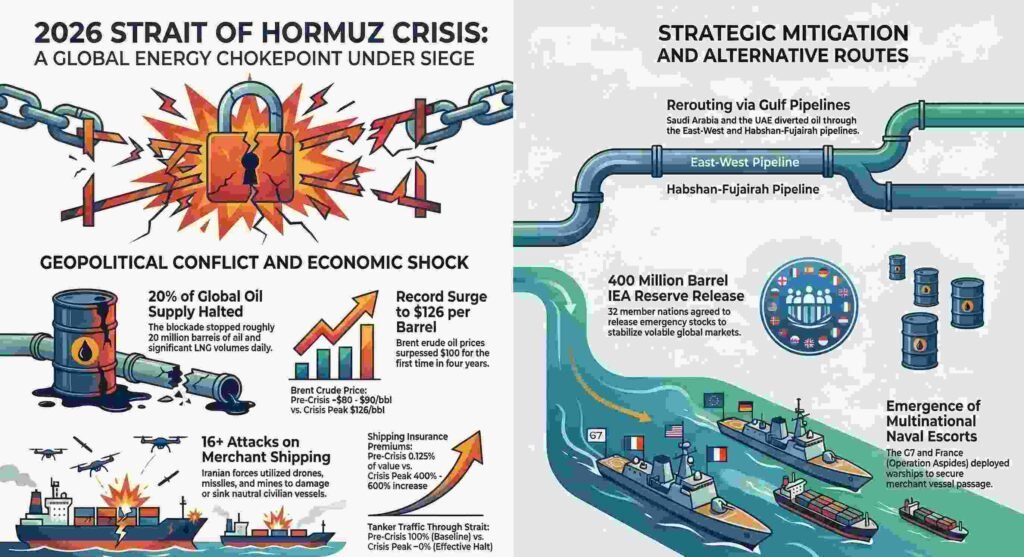
This was not merely a regional skirmish; it was a brutal stress test for the modern age. At the height of the crisis, the disruption of this narrow corridor—through which 20% of the world’s oil and liquefied natural gas (LNG) must pass—pushed Brent crude prices to a staggering peak of $126 per barrel. As we look back at the events triggered on February 28, 2026, the crisis revealed that our global energy security remains a hostage to a geography that has remained unchanged for millennia, even as the technology of warfare has evolved at a breakneck pace.
1. The “Effective” Blockade: How Risk Outran Reality
One of the most counter-intuitive aspects of the 2026 crisis was that the Strait was never legally “closed.” Iran did not formally declare a blockade, a move that would have triggered specific international legal consequences. Instead, the Islamic Revolutionary Guard Corps (IRGC) utilized a more modern and devastatingly efficient tool: the weaponization of risk.
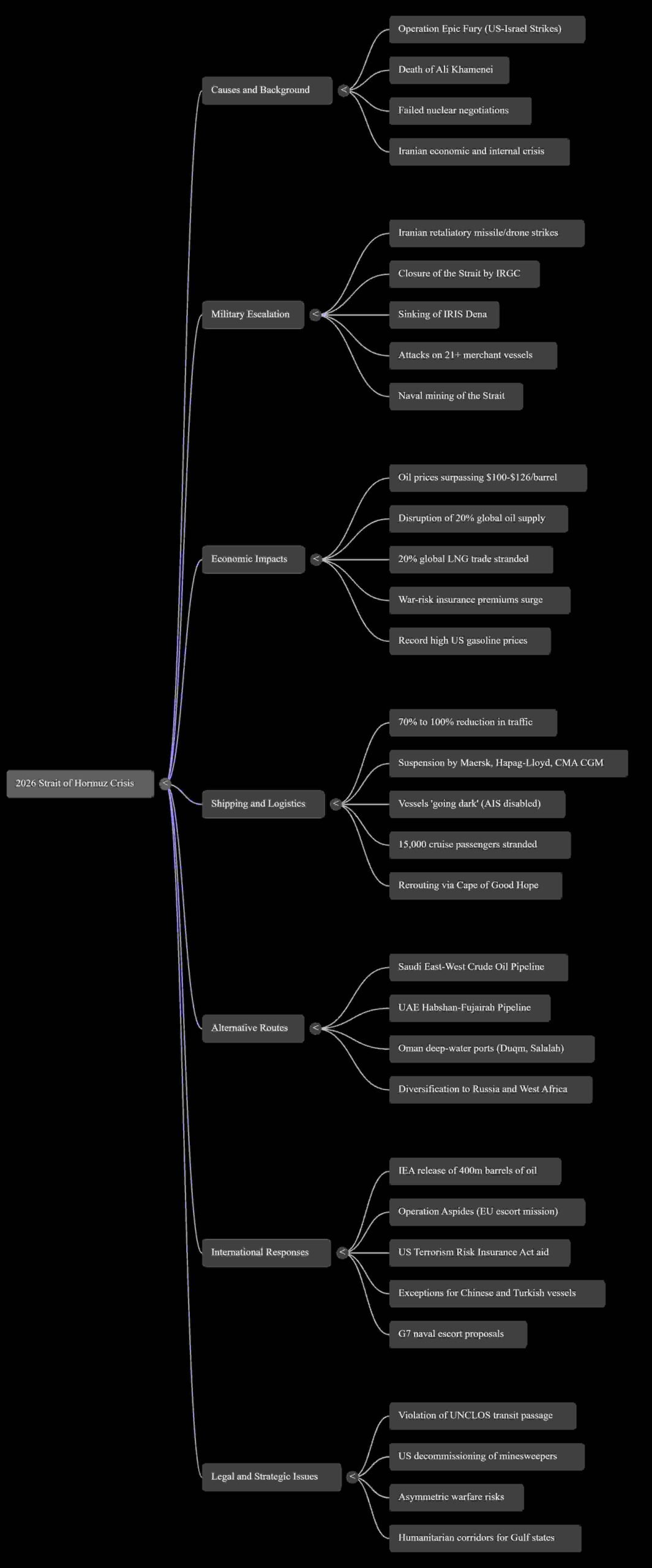
By launching targeted strikes on neutral vessels and broadcasting warnings over VHF radio, Tehran created a psychological minefield. Within days, maritime insurance premiums for the passage surged four to six times their original rates. Most critically, Protection and Indemnity (P&I) clubs removed “war risk” cover for the area entirely. For ship owners, the risk of losing a multi-million dollar hull—and the inability to insure it—became a greater deterrent than any physical Iranian warship.
“The Strait is technically open, but commercial tanker passage has effectively ceased.” — The Maritime Executive
2. Geopolitical Favoritism: The “Selective” Toll Booth
The 2026 crisis saw the Strait of Hormuz transformed from a global maritime highway into a political tool used to reward “supportive stances” and punish Western allies. Iran adopted a policy of “selective passage,” allowing ships from specific nations to transit safely while others were targeted or turned back.
This favoritism was managed through maritime signaling and a digital “loyalty check.” The bulk carrier Iron Maiden successfully transited the strait by broadcasting “CHINA OWNER” via its Automatic Identification System (AIS). Similarly, the LPG tanker Bogazici secured passage by broadcasting that it was “Muslim-owned and Turkish-operated.” This turned the strait into a geopolitical toll booth, where a nation’s diplomatic alignment determined whether its energy supply would be secured or severed, effectively ending the era of “freedom of navigation” in the Persian Gulf.
3. The Pipeline Myth: Why the Buffer Failed
A common misconception among policymakers is that existing pipelines offer a robust “Plan B” to bypass the Strait of Hormuz. The 2026 crisis proved this to be a dangerous fallacy. While Saudi Arabia and the UAE utilized their respective bypasses to the Red Sea and the Gulf of Oman, the sheer scale of the shortfall was insurmountable.
The math of the bypass deficit remains a sobering reminder of our vulnerability:
- Total Bypass Capacity (Saudi & UAE): Approx. 2.6 million barrels/day
- Normal Strait Transit Volume: Approx. 20 million barrels/day
- The Global Shortfall: 12 million barrels/day (minimum)
This 12-million-barrel deficit exists because regional giants like Iraq, Kuwait, and Qatar are helplessly tethered to the Strait; they possess no comparable pipeline alternatives for their exports. Furthermore, the 2026 conflict proved that pipelines are not a panacea. Iranian drone strikes on the Omani ports of Duqm and Salalah demonstrated that even the ports meant to bypass the chokepoint remain within reach of asymmetric threats, while the high volume of existing debris in the shallow 200-foot waters of the Strait provided natural camouflage for new hazards.
4. The Minefield Blind Spot: A Costly Lesson in Timing
There is a profound geopolitical irony in the fact that the U.S. Navy’s mine-clearing capabilities were at their lowest ebb just as the crisis began. Only one month before the conflict, the U.S. decommissioned its four remaining Avenger-class minesweepers in Bahrain, sending them to the Philadelphia Naval Shipyard for scrapping. The Navy had intended to pivot to a transitional strategy using the Littoral Combat Ship (LCS) and autonomous drones.
This created a critical capability gap at the exact moment the IRGC began seeding the Strait with naval mines. The asymmetric advantage was stark: a mine costing $10,000 can cause billions in damage and halt a hundred-million-dollar tanker. In the shallow 200-foot depths of the Strait, the high volume of existing debris acts as natural camouflage, making demining nearly impossible while active drone threats persist.
“The U.S. Navy’s very recent decommissioning of an entire class of minesweepers, without an effective ready replacement, makes an already precarious situation worse.” — Mark Nevitt, Just Security
5. History Rhyming: The Sinking of IRIS Dena
The 2026 crisis inevitably drew comparisons to the 1988 “Tanker War” and Operation Praying Mantis. However, 2026 was a far more lethal environment for traditional surface fleets. The sinking of the Iranian frigate IRIS Dena marked the first sinking of a major surface combatant in the region since the U.S. sank the IRIS Sahand in 1988.
While the 1988 playbook relied on convoys and reflagging to secure transit, these tactics proved unsustainable in 2026. The U.S. surface fleet was significantly smaller than in the 1980s, and the proliferation of low-cost Shahed drones and sea drones created a “saturated threat environment.” Unlike the 1980s, where the threat was primarily from surface-to-surface missiles or traditional aircraft, 2026 required 24/7 air cover against swarms of drones, a resource-heavy requirement that made traditional escort missions for long-term commerce impossible to execute.
Conclusion: A New Maritime Reality
The 2026 Strait of Hormuz crisis shattered the illusion that “transit passage” is a permanent right. It proved that international maritime doctrine is robust in theory but fragile in the face of a state willing to violate rules at scale. Technology—from sea drones to the LCS—has not yet liberated us from the dictates of ancient geography; if anything, it has made the world’s most critical choke points more vulnerable to low-cost disruption.
As the global economy attempts to de-risk following Operation Epic Fury, we are left with a fundamental question: can we ever truly escape this 21-mile dependency? Or are we permanently hostage to the “geography of the land and the dead,” where a single narrow passage remains the ultimate pressure point for the world’s most powerful nations?