
The 2026 Assembly elections across West Bengal, Tamil Nadu, Kerala, Assam, and Puducherry have delivered a seismic shift that transcends mere seat counts. On a scale that has left pollsters reeling and traditional political logic in tatters, the pulse of the nation indicates a voter base no longer tethered to legacy loyalties. This isn’t just an election; it’s a total remapping of the Indian political soul.
From the rise of debutant “warriors” to the breach of seemingly invincible fortresses, these results signal a new era of volatility. Here are the five definitive takeaways from a result that will haunt legacy parties into 2029.
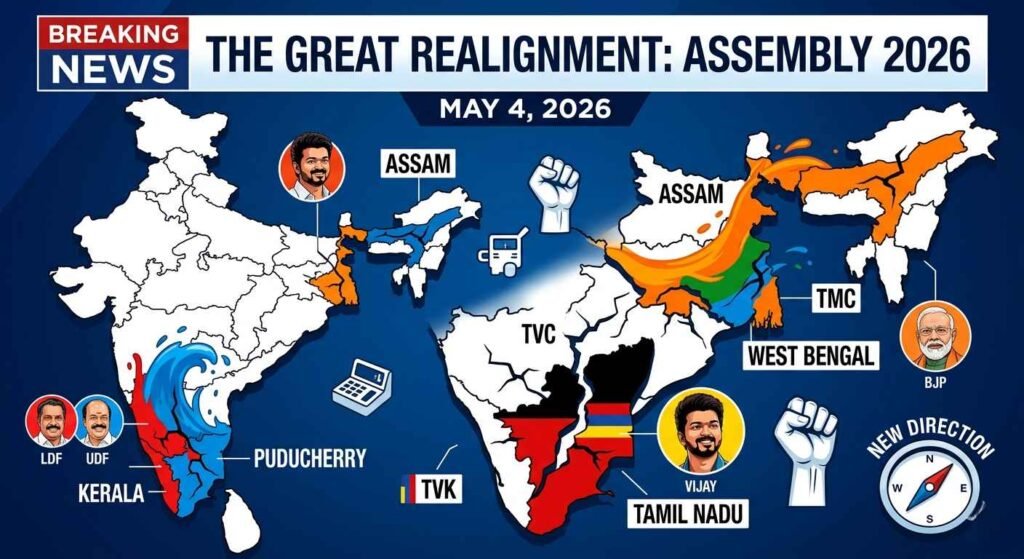
1. The “Thalapathy” Earthquake: A New Era in Tamil Nadu
The decades-old DMK-AIADMK duopoly didn’t just crack; it shattered. In a historic pivot point, Vijay’s Tamilaga Vettri Kazhagam (TVK) emerged as the single largest force in terms of leads, effectively ending the Dravidian era as we knew it.
The narrative isn’t just about the “actor-turned-politician” trope—it’s about cold, hard data. TVK President Vijay secured a decisive victory in the Perambur constituency, proving his ground-level mettle. More shocking was the fall of the Titan: sitting Chief Minister MK Stalin was defeated in his stronghold of Kolathur by TVK’s VS Babu by a margin of 9,000 votes.
Regarding this debut performance, Andhra Pradesh Minister Nara Lokesh noted that the victory reflects the aspirations of voters and has brought a:
“New dimension to the political stage.”
| Tamil Nadu Snapshot | Leads | Wins |
| TVK | 77 | 28 |
| DMK+ | 55 | 18 |
| AIADMK+ | 43 | 13 |
2. Breaking the Fortress: The Saffron Surge in West Bengal
In West Bengal, the “Lotus Blooming” narrative reached a fever pitch against a backdrop of unprecedented voter engagement—a staggering 92.84% polling rate. This surge suggests a fundamental shift in the state’s political identity, where the TMC’s “fortress” was breached by a disciplined saffron campaign.
The symbolic heart of this battle was Bhawanipur, where CM Mamata Banerjee trailed significantly in early rounds, while Suvendu Adhikari maintained a commanding performance. Adhikari, projecting a final tally of 180+ seats, characterized this as the end of TMC dominance. However, the victory was marred by controversy; Mamata Banerjee alleged that the BJP “stole votes” using candidates with the title “Sir” to confuse voters, while reporting tactical power cuts and CCTV outages during the count. Furthermore, investigative eyes remain on the Falta constituency, where re-polling was ordered following documented irregularities.
| West Bengal Snapshot | Leads | Wins |
| BJP | 162 | 40 |
| TMC+ | 75 | 11 |
| Left/Others | 2 | 2 |
3. Kerala’s Pendulum: The UDF’s “Century” Victory
Kerala has historically followed a “pendulum” pattern, but 2026 represents a total collapse of the Left’s hope for a historic hat-trick. The United Democratic Front (UDF) crossed the psychological “century” mark in wins, signaling a rejection of the LDF’s governance.
The shift was symbolized by CM Pinarayi Vijayan trailing early in his own constituency of Dharmadam. For the Communist-led LDF, losing its last national stronghold is more than a local defeat; it is an existential crisis.
| Kerala Snapshot | Leads | Wins |
| UDF | 2 | 100 |
| LDF | 4 | 31 |
| NDA | 2 | 1 |
4. Assam’s Historic Continuity and the “Mama” Factor
While volatility defined the South and the East, Assam provided a masterclass in incumbency strength. Defying the anti-incumbent wave seen elsewhere, the BJP is on track for a hat-trick victory, fueled by an 85.96% voter turnout.
This stability is largely credited to the strategic leadership of Himanta Biswa Sarma, affectionately known as “Mama.” By contrasting the BJP’s 83 wins against the Congress’s dismal 10, the “Mama” factor has turned Assam into a geographic outlier where developmental continuity trumped the national trend of disruption.
| Assam Snapshot | Leads | Wins |
| BJP+ | 18 | 83 |
| Congress+ | 12 | 10 |
| AIUDF/Others | 1 | 2 |
5. The “Modi-Mayam” Map and Market Euphoria
The political results triggered an immediate “bull run” in India’s financial hubs. As the BJP released its celebratory “India Map”—a “Modi-fied” graphic spanning from Delhi to Bengal—the markets responded with aggressive optimism. The map was framed not just as a victory lap, but as a claim of “Developmental Faith.”
The Sensex surged over 900 points, with the Nifty crossing the 24,200 mark. Investors clearly perceive the BJP’s expansion into the East and the rise of new forces as a sign of pro-business stability. Reflecting on the grit required for such a solo campaign in Tamil Nadu, SA Chandrasekhar remarked on the “lone warrior” spirit:
“I appreciate that attitude… he stood on his own feet without any alliances and established the party.”
Conclusion: A New Political Cartography
The 2026 Assembly results represent a transformation in the political cartography of India. The rise of TVK in Tamil Nadu and the NR Congress/TVK alliance’s impact in Puducherry (where NRC+ secured 13 wins and TVK+ took 3) show that the “legacy wall” is crumbling.
As we look toward the 2029 national landscape, a critical question remains: Can legacy parties reinvent themselves, or are we witnessing the permanent erasure of old-guard politics? Telangana Rakshana Sena founder Kavitha captured the national mood perfectly:
“We are tired of those who are there… we are weary of those thirsty for power. ‘New Political Forces’ are needed to rewrite this corrupt political history.”
❓ తరచుగా అడిగే ప్రశ్నలు (FAQs)
ఈ వార్త లేదా కథనంలో ముఖ్యమైన అంశం ఏమిటి?
The 2026 Mandate: Five States That Just Flipped the Script on Indian Politics గురించిన పూర్తి సమాచారం మరియు తాజా ముఖ్యాంశాలు ఈ కథనంలో సమగ్రంగా వివరించబడ్డాయి.
ఈ తాజా పరిణామం ఎందుకు ప్రాధాన్యత సంతరించుకుంది?
ప్రజా ప్రయోజనాలు, సంబంధిత వర్గాలు మరియు ప్రస్తుత పరిస్థితుల దృష్ట్యా ఈ పరిణామం అత్యంత కీలకమైనదిగా మారింది.
ఈ అంశంపై అధికారిక వివరాలు మరియు తాజా అప్డేట్స్ ఎక్కడ తెలుసుకోవచ్చు?
సంబంధిత అధికారిక వర్గాలు వెల్లడించే తదుపరి సమాచారం మరియు ప్రత్యక్ష అప్డేట్స్ కోసం మా వెబ్సైట్ను నిరంతరం ఫాలో అవ్వండి.