
Gold has reached unprecedented heights in late October 2026, trading near eye-watering levels of ₹1.42–₹1.44 lakh per 10 grams for 24K bullion. In Mumbai, 24K gold stood at ₹1,42,480 per 10 grams on October 23, 2026. Yet, right alongside these historic peaks, the market has experienced intense volatility. On October 23 alone, 24K gold prices plunged by ₹1,900 per 10 grams (-1.32%) in a single trading session, falling sharply from ₹1,44,380 on October 22.
This abrupt surge in daily price swings leaves everyday retail buyers and seasoned market participants facing an urgent dilemma. Is this sharp pullback a prime buying window, a signal to hold existing allocations, or a warning sign to step back from an overheating asset class?
To navigate this high-stakes landscape, here are five crucial market realities—plus a fascinating historical insight—that every gold investor must understand today.
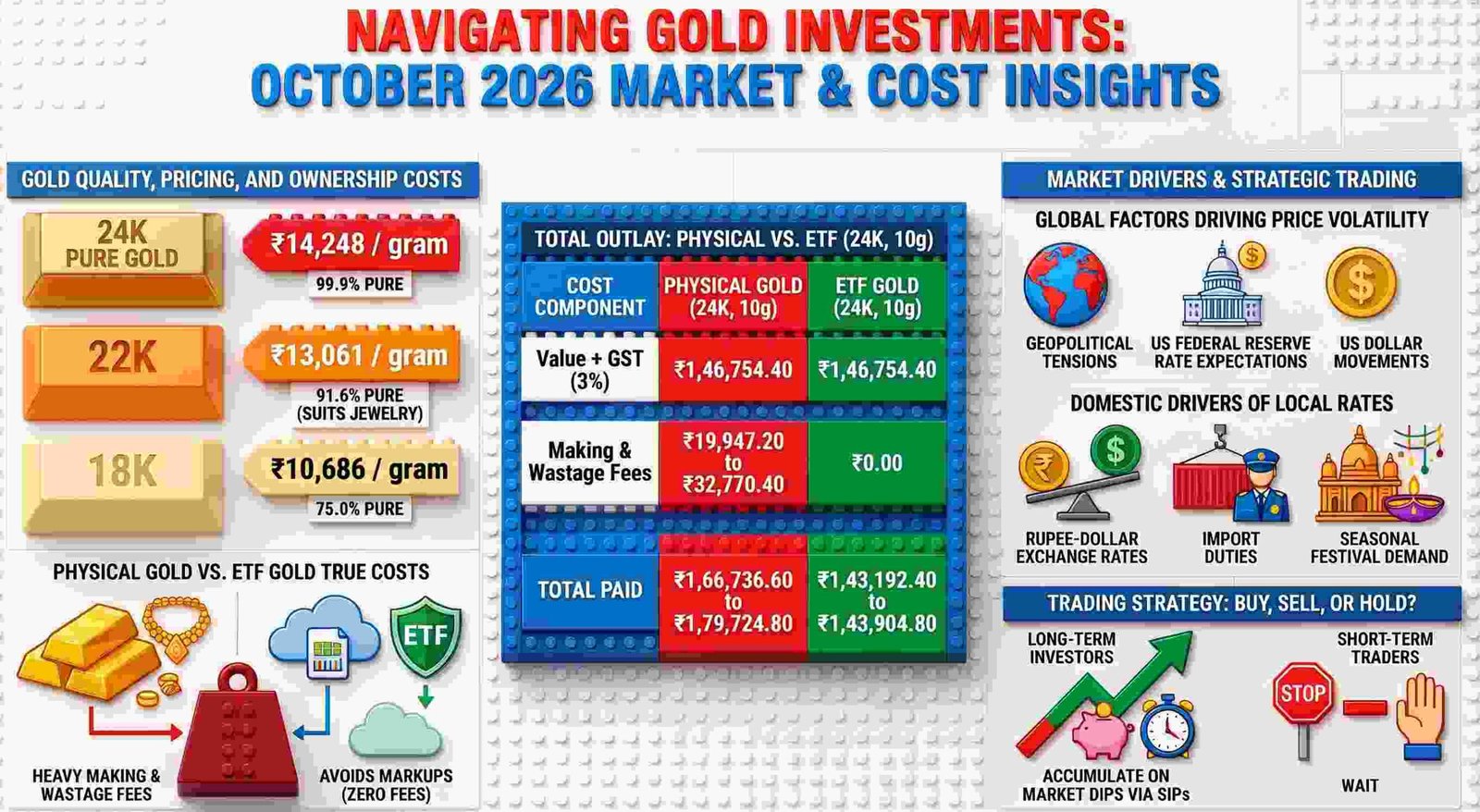
1. The Hidden Premium: Why 10g of Physical Gold Costs Far More Than Its Listed Price
When you consult a spot market rate sheet, the headline price reflects pure 24K gold value before retail markups. However, acquiring physical jewelry or coins incurs heavy overhead—specifically 3% Goods and Services Tax (GST), making charges averaging 12% to 18%, and wastage fees between 2% and 5%.
The cost breakdown below contrasts the true capital requirement of acquiring 10 grams of 24K physical gold versus 10 grams of 24K ETF gold in Mumbai:
| Cost Element | Physical Gold (24K, 10g) | ETF Gold (24K, 10g) |
| Value Before Tax (Base) | ₹1,42,480.00 | ₹1,42,480.00 |
| + GST (3%) | + ₹4,274.40 | — |
| + Making Charges (Avg. 12–18%) | + ₹17,097.60 to ₹25,646.40 | — |
| + Wastage Charges (2–5%) | + ₹2,849.60 to ₹7,124.00 | — |
| + Hallmarking / Custody Fees | + ₹35.00 to ₹200.00 | + ₹712.40 to ₹1,424.80 |
| Total Actual Purchase Cost | ₹1,66,736.60 to ₹1,79,724.80 | ₹1,43,192.40 to ₹1,43,904.80 |
When purchasing physical gold jewelry or fabricated bars, retail buyers immediately pay up to ₹37,000 above raw metal value due to fabrication, wastage, and tax markups. Because this outlay represents instant equity destruction that cannot be recovered upon resale, Gold ETFs offer a mathematically superior vehicle for investors seeking pure spot-price exposure without absorbing physical manufacturing friction.
2. The Unprecedented Surge: Gold Just Experienced Its Biggest YoY Growth in Modern History
The current price ceiling is not merely an incremental move; it represents a monumental structural shift. Published data from the Reserve Bank of India (RBI) tracking financial year-wise average 24K gold rates highlights a staggering acceleration over the past twelve months:
- FY 2024–25 Average Rate: ₹75,841.87 per 10g (+25.10% YoY)
- FY 2025–26 Average Rate: ₹1,46,160.00 per 10g (+92.70% YoY)
To gauge the magnitude of this +92.70% single-year surge, compare it against historical financial-year benchmarks:
- FY 1964–65: ₹63.25 per 10g
- FY 1978–79: ₹791.22 per 10g
- FY 2008–09: ₹12,889.74 per 10g
- FY 2020–21: ₹48,723.22 per 10g
- FY 2026–27 (Partial Year):* ₹1,45,690.00 per 10g (-0.30%)
While gold required decades to climb from double-digit rates to ₹50,000, its recent single-year surge nearly doubled its global baseline. Early partial-year data for FY 2026–27 shows prices consolidating near these elevated highs (-0.30%), confirming that the market is currently digesting its largest Year-over-Year expansion in modern history.
3. Interest Rates vs. War: Why Rate Hikes Are Crushing Safe-Haven Rallies
In late October 2026, precious metals markets displayed counter-intuitive behavior. Severe geopolitical escalation erupted across the Middle East—a drone attack targeted Saudi Aramco’s Shaybah oilfield, killing two people, and the US State Department ordered non-emergency diplomats and families to evacuate mission posts in Saudi Arabia.
Under standard market conditions, acute military conflict triggers an aggressive flight to safety. Instead, futures markets experienced sharp liquidations across the board:
- MCX Gold Futures (Dec 2026): Dropped ₹2,000 per 10g to ₹144,196.
- MCX Silver Futures (Dec 2026): Plunged ₹5,700 per kg to ₹203,520.
- International Spot Gold: Slipped to $4,115.50 per ounce, after testing a multi-week low of $4,104.33 on October 15.
This paradox highlights the dominant influence of macroeconomic monetary policy over regional conflict premiums. Market participants are fixated on the US Federal Reserve’s October 27–28 policy meeting and upcoming Personal Consumption Expenditures (PCE) inflation readings—the Fed’s primary inflation benchmark as it targets a 2% rate.
While economists expect the Fed to hold rates steady in October (16% hike probability), traders are pricing in a commanding 90% probability of a December 2026 rate hike according to CME’s FedWatch Tool. Higher benchmark interest rates increase real Treasury yields, elevating the opportunity cost of holding non-yielding bullion and effectively overpowering short-term geopolitical risk bids.
4. Trading vs. Investing: The Critical Difference Between MCX Futures and ETFs
Navigating volatile commodity trends requires selecting an appropriate structural mechanism. Trading derivative contracts on the Multi Commodity Exchange (MCX) differs fundamentally from holding units in a Gold Exchange Traded Fund (ETF).
MCX Gold contracts are cash-settled futures utilizing 10x to 20x financial leverage. Because these positions undergo mark-to-market daily cash settlement, profits and losses are realized at the close of every trading session. A modest tick against a leveraged trade can trigger immediate margin call liquidity squeezes, forcing involuntary liquidation of underlying capital.
Conversely, Gold ETFs trade on equity exchanges (NSE/BSE) during market hours and hold underlying physical gold in secure vaults without leverage. Charging modest expense ratios between 0.4% and 0.6%, ETFs track spot bullion prices transparently without subjecting holders to derivative margin maintenance.
Key Distinction: MCX Futures are highly leveraged, cash-settled contracts designed for active traders managing fast mark-to-market swings and daily margin demands. Gold ETFs offer unleveraged, passive spot-price tracking with modest expense ratios, making them structurally superior for long-term wealth preservation.
5. The Expert Playbook: Accumulate via SIPs, Don’t Catch Falling Knives
Attempting to time absolute market bottoms during policy-driven pullbacks introduces significant execution risk. Commodity analyst Manoj Kumar Jain of Prithvi Finmart highlights the critical technical boundaries defining the current channel:
- MCX Gold Support: ₹1,45,400 – ₹1,44,650
- MCX Gold Resistance: ₹1,46,600 – ₹1,47,200
- International Spot Gold Support: $4,110 – $4,084 per troy ounce
- International Spot Gold Resistance: $4,174 – $4,192 per troy ounce
Rather than committing capital in lump sums during sharp sell-offs, Jain outlines a disciplined institutional framework:
“Long-term investors should accumulate gold and silver through systematic investment plans (SIPs) during the current market decline, while traders should wait for markets to stabilize before initiating fresh positions.” — Manoj Kumar Jain, Prithvi Finmart
Deploying rupee-cost averaging via Systematic Investment Plans (SIPs) in Gold ETFs or Gold Mutual Funds insulates portfolios from short-term interest rate speculation shocks while building a core strategic position over time.
Bonus Fact: The 1833 British-Era Unit Still Driving Indian Gold Sales
When examining rate cards across physical Indian bullion markets, prices are frequently quoted per “Tola”. The Tola is a traditional South Asian weight unit officially standardized in British India around 1833 to establish uniform fair-trade measures for grain and precious metals across colonial bazaars.
In standardized modern metric conversions, 1 Tola is formally treated as 10 grams. However, physical market rate schedules—particularly in western hubs like Mumbai—often map regional price cards to a 12-gram schedule (where 1 Tola = 12g, priced today at ₹1,70,976 for 24K). Recognizing whether a jeweler is pricing on a 10g metric standard or a 12g trade scale is essential for verifying invoice accuracy at retail counters.
Conclusion & Final Reflection
Gold’s overarching narrative remains anchored in its historic function as a hedge against currency debasement and secular inflation. However, capturing capital appreciation requires institutional discipline: unbundling true 24K asset value from high 22K/18K retail jewelry markups, eliminating unnecessary physical transaction friction, and avoiding dangerous leverage traps in derivatives markets.
By favoring systematic, unleveraged accumulation through ETFs or fund vehicles over impulsive physical purchases during market pullbacks, investors can build durable multi-asset resilience. As global central banks shift monetary policies and physical premiums bite, are you holding gold for true long-term security, or are you paying a high price for the illusion of it?