
1. The Festive Shopping Tug-of-War
The holiday shopping rush is in full swing across India. Consumers are navigating a high-decibel barrage of marketing campaigns, endless app notification banners, and the constant psychological pull to splurge. In a festive environment naturally tied to optimism and celebration, consumer spending resistance drops, creating the ideal conditions for impulse buying.
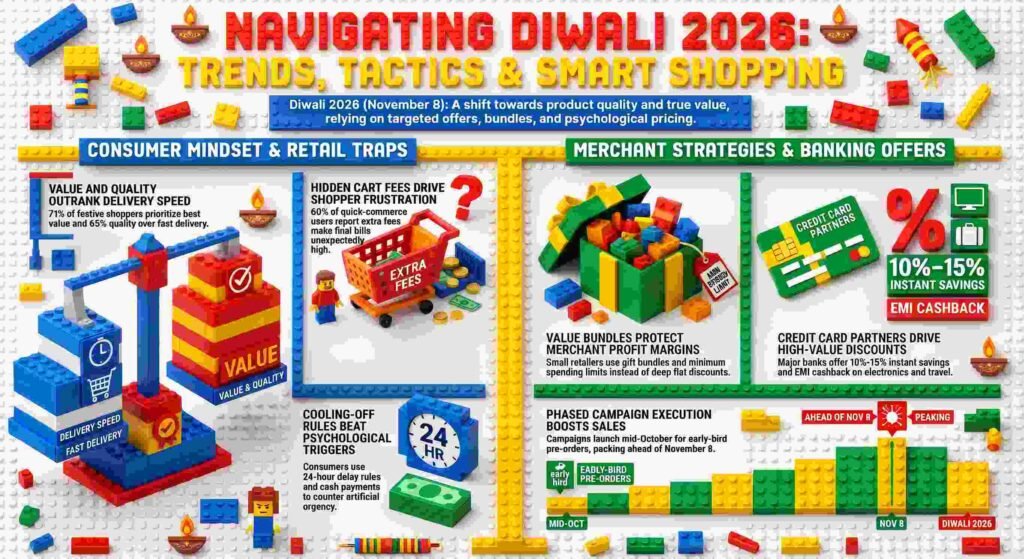
Yet the macro-economic environment telling this year’s story is nuanced. Amid broader economic caution, many Indian households have deliberately deferred discretionary purchases until the final weeks leading up to the festival. With Diwali falling on Sunday, November 8, 2026 (preceded by Dhanteras on Friday, November 6), this compressed buying window has created an intense, last-minute tug-of-war between retail giants, quick-commerce players, small merchants, and value-conscious consumers.
While headline banners loudly trumpet “Up to 80% Off,” an analytical look at the data reveals that consumer behavior in 2026 is far more calculated than raw discount percentages suggest. Beneath the promotional noise lies a dramatic evolution in fulfillment expectations, pricing psychology, merchant margin strategies, and cross-border gifting mechanisms.
2. Speed is Out, Value is In (The Quick-Commerce Plot Twist)
The defining narrative of India’s quick-commerce sector—the hyper-fast “10-minute delivery promise”—has hit a strategic inflection point during festive sales. While rapid delivery remains table stakes for routine daily top-ups, shoppers applying a festive lens are prioritizing fiscal discipline over sheer speed.
According to research from LocalCircles, consumer choices on quick-commerce platforms during the festive window are driven by a clear hierarchy of needs:
- Overall Value Over Speed: 71% of festive quick-commerce users select platforms based on best price and overall value, while 65% prioritize product quality.
- Fulfillment Speed Deprioritized: A mere 22% of shoppers consider fast delivery an important decision factor when buying festive goods.
- Secondary Motivations: Product availability when needed (46%), low or non-existent extra fees (43%), promotional offers (38%), and wider festive assortments (31%) all outrank rapid delivery speed.
Hidden Fees Drive Consumer Frustration
This shift toward strict value sensitivity is directly linked to growing friction over post-cart bill inflation. Six in 10 quick-commerce users express active frustration that additional line items—such as handling, delivery, surge, and small-cart fees—unexpectedly raise their final totals.
This fee sensitivity is critical because 69% of festive quick-commerce orders fall within the modest ₹200 to ₹999 range (specifically: 20% spend ₹200–₹399, 27% spend ₹400–₹599, and 22% spend ₹600–₹999). On small-to-midsize basket sizes, flat extra fees significantly erode the perceived discount, pushing consumers to re-evaluate platform loyalty.
Why Platform Preferences Shift During Festive Sales
This dynamics shift explains a dramatic divergence between everyday app usage and festive platform preference:
- Amazon Now takes the lead for last-minute festive orders at 22% preference.
- Blinkit drops to 19% during festive shopping (compared to its everyday market lead of 31%).
- Zepto captures 14% of festive preference.
- BigBasket holds 12%.
The strategic why behind Blinkit’s festive drop lies in consumer trust metrics regarding pricing. In consumer rating evaluations, while Blinkit achieved a perfect 5/5 score for fulfillment speed and selection depth, it received a low 2.5/5 for price value and fee transparency. Conversely, Amazon Now and Zepto scored 4.5/5 on charge transparency, sharing the top overall consumer rating of 27.5 out of 35. For shoppers holding back orders until the final days, predictable checkout pricing beats a 10-minute guarantee every time.
3. The “Spaving” Trap and Retailers’ Mind Games
To combat consumer hesitation, e-commerce giants and brick-and-mortar chains deploy behavioral mechanics designed to bypass deliberate budgeting, encouraging shoppers to spend more under the impression that they are saving—a psychological trap known as “spaving.”
- Anchor Pricing (Inflated Reference Prices): Retailers display a high, artificially inflated original price next to a sale rate (e.g., marked down from ₹4,999 to ₹2,999). This anchors the buyer’s cognitive focus on the apparent ₹2,000 “savings” rather than evaluating whether ₹2,999 reflects true market value.
- Goal Gradient Effect (Spend Thresholds): Prompts like “Spend ₹300 more to unlock free delivery” capitalize on the human drive to complete a benchmark, tricking consumers into adding unneeded items to cart to avoid a minor baseline fee.
- Payment Decoupling (No-Cost EMIs): Dividing large lump sums into small monthly installments removes the immediate psychological “pain of paying,” making luxury purchases appear instantly affordable while masking hidden processing charges.
- Charm Pricing & Number Mechanics: Pricing items at ₹1,999 exploits the left-digit effect, tricking the brain into anchoring on the initial “1” rather than rounding up to ₹2,000.
“American economist Richard Thaler’s work on mental accounting describes two pleasures in a purchase: the item itself, and the deal. A sale sells you the latter.” — Dr. Prerna Kohli, Founder, MindTribe
Practical Shopper Defense Tactics
- Apply the 24-Hour Rule: Enforce a mandatory 24-hour cooling-off period for any impulse purchase. Psychological urges to buy are emotional waves that peak and dissipate rapidly within hours.
- Delete Saved Card Details: Remove auto-filled credit card details and digital wallets from merchant apps. Forcing yourself to locate a physical wallet and manually type card numbers introduces critical friction, giving common sense time to intervene.
- Translate “Save” to “Spend”: Reframe promotional language immediately. If “Save ₹4,000” requires spending ₹6,000 of real income, evaluate whether you would purchase the item at full price on a standard Tuesday.
4. Small Businesses Win by Not Competing on Price
While corporate platforms wage margin-destroying price wars, small online sellers and local restaurants survive and thrive by protecting their unit economics through intelligent offer structures.
Smart Offer Structures for Small Merchants
Instead of across-the-board flat discounts, independent businesses are implementing targeted incentive mechanics:
- Free Shipping Thresholds: Setting delivery limits slightly above the store’s average order value encourages shoppers to add an incremental item to hit the target naturally.
- Curated Gift-Box Bundles: Packaging three complementary SKUs into a single festive gift box increases average order value while maintaining product margins.
- Prepaid UPI Incentives: Offering a small ₹50–₹100 discount for upfront UPI payment slashes expensive cash-on-delivery (COD) order rejections during peak logistics weeks.
- Non-Cash Perceived Perks: Including a small branded physical gift (such as a decorative diya or festive pouch) generates stronger customer goodwill than an equivalent cash price reduction.
- Direct Ordering Benefits: Independent restaurants offer free desserts or complimentary delivery exclusively on WhatsApp or direct websites, avoiding the 30%+ commissions charged by food aggregators.
Operational Execution Timeline
Successful independent merchants follow a strict operational calendar leading up to and through the festive cycle:
- By October 10: Finalize festive product bundles, shoot promotional photography, establish inventory caps and courier shipping thresholds.
- October 11–25: Launch private “early-bird” promo codes exclusively to past customer databases to smooth out fulfillment demand.
- October 26–November 3: Initiate the main public festive sale, prominently displaying gift bundles and free-shipping tiers on store landing pages.
- By November 1–2: Enforce and communicate last-order deadline dates for guaranteed delivery before Diwali.
- November 6 (Dhanteras): Final cutoff for sweet box and catering pre-orders; allocate dedicated staff for in-store pickups.
- November 8 (Diwali Day): Pause aggressive sales broadcasts; send warm, unpromotional festive greetings.
- November 10 (Bhai Dooj): Roll out targeted “meal-for-two” and sibling gift promotions.
- November 12–30 (Post-Festive Window): Issue “Come back” bounce-back coupons valid through late November or enable double loyalty point redemptions starting November 11 to bridge the predictable post-holiday spending slump.
5. The Card-Stacking Formula for High-Value Goods
For planned, high-ticket purchases—spanning consumer tech, large appliances, luxury travel, and gold—savvy consumers maximize savings by stacking platform sale prices with bank card partnerships, digital payment perks, and trade-in allowances.
| Category / Merchant | Festive Event & Duration | Key Bank Partnerships & Payment Offers | Strategic Optimization Tactics |
| Major E-Commerce | Amazon Great Indian Festival (Started Oct 8) | SBI Credit Cards: 10% instant discount.<br>Amazon Pay ICICI Card: 5% unlimited cashback for Prime members. | Combine card discounts with category markdowns of up to 80% on electronics and 75% on home furnishings. |
| Major E-Commerce | Flipkart Big Billion Days (Started Oct 9) | Axis & ICICI Bank Cards: 10% instant discount.<br>SuperMoney / UPI: 10% off first SuperMoney transaction; 5% off digital gift cards via UPI. | Layer UPI payment discounts on top of bank card tiers at checkout screen for digital gift card purchases. |
| Tech & Premium Laptops | Apple India Festive Offers (October–November) | Amex, Axis & ICICI Bank: Instant cashbacks up to ₹15,000 on MacBooks (Pro models ₹15k, Air ₹9k), ₹7,000 on iPhone 18 Pro/Pro Max, ₹5,000 on Macs. | Combine cashback offers with up to 6 months No-Cost EMI and trade-in credit allowances for old hardware. |
| Home Appliances & TVs | LG India Diwali Sale (Oct 1 – Nov 15) | Direct Brand & Retailer Offers: Up to 26% cashback (capped at ₹30,000) on 100QNED86B TV; up to 55% off monitor models. | Pair brand cashback caps with retailer-specific bank tiers (e.g., SBI Card up to ₹16,000 off at Bajaj Electronics; HDFC EASYEMI up to ₹15,000 off at Vijay Sales). |
| Festive Travel & Flights | Travel Aggregators (MakeMyTrip, Yatra, EaseMyTrip) | Kotak Cards: Up to 15% off (capped at ₹20,000) on MMT.<br>ICICI Bank: Up to 12% off international flights (capped at ₹10,000).<br>HDFC Bank: Up to ₹9,000 off MMT via EASYEMI. | Apply flight-specific EMI card offers to lock in long-haul international travel before festive rate surcharges peak. |
| Jewellery & Gold | Joyalukkas / Thangamayil (October Sales Events) | Joyalukkas: Flat 50% off making charges; 0% deduction on old gold exchange; 10% advance rate protection.<br>Thangamayil: Up to ₹500/g off gold; 30g free silver per 10g gold. | Utilize 10% advance booking schemes to lock in current gold rates as a hedge against pre-Dhanteras price increases. |
6. Global Indian Expats are Changing How Gifting Works
The international Indian diaspora (NRIs and expats) is fundamentally changing how festive cross-border gifting operates. Historically, overseas Indians relied on physical international parcel shipping—a process increasingly hindered by steep freight rates, unpredictable customs duties, and delivery delays during peak holiday seasons.
Driven by economic caution and a desire for efficiency, expats are shifting toward direct digital cross-border transfers. Utilizing instant remittance services like Profee—where over 95% of cross-border transfers to India complete within minutes—expats send funds directly to family bank accounts.
This digital remittance model provides clear operational advantages for domestic recipients:
- Elimination of Transit Risk: Eliminates international shipping fees, import tariffs, and logistics delays.
- Local Price Optimization: Allows families in India to shop locally, comparing real-time festive markdowns across physical markets and quick-commerce channels.
- Local Discount Stacking: Enables domestic recipients to utilize native Indian payment instruments, capturing local UPI cashback perks and domestic bank credit card offers that are inaccessible from abroad.
7. The Smart Shopper’s Final Rule
Navigating the 2026 Diwali retail landscape successfully requires shifting from headline-chasing to net-value evaluation. Whether you are managing family finances or overseeing a retail business margin, inflated discount percentages mean little if they lead to unnecessary spending or destroyed profit margins.
Before confirming any transaction this festive season, filter your purchases through two analytical questions:
- Would I purchase this item at its current price if there were no “sale” banner attached to it?
- When translating every nominal “saving” into actual cash out of my bank account, does this purchase add lasting value to my life or financial goals?
As countdown banners and flash-sale clocks tick down this Diwali, keep the ultimate retail truth in mind: Are you buying a product that serves a genuine purpose, or are you simply paying for the fleeting psychological thrill of a deal?