
For decades, the public imagination has reduced therapy to a static, sterile image: a patient reclining on a leather sofa while a stoic clinician takes silent, judgmental notes. But for the modern, health-conscious individual, that stereotype is a relic of the past. Today’s mental health landscape has undergone a radical transformation, evolving from a cold, diagnostic machine into a dynamic, tech-integrated, and deeply human-centric partnership.
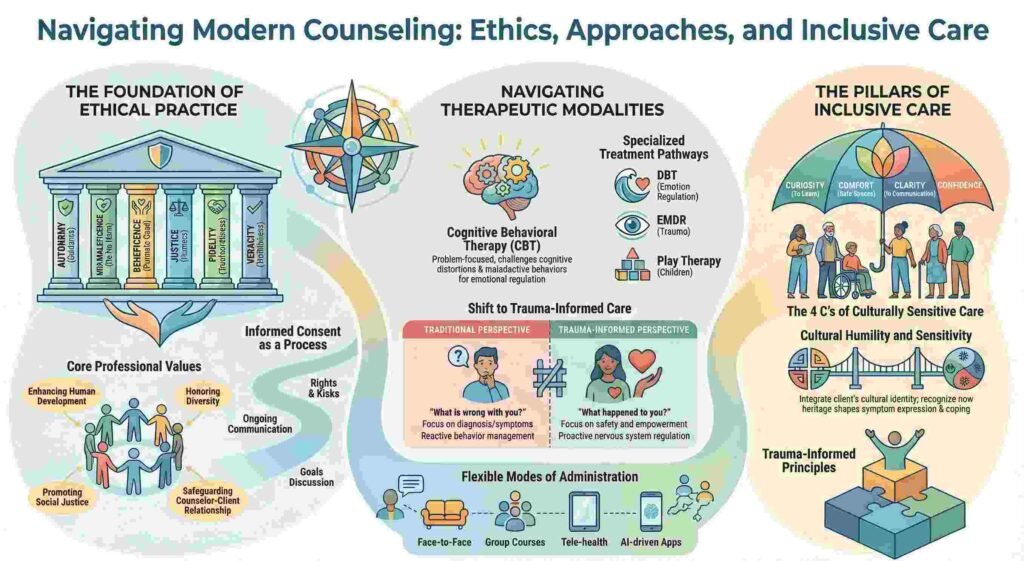
Guided by rigorous ethical frameworks like the American Counseling Association (ACA) Code of Ethics, the field is moving away from “fixing” people and toward honoring the vibrant, complex tapestry of the human experience. Here are five surprising truths about the current state of professional counseling that reveal a new era of wellness.
1. The Erasure of “What’s Wrong With You?”
The most profound shift in modern psychology is the rise of Trauma-Informed Therapy. This philosophy represents a fundamental move away from traditional diagnostic labeling, which often pathologizes a person’s survival instincts as mere “defects.” Instead of asking “What’s wrong with you?” clinicians now ask “What happened to you?”
This isn’t just a semantic change; it is grounded in the neurological basis of trauma. We now understand that traumatic experiences disrupt the autonomic nervous system, locking individuals in a “fight-flight-freeze” response. What might look like “uncooperative behavior” is often a survival strategy stored in the nervous system. To address this, the trauma-informed model relies on four non-negotiable principles: safety, trustworthiness, empowerment, and collaboration. By prioritizing these, therapists ensure the clinical environment doesn’t inadvertently retraumatize the client.
Crucially, this shift recognizes that a person’s history is inextricably linked to their culture. Your “history” is your “culture,” and the way we process what happened to us is dictated by the world we inhabit.
“Rather than asking ‘What’s wrong with you?’ trauma-informed therapy asks ‘What happened to you?’”
2. Why Your Culture Changes the Way You Feel Pain
For too long, the therapist’s office was treated as a vacuum, often ignoring the vibrant cultural context a client brings into the room. Modern therapy has finally abandoned the “one-size-fits-all” Western model for Culturally Sensitive Therapy. This is a clinical necessity, not just a social preference, because culture dictates how we experience—and even physically feel—emotional distress.
In many cultures, depression is not expressed as verbalized sadness. Instead, it manifests as somatic symptoms: physical fatigue, chronic aches, or unexplained pains. Without cultural awareness, a therapist risks dangerous misdiagnoses. For example, “hearing voices” might be interpreted as a symptom of schizophrenia in a Western clinical setting, yet in other cultures, it is understood as a profound spiritual or religious experience. To bridge these gaps, expert therapists now utilize the “4 C’s” framework:
- Curiosity: A genuine desire to learn the nuances of a client’s traditions.
- Comfort: Creating a sanctuary where marginalized identities are celebrated.
- Clarity: Ensuring communication cues—both verbal and non-verbal—are mutually understood.
- Confidence: The clinical assurance to navigate cultural differences with respect.
3. The Strict Five-Year “Cooling Off” Rule
The therapeutic relationship is a sanctuary, not a social circle. Because of the inherent power differential between a counselor and a client, the profession is governed by the ACA Code of Ethics to safeguard the integrity of the bond. Trust is the cornerstone of this work, and the boundaries are surprisingly rigid.
One of the most significant protections involves the total prohibition of sexual or romantic relationships. According to Section A.5 of the Code, counselors are strictly prohibited from romantic interactions with current clients, their partners, or their family members. But the rigor doesn’t end when the sessions do. The Code mandates a five-year “cooling off” period after the final professional contact before any such relationship could even be considered. Even then, the counselor must document in writing whether the relationship could be exploitative or harmful.
These boundaries exist to ensure that the counselor’s primary responsibility remains clear. As stated in Section A.1.a of the ACA Code of Ethics:
“The primary responsibility of counselors is to respect the dignity and promote the welfare of clients.”
4. The “Third Wave” Revolution: When CBT Met Buddhism
Cognitive Behavioral Therapy (CBT) is a household name, but few realize it has survived a “Three-Wave” revolution. The first wave (1920s-1950s) focused purely on behavior—the unlearning of fears. The second wave (1960s-1990s) introduced the “cognitive revolution,” where clinicians like Aaron Beck focused on challenging irrational thoughts.
However, the second wave eventually hit a wall; behaviorism and traditional cognitive techniques sometimes failed to effectively treat complex depression or borderline personality disorder. This “failure” birthed the Third Wave in the 1980s and 90s, which integrated principles of mindfulness and acceptance originating from Buddhism.
Newer modalities like Dialectical Behavior Therapy (DBT) and Acceptance and Commitment Therapy (ACT) introduced a counter-intuitive idea: sometimes, trying to “change” an uncomfortable thought only gives it more power. Instead, clients learn to change their relationship to those thoughts. By accepting a thought without judgment, its emotional intensity often diminishes more effectively than through direct combat.
5. More Than Just Talk: The Rise of High-Tech and High-Touch Tools
Modern therapy is being “democratized” through a blend of high-tech accessibility and specialized “high-touch” modalities that move beyond the office walls.
- Ethical Distance Counseling: Under Section H of the ACA Code, therapy now includes encrypted video, smartphone apps, and AI chatbots. This allows for 24/7 support, but it comes with expert-level hurdles. Counselors must now navigate complex ethics like managing time zone differences, establishing emergency procedures when the clinician isn’t physically present, and maintaining high-level encryption to protect digital privacy.
- Animal-Assisted Therapy (AAT): This is more than just “petting a dog.” AAT is a clinical tool used to reduce stress and trauma. In fact, research suggests that using AAT alongside other supportive therapies can significantly reduce coercive treatment and the need for seclusion in psychiatric hospital settings.
- Creative Arts Therapy: By using dance, music, and poetry, therapists engage the mind’s creative centers to help clients express feelings that are often too complex for spoken language alone.
Conclusion: A New Era of Wellness
Therapy is no longer a static practice of “fixing” what is broken; it is an evolving, dynamic field that prioritizes human dignity, cultural context, and absolute safety. As we integrate technology and ancient mindfulness into rigorous clinical frameworks, we are entering an era where the therapeutic journey is as diverse as the people it serves.
Final Ponderable: If therapy is moving from fixing “what’s wrong” to understanding “what happened,” how might that change the way we view our own mental health journeys?
❓ తరచుగా అడిగే ప్రశ్నలు (FAQs)
ఈ వార్త లేదా కథనంలో ముఖ్యమైన అంశం ఏమిటి?
Beyond the Couch: 5 Surprising Truths About Modern Therapy You Didn't Know గురించిన పూర్తి సమాచారం మరియు తాజా ముఖ్యాంశాలు ఈ కథనంలో సమగ్రంగా వివరించబడ్డాయి.
ఈ తాజా పరిణామం ఎందుకు ప్రాధాన్యత సంతరించుకుంది?
ప్రజా ప్రయోజనాలు, సంబంధిత వర్గాలు మరియు ప్రస్తుత పరిస్థితుల దృష్ట్యా ఈ పరిణామం అత్యంత కీలకమైనదిగా మారింది.
ఈ అంశంపై అధికారిక వివరాలు మరియు తాజా అప్డేట్స్ ఎక్కడ తెలుసుకోవచ్చు?
సంబంధిత అధికారిక వర్గాలు వెల్లడించే తదుపరి సమాచారం మరియు ప్రత్యక్ష అప్డేట్స్ కోసం మా వెబ్సైట్ను నిరంతరం ఫాలో అవ్వండి.