
Indian cricket has long been a pursuit of individual brilliance, but the 2026 Naman Awards in New Delhi felt like a collective flag-planting on the summit of the global game. The annual gala is often a formal ledger of the previous year’s statistics, yet this particular evening was different. It was a moment of national reflection—a rare alignment where the routine of awarding silverware met an unprecedented historical stretch. In a sport defined by cycles, the 2026 ceremony confirmed that India is currently existing in a “Golden Era” where the peak has become the expected vantage point.
The Historic “Five-Star” Sweep
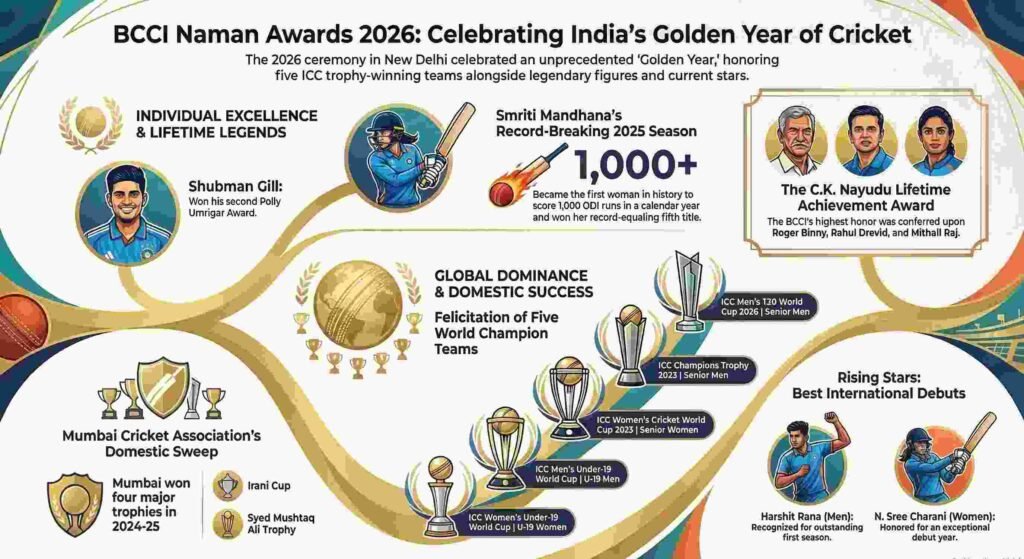
For the first time in the history of the sport, a single room housed five distinct sets of World Champions. This “five-star” sweep is perhaps the most visceral evidence of the depth within India’s developmental system, proving that the machinery of Indian cricket is functioning with terrifying efficiency across every demographic. The ceremony felicitated the champions of:
- The Under-19 Women’s T20 World Cup
- The ICC Champions Trophy 2025
- The Under-19 Men’s World Cup
- The Women’s ODI World Cup 2025
- The ICC Men’s T20 World Cup 2026
The breadth of this dominance was best captured by BCCI Secretary Devajit Saikia, who emphasized the scale of the achievement:
“Five ICC trophies were won by various Indian teams during the course of the last year—all the members of those teams will be honored on the awards night, and it will be a great evening. We are going to invite all the ICC tournament winners, including the recent T20 World Cup champions, as well as coaches.”
The Mandhana Monopoly: A Five-Time Phenomenon
If the team awards showcased the system, Smriti Mandhana’s fifth Polly Umrigar Award for Best International Cricketer (Women) highlighted the individual standard required to lead it. By securing this honor for the 2024-25 season, Mandhana matched Virat Kohli for the most top-tier BCCI awards in history, a testament to her role as the definitive face of the modern game.
Her statistics during the period were nothing short of a manual on batting excellence. Mandhana amassed 1,800 runs across 36 matches, but the true benchmark was her performance in the 50-over format. She became the first woman in ODI history to cross 1,000 runs in a single calendar year, eventually setting the all-time benchmark at 1,362 ODI runs. This was not merely a productive season; it was a total recalibration of what a top-order anchor can achieve in the women’s game.
The Transition of “The Wall”: From Player to Lifetime Legend
The conferring of the Col. C. K. Nayudu Lifetime Achievement Award is traditionally a moment of nostalgia, but in 2026, it felt more like a celebration of ongoing service. The honor was shared by Roger Binny and Rahul Dravid, two figures whose lineages define the grit of Indian cricket. Binny, the 1983 World Cup hero, transitioned from a swing-bowling master to a title-winning U-19 coach and ultimately the 36th BCCI President. Dravid, meanwhile, completed a poetic arc from his 24,000-run playing career to the coaching mastermind behind the 2024 T20 World Cup triumph.
Crucially, the evening also honored Mithali Raj with the Lifetime Achievement Award for Women. Raj’s 23-year career and her all-time record of 7,805 ODI runs provided the foundation upon which the current world-beating women’s side was built. Honoring Raj alongside Binny and Dravid reinforces a culture where legacy is viewed as a continuous thread.
Reflecting on the unique atmosphere of a room filled with three generations of champions, Rahul Dravid remarked:
“It just kind of feels right, right?”
The New Guard: Shubman Gill’s Dual-Format Ascension
Shubman Gill’s second Polly Umrigar Award for Best International Cricketer (Men) served as a fascinating study in the BCCI’s internal hierarchy of values. Despite a lean patch that saw him omitted from the recent T20 World Cup squad, Gill’s dominance in the traditional formats was so overwhelming that his status as the premier cricketer of the year remained unchallenged.
The technical bar was set during the Anderson-Tendulkar Trophy 2025—the high-stakes five-Test series against England. Gill captained with a maturity that belied his age and batted with a clinical precision, finishing as the series’ highest run-scorer with 754 runs. His average of 75.40 and a haul of four centuries in that series alone proved that while T20s may capture the public’s immediate attention, the BCCI still views red-ball mastery as the ultimate barometer of greatness.
The “Naman” Philosophy: More Than Just a Name
To understand the 2026 ceremony is to understand the etymology of the word Naman. Derived from the Hindi for “bowing down” or “paying respect,” the name reflects a conscious decision by the Board in 2017 to merge the awards with the MAK Pataudi Memorial Lecture.
This merger was intended to intellectualize the celebration. It shifted the focus from a cold tally of statistics to a broader salutation of the game’s soul. By combining the lecture—a forum for deep thought and philosophy—with the distribution of trophies, the BCCI has created a unified platform. It is an annual reminder that every contemporary trophy is an act of salutation to the history, legends, and relentless grit that preceded it.
A Final Thought: Can the Peak Become the Plateau?
The 2026 Naman Awards offered plenty of evidence that the pipeline remains fertile. The recognition of “Best International Debut” for Harshit Rana and N. Sree Charani—who announced herself with a staggering 4/12 against England—suggests that the replacement parts for this winning machine are already being forged.
However, as the evening concluded, a more philosophical question lingered in the air of New Delhi. Has Indian cricket reached its absolute peak, becoming a sporting monolith that can no longer be surpassed? Or has this “Golden Year” of five global trophies simply established a new, grueling standard? If this peak is to become the new plateau, the pressure of maintaining it will be the next great test for the nation’s champions. In 2026, the cabinet is full, but the hunger of the next generation suggests the salutation is far from over.
❓ తరచుగా అడిగే ప్రశ్నలు (FAQs)
ఈ వార్త లేదా కథనంలో ముఖ్యమైన అంశం ఏమిటి?
5 Revelations from Indian Cricket’s Night of Champions గురించిన పూర్తి సమాచారం మరియు తాజా ముఖ్యాంశాలు ఈ కథనంలో సమగ్రంగా వివరించబడ్డాయి.
ఈ తాజా పరిణామం ఎందుకు ప్రాధాన్యత సంతరించుకుంది?
ప్రజా ప్రయోజనాలు, సంబంధిత వర్గాలు మరియు ప్రస్తుత పరిస్థితుల దృష్ట్యా ఈ పరిణామం అత్యంత కీలకమైనదిగా మారింది.
ఈ అంశంపై అధికారిక వివరాలు మరియు తాజా అప్డేట్స్ ఎక్కడ తెలుసుకోవచ్చు?
సంబంధిత అధికారిక వర్గాలు వెల్లడించే తదుపరి సమాచారం మరియు ప్రత్యక్ష అప్డేట్స్ కోసం మా వెబ్సైట్ను నిరంతరం ఫాలో అవ్వండి.