
1. Introduction: The Great Re-Evaluation of 2026
The labor market of 2026 is no longer a theater of movement; it has become a harbor of anchors. In the “Great Resignation” of 2022, professionals aggressively used a shortage of workers to their advantage, pushing voluntary turnover to a 3% peak. Today, the landscape is unrecognizable. According to June 2025 JOLTS data, the quits rate has plummeted to 2.1%—its lowest sustained level since 2016. We have transitioned from the era of the “hopper” to the age of “job hugging,” where the priority has shifted from career optimization to basic preservation.
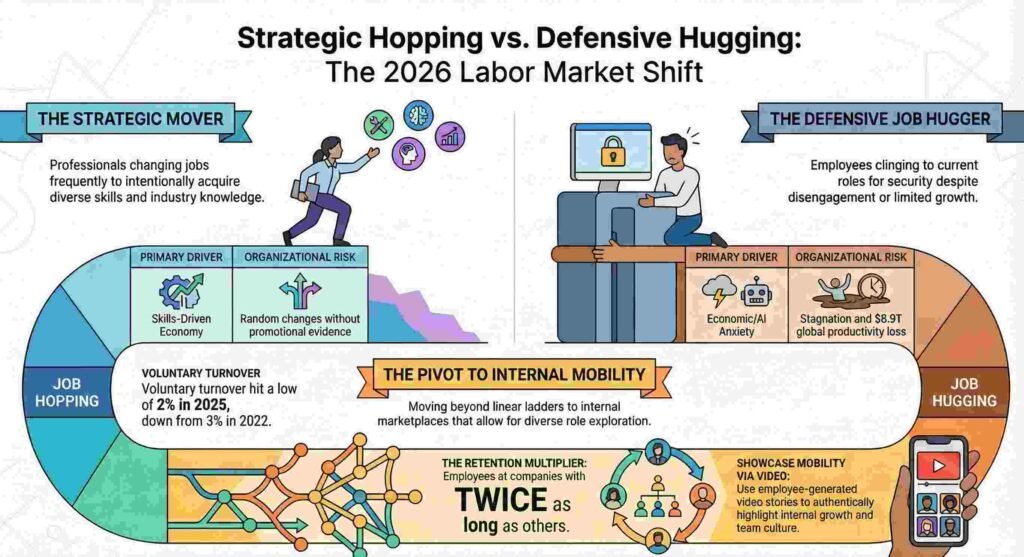
This shift is fueled by a collective, relatable anxiety: the fear that the technological and economic ground is shifting too quickly to risk a leap. While the “one career for life” model remains a relic of the past, the “hop every year” strategy is now equally under siege. Workers are no longer chasing the next horizon; they are clinging to the stability of their current roles, creating a stationary workforce that prizes security over growth. This article explores the forces behind this “Great Anchor” and what it means for the future of professional strategy.
2. Takeaway 1: From “Job Hopping” to “Job Hugging” — Survival Mode is the New Norm
The term “job hugging” defines a labor market dynamic where employees remain in their current roles despite feeling disengaged or seeing limited advancement. Driven by economic volatility and the rapid evolution of artificial intelligence, this behavior is a form of “survival mode.”
Workplace commentators use the metaphor of a rock climber clinging to a steep cliff or a shipwrecked passenger holding onto a lifeboat in a turbulent sea. This instinct has created what analysts call a “talent jam.” Peter Cappelli, a professor at the Wharton School, notes that this behavior stalls movement in the broader job market because fewer vacancies open up for others. When the “hugging” becomes universal, the natural flow of talent stops, leaving both companies and careers in a state of inertia.
“Job hugging describes a recent labor market dynamic in which employees increasingly prioritize job stability. Job-hugging employees choose to hold onto their current jobs instead of pursuing new opportunities or career advancement – regardless of how engaged they feel at the company.” — Culture Amp / Wikipedia
3. Takeaway 2: The Myth of the Millennial “Hopper” Finally Debunked
For a decade, Millennials and Gen Z were stereotyped as inherently disloyal workers. Research from the National Institute on Retirement Security (NIRS) has finally dismantled this narrative. The data shows that younger workers stay in roles at nearly identical rates to Baby Boomers when they were the same age.
The NIRS research highlights:
- Median Tenure (25–34-year-olds): 2.7 years in 2024.
- Historical Comparison: 3.0 years for the same age group in 1983.
- The Retention Catalyst: The study notes that public sector employees have significantly lower quit rates due to widespread access to pensions.
For private-sector leaders, this provides a clear insight: generational attitudes aren’t the problem; the absence of structured, long-term benefits is. Economic conditions and the search for security, rather than age, are the true drivers of turnover.
4. Takeaway 3: The Death of the “Switching Premium”
In previous years, the primary incentive for mobility was the “switching premium”—a significant pay raise that justified the risk of moving. In 2026, that financial bridge has effectively collapsed. Data from the Atlanta Fed shows that the gap between those who stay and those who switch has hit a decade-long low.
- Stayers: Received a median wage increase of 4.6%.
- Switchers: Received a median wage increase of 4.8%.
With a negligible 0.2% gap, the financial reward for changing employers no longer justifies the risk of being “last in, first out” during a restructure. Furthermore, Lightcast data indicates that in career areas like Transportation and Sales, salary growth has actually failed to keep pace with inflation. The financial risk of leaving now frequently outweighs the reward, removing the engine that once drove labor market churn.
5. Takeaway 4: AI Anxiety as a Career Anchor
Artificial intelligence has become a powerful psychological anchor, grounding workers through a sense of existential dread. Anxiety regarding skill obsolescence is no longer a future concern; it is a present-day driver of labor immobility.
Surveys indicate that 71% of workers fear AI will eventually displace their roles. This fear is grounded in findings from Stanford University’s Digital Economy Lab, which noted a 13% relative decline in employment for early-career workers in AI-exposed occupations since 2022. When professionals feel their skills are becoming “dated,” they prioritize the safety of their current position over the “job-hopping premium,” choosing to navigate the technological shift from a place of perceived security.
6. Takeaway 5: Internal Mobility is the New “Career Insurance”
As external hiring slows, forward-thinking organizations are addressing the “talent jam” by prioritizing the “Career Lattice” over the traditional ladder. Companies like Uber, the American Heart Association (AHA), and Ascension Health are transforming their strategies to treat existing staff as their primary talent source.
- Uber: Now fills 30–40% of positions internally. By using employee-generated video to showcase lateral moves, they boosted their SEO traffic by up to 75%.
- Memorial Sloan Kettering (MSK): Developed the “Lab Scholars” program to reskill internal staff, allowing them to attend school full-time while maintaining a full salary to meet technician shortages.
- American Heart Association: Uses a “Talent Exchange Portal” where employees join “gigs” or stretch projects organically, honing skills they wouldn’t use in their daily roles.
“I believe internal mobility is the future of work. We want employees to have an experience-based career, and we want them to do it on their own timeline.” — Director of Talent Mobility and Advancement, Uber
7. Takeaway 6: “Strategic Hopping” vs. “Random Changes”
Despite the trend toward stability, mobility has not vanished—it has become more intentional. Recruiters in 2026 have moved away from raw tenure as a benchmark, focusing instead on “purposeful mobility.”
To justify a move today, candidates must show:
- Increased Job Scope: Evidence of taking on bigger responsibilities or entering more complex environments.
- Competency Progression: A clear increase in the level of skills mastered at each stop.
- Storytelling: The ability to explain why moves were made.
According to PACE Recruit, storytelling has become the single most critical skill for career advancement. Recruiters now view strategic moves as a sign of resilience rather than a risk, provided the professional can articulate a consistent narrative of growth.
8. Conclusion: Moving from “Job Hugging” to “Job Loving”
The rise of “job hugging” presents a hidden crisis for leadership. On paper, retention metrics look “green,” but this fear-based loyalty is a significant liability. Stability born of anxiety is not the same as stability born of commitment. Gallup research estimates that disengaged employees who remain in their roles cost the global economy $8.9 trillion annually in lost productivity.
As we move through 2026, the challenge for organizations is to transform “survival mode” into “growth mode.” True retention is not about keeping heads in seats; it is about energizing the people in them.
Are you staying in your current role because you are truly thriving, or simply because you are afraid of the cliff outside?