
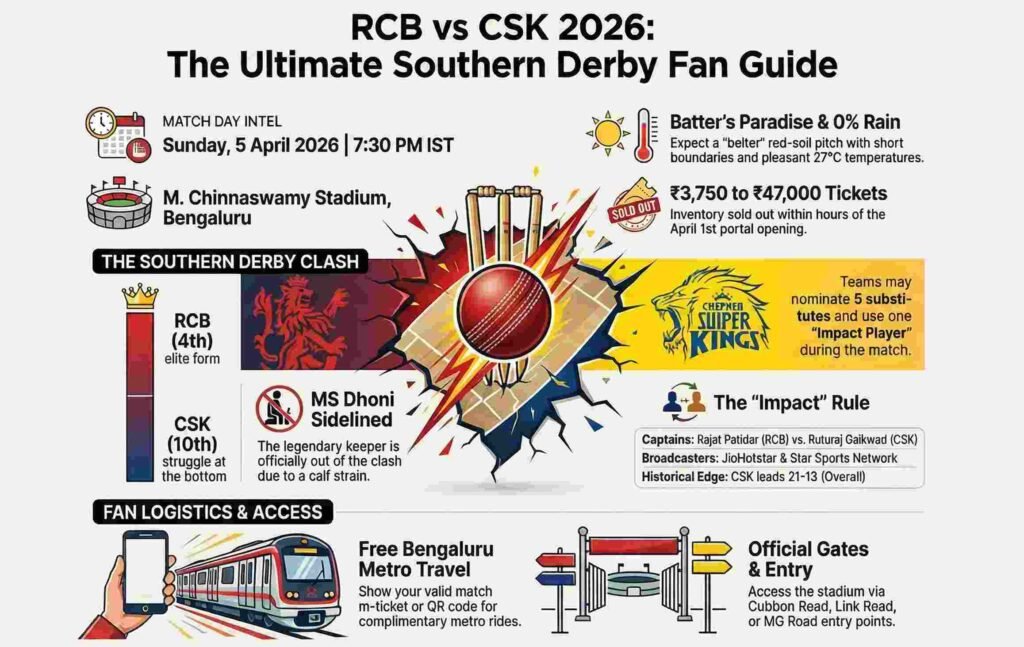
The “Southern Derby” has long been the cardiovascular system of the Indian Premier League, but by April 2026, it has evolved into something far more complex than a regional rivalry. On the afternoon of April 1st, the usual “algorithmic anxiety” took hold of Bengaluru as the RCB official app went live with ticket inventory. Within minutes, a digital queue of hundreds of thousands faced the brutal scarcity economics of the modern IPL. By the time the dust settled, the M. Chinnaswamy Stadium was a mathematical vacuum: zero tickets remained for the April 5th clash.
This is no longer just a game; it is a high-stakes digital fever dream. To understand the 2026 iteration of RCB vs. CSK, we must look beyond the boundary ropes to see how the league is fundamentally re-engineering the relationship between the fan, the city, and the laws of physics.
The ₹47,000 Luxury Gap: Premiumization of the Derby
The commercial bifurcation of the IPL reached a new zenith with this fixture. The pricing spectrum—ranging from ₹3,750 for general stands to a staggering ₹47,000 for premium hospitality—reveals a league that is rapidly tiering its experience.
Synopsis: The highly anticipated RCB vs. CSK 2026 match tickets, which went live on April 1, have officially sold out on the Royal Challengers Bengaluru website and app. With a price range spanning from ₹3,750 to ₹47,000, the inventory was exhausted within hours of the portal opening.
For the general fan, ₹3,750 represents a significant investment, often nearly a week’s wages for many in the local service economy. Meanwhile, the ₹47,000 elite tier highlights the “premiumization” of the Southern Derby—it is now a luxury asset, insulated from the usual ebbs and flows of team performance.
The MS Dhoni Void: A Survival Battle at the Bottom
The Rarity of a Zero-Win “Men in Yellow”
In a startling departure from historical dominance, the 2026 standings present a surreal tableau. As we approach Match 11, the “Men in Yellow” find themselves in the basement, languishing at 10th place with zero wins. Conversely, the Rajat Patidar-led RCB sits comfortably at 4th, having established a psychological stranglehold with a three-match winning streak over their rivals.
The gravitas of this match is heavy with the “MS Dhoni Void.” With the legendary on-field architect sidelined by a calf strain, the silence from the “Yellow Wall” of fans is palpable. The tactical burden now falls entirely on Ruturaj Gaikwad, who must navigate this transition without the calming presence of his predecessor. This isn’t just a game for CSK; it is a survival battle to prove they can remain relevant in the Patidar vs. Gaikwad era—a definitive shift away from the Kohli/Dhoni captaincy legacy that defined the last decade.
The “Metro Perk”: Rebranding the Commuter-Citizen
In perhaps the most successful piece of social engineering in IPL history, the 2026 season has fully integrated the stadium into Bengaluru’s “Smart City” evolution. A match ticket is no longer just an entry pass; it is a functional node in the city’s infrastructure.
By doubling as a QR code for a complimentary metro ride, the IPL is rebranding the fan as a “commuter-citizen.” This integration addresses the logistical nightmare of Bengaluru’s congestion, transforming the M. Chinnaswamy from a isolated island of entertainment into an integrated urban node. This “Metro Perk” is a necessary evolution, proving that for a stadium to thrive in 2026, it must facilitate the flow of the city, not just the flow of the game.
Engineering Fairness: The Dew Protocol and Technical Brief
The Chinnaswamy remains a “belter,” specifically engineered on Pitch No. 7 with red soil and aggressive 60-meter square boundaries. To neutralize the “toss advantage” created by rising humidity and a lightning-fast outfield, the TATA IPL 2026 Playing Conditions (Clause 4.4) have introduced a mandatory ball-change protocol for evening games.
Technical Brief: Mandatory Ball Change Protocol
- Scenario 1: If the umpires are forced to change the ball because it is wet, out of shape, or lost at any point before the 10th over, the fielding captain still retains the absolute right to request a formal ball change after the completion of the 10th over. In this instance, the umpires must mandatorily change the ball to ensure a dry, fair contest for the remainder of the innings.
This is bureaucracy as an equalizer—using specific protocols to ensure that dew does not dictate the winner of the Southern Derby.
The Death of “Smart Running”: New Catch Technicalities
The 2026 Playing Conditions have also signaled the death knell for traditional “smart running” tactics during high-pressure catch scenarios. Under Section 33.1, the tactical rotation of strike has been effectively automated out of the game.
Clause 33.2.2.1 (Fair Catch): The ball is held in the hand or hands of a fielder, even if the hand holding the ball is touching the ground, or is hugged to the body, or lodges in the external protective equipment worn by a fielder, or lodges accidentally in a fielder’s clothing.
Crucially, the 2026 update mandates that upon a catch dismissal, the incoming batter must take strike, regardless of whether the two batters crossed each other before the catch was completed (the only exception being the last ball of an over). This eliminates the decade-old tactic of batters crossing mid-air to keep a set player on strike, shifting the focus from veteran running intelligence to the raw ability of the new batter to handle immediate pressure.
Summary: The Engineered Spectacle
The 2026 RCB vs. CSK clash confirms that the IPL has matured into a high-tech, high-cost, and highly regulated organism. We are watching a game where fairness is engineered through mandatory ball changes, and urban transit is a perk of the premium ticket.
Yet, as the league moves toward this frictionless future, we must ask if something is being lost. Does the Southern Derby feel the same when the icons are in the dugout and the rules are governed by hyper-specific technicalities? As we move toward the ₹47,000 ticket and automated strike rotations, one must wonder: do these technical shifts enhance our connection to the game, or do they slowly distance us from the unpredictable “Spirit of Cricket” that made us fans in the first place?