
The modern marketer is currently navigating a high-stakes paradox: the institutional pressure to scale at velocity is colliding with a fortification of consumer skepticism and “banner blindness.” As data from the Sudha Paulin research suggests, we are witnessing a “Market Failure Perspective” in real-time. When brands overextend the scope of data collection without providing clear value or transparency, they create a conflict that prevents them from accruing any long-term business advantage.
In an era defined by “soaring numbers of data breaches” and explosive data growth, the “Trust Economy” is no longer a buzzword—it is a survival mechanism. The transition from outbound to inbound strategies represents a fundamental shift from “buying the right to interrupt” to “earning the right to interact.” By synthesizing the latest findings in ethics, influence, and ROI, we can identify the five surprising realities reshaping our field.
——————————————————————————–
1. The Micro-Influencer Miracle: Why Smaller is Mightier
The “commercial faces” of celebrities are losing their luster. While celebrity influencers offer massive reach, they often lack the “perceived authenticity” required to convert modern audiences. Research from Nguyen Lan Anh indicates that micro-influencers command an 85% trust level and a 78% engagement rate, dwarfing the 55% trust and 50% engagement levels of their celebrity counterparts.
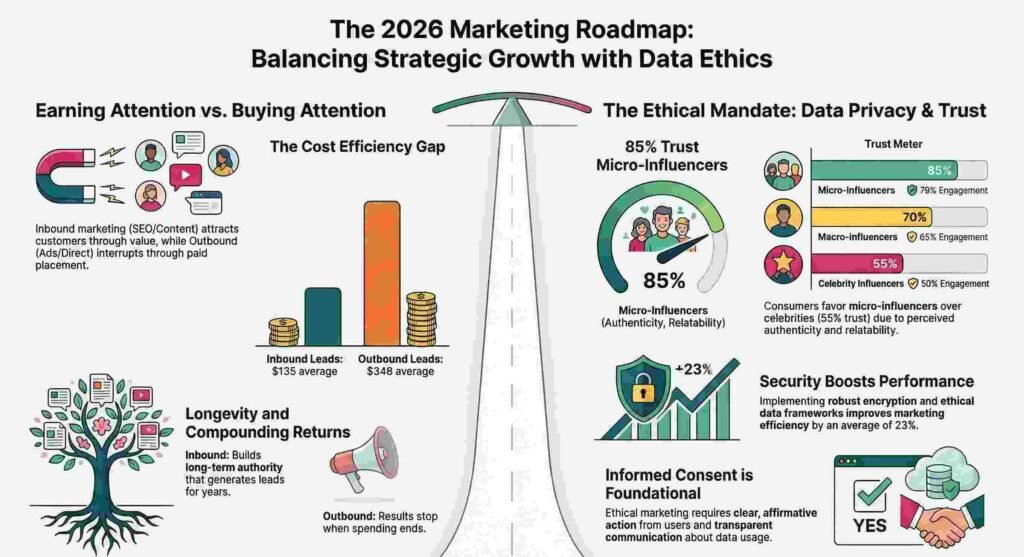
For a digital strategist, the value of the micro-influencer lies in their role as “opinion leaders.” Unlike celebrities, who are often viewed through a purely commercial lens, micro-influencers cultivate “parasocial relationships”—a psychological mechanism where followers perceive the influencer as a trusted peer or friend.
“Studies have highlighted the psychological mechanisms behind influencer marketing, such as parasocial relationships, which lead consumers to perceive influencers as friends and thus trust their recommendations more.” — Nguyen Lan Anh
By prioritizing these niche creators, brands move away from broad-reach endorsements and toward credible, relatable advocacy that resonates within the trust economy.
2. The $211 Gap: The Power of Loop Marketing
The financial divide between “push” and “pull” strategies is stark. According to HubSpot research, Inbound leads cost an average of $135, while Outbound leads cost $346. This $211 gap is a symptom of a deeper structural difference in how marketing value scales.
Outbound marketing relies on “linear scaling”: your results cease immediately the moment your spending stops. Conversely, Inbound marketing functions through “Loop Marketing” or self-reinforcing growth cycles. Content created today for inbound purposes—blogs, SEO assets, and educational videos—compounds in value over time. While outbound is an expense that buys temporary visibility, inbound is an investment in long-term assets that continue to attract, convert, and educate long after the initial production.
3. Transparency is a Conversion Engine, Not a Hurdle
Ethical data collection is often viewed as a regulatory burden, but the data suggests it is actually a lever for performance. Sudha Paulin’s research reveals a significant statistical difference in consumer perception: respondents who provide informed consent report a transparency score of 4.20 (Mean), compared to just 3.50 for those who do not.
The “Market Failure Perspective” warns that businesses fail to gain an advantage when they mask their data practices. To correct this, strategists must move beyond “long, puzzling consent processes” and adopt “plain language” and “clear, affirmative action.”
Sidebar: The 8 Principles of Ethical Marketing To build a resilient brand, strategists should visualize and implement these core principles:
- Honesty and Transparency
- Fairness and Respect
- Maintaining User Privacy
- Accountability for Mistakes
- Sustainability
- Distinguishing Marketing from News/Entertainment
- Endorsement Transparency
- Human Rights Compliance
4. Security is the New Customer Satisfaction
We must stop treating encryption and Two-Factor Authentication (2FA) as purely IT concerns. In a landscape of “soaring data breaches,” proper security measures have a direct, positive impact on “Online Product Confidence.”
Marketers are currently battling “Operational Complexity”—the intersection of evolving global regulations, explosive data growth, and rising customer expectations. While many stakeholders currently “preference convenience over security,” the strategist’s role is to reverse this trend. By using robust security protocols as a marketing differentiator, brands can lower the odds of data theft and fundamentally increase customer satisfaction and long-term success.
5. The 23% Efficiency Boost: Moving Toward Evidence-Based Strategy
Research by Tahir Tayor Bukhari indicates that organizations adopting comprehensive, integrated ROI frameworks experience an average 23% improvement in marketing efficiency. This shift requires moving away from “intuition-based decision making” and “last-click” models in favor of Multi-Touch Attribution and Customer Lifetime Value (CLV) models.
The goal is to view the entire engagement pipeline. According to HubSpot’s 2025 State of Marketing Report, 96% of marketers agree that personalized experiences increase sales. However, the true strategic win is deeper: organizations with sophisticated personalization and integrated data pipelines demonstrate a 31% higher CLV than those using basic approaches. By tracking the complete journey—from real-time behavioral triggers to long-term retention—brands can optimize for value rather than just volume.
——————————————————————————–
Conclusion: Earning the Right to Interact
The evidence is undeniable: the future of digital marketing lies at the intersection of authenticity, strategic personalization, and rigorous data ethics. Adopting an ethical framework is no longer just a “regulatory obligation”—it is a distinct “strategic advantage” that protects the brand from the market failure of consumer distrust.
By shifting our focus from buying the right to interrupt to earning the right to interact, we build a foundation that can withstand the complexities of the modern digital landscape.