
1. Introduction: The Geopolitics of Your Kitchen Stove
On February 28, 2026, the high-stakes military theater of West Asia shifted from a simmer to a boil. As missile strikes echoed across the Persian Gulf, the impact was felt not just in naval command centers, but in the kitchens of 33 crore Indian households. The effective closure of the Strait of Hormuz has turned the mundane act of lighting a gas stove into a geopolitical triumph. In this climate, two state-owned vessels—the Shivalik and the Nanda Devi—have emerged as the most critical assets in the Republic. Owned by the Shipping Corporation of India (SCI), these Very Large Gas Carriers (VLGCs) are the only things standing between a functional domestic life and a national energy blackout.
.
2. Reality 1: The 90% Nerve Center
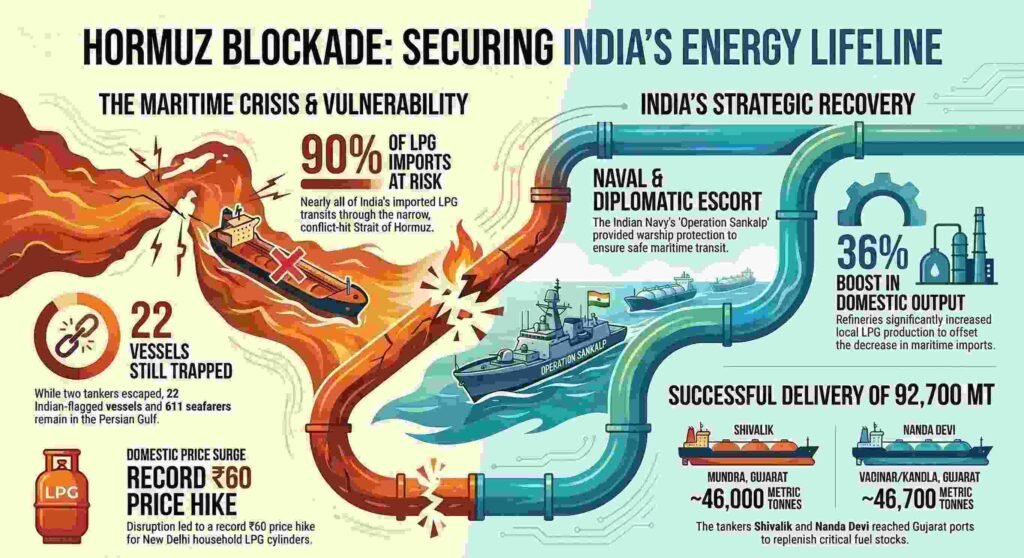
While the global media often fixates on the Strait of Hormuz as a conduit for 20% of the world’s oil, for New Delhi, the waterway is a singular point of failure for Liquefied Petroleum Gas (LPG). The closure is a massive strategic headache because India’s energy dependency is not evenly distributed; it is dangerously concentrated.
The statistics of this vulnerability are stark:
- LPG Imports: A staggering 90% of total imports transit the Strait.
- LNG Imports: Over 50% pass through this narrow waterway.
- Crude Oil Imports: Approximately 40% are dependent on this route.
With LPG imports accounting for roughly 54% of total domestic consumption, the blockade hits the most politically sensitive fuel first. This is why the Prime Minister’s recent dialogue with Tehran was so urgent.
“Prime Minister Narendra Modi spoke with Iran’s President Masoud Pezeshkian… Modi mentioned ‘unhindered transit of goods and energy’ as one of India’s top priorities.”
3. Reality 2: The Conditional Handshake
The “Hormuz Handshake” refers to a counter-intuitive diplomatic opening where Iran granted “case-by-case” safe passage to Indian-flagged tankers while blockading others. External Affairs Minister S. Jaishankar has noted that this is not a blanket alliance but a result of grueling direct dialogue. However, this handshake has a dark side: reports suggest Tehran’s cooperation is transactional, potentially tied to the requested return of three tankers previously seized by India.
Despite the complexities, the logistics are moving. The SCI-owned VLGCs Shivalik and Nanda Devi successfully navigated the chokepoint, cumulatively carrying 92,712 metric tonnes of LPG. The Shivalik delivered its cargo to Mundra, while the Nanda Devi arrived at Vadinar (Jamnagar) to perform a complex Ship-to-Ship (STS) transfer to the vessel MT BW Birch for further distribution.
4. Reality 3: The 36% Surge and the Industrial Toll
To offset the blockade, the government turned the domestic dial to eleven, ramping up refinery LPG production by 36% compared to early March levels. But this increase came with a ruthless prioritization: commercial and industrial users were effectively cut off to protect the “kitchen fuel” of the masses.
The economic weight of this shift is already visible. In Bengaluru, the hotel business reported a 30% decline as kitchens struggled to stay open. The crisis has even reached the consumer’s bill in unexpected ways; Bengaluru’s Theo Cafe recently made headlines for adding a “gas crisis charge” to a simple glass of lemonade. It is a reminder that when the Strait closes, the cost of doing business rises everywhere.
5. Reality 4: The New Etiquette of Consumption
The crisis has forced a radical rewrite of India’s “Control Order.” Under the new rules issued on March 14, the government has moved to end the era of energy hoarding.
The new “Etiquette of Consumption” includes:
- Mandatory Surrender: Consumers with Piped Natural Gas (PNG) connections must surrender their LPG cylinders immediately.
- Revised Intervals: Booking gaps have been extended to 25 days for urban and 45 days for rural consumers.
- The Digital Clampdown: To prevent black-marketing, the Delivery Authentication Code (DAC) coverage was aggressively pushed from 53% to 72%.
Despite these measures, “panic booking” surged from 84% to 90% in mid-March, proving that psychological security is just as hard to manage as physical supply.
6. Reality 5: Operation Sankalp and the Human Stakes
While the Jag Laadki—carrying 81,000 tonnes of UAE Murban crude—and other tankers move under the “quiet” escort of the Indian Navy, the human cost of this conflict is significant. This is not merely a logistical exercise; it is a military necessity. While 611 Indian seafarers are currently safe in the region, the risks are visceral. Data reveals that 78 Indian seafarers were on foreign-flagged ships that came under attack, resulting in three deaths and one missing person.
“All Indian seafarers in the region are reported safe, with no untoward incidents reported in the last 24 hours… The Shipping Ministry and the Directorate General of Shipping are closely monitoring the situation.” — Rajesh Kumar Sinha, Special Secretary, Ministry of Shipping.
7. Conclusion: Beyond the Chokepoint
The current crisis is a brutal stress test of India’s goal to become a top-five maritime nation by 2047. The arrival of the Shivalik and Nanda Devi provides a temporary reprieve, but the “Hormuz Habit” remains a long-term liability.
As we look toward a “Viksit Bharat,” the path to maritime self-reliance must involve an end-to-end ecosystem of building, owning, and repairing our own energy carriers. The ultimate question remains: Will this crisis finally force India to diversify its energy geography—moving toward North America, Europe, and Russia—to ensure our kitchens never again depend on a single, volatile handshake?