The Delhi Drama: 5 Most Impactful Takeaways from the DC vs MI IPL 2026 Showdown

The Mumbai Indians arrived at the Arun Jaitley Stadium riding the high of Match 2, where they finally dismantled their 13-season opening-match jinx. However, Match 8 proved that T20 momentum is notoriously non-linear, especially when subjected to the oppressive “Delhi heat” of the season’s first afternoon kick-off. While Mumbai sought to consolidate their position, a tactically brave Delhi Capitals side exploited the conditions and personnel shifts to provide a stark reality check to the five-time champions..
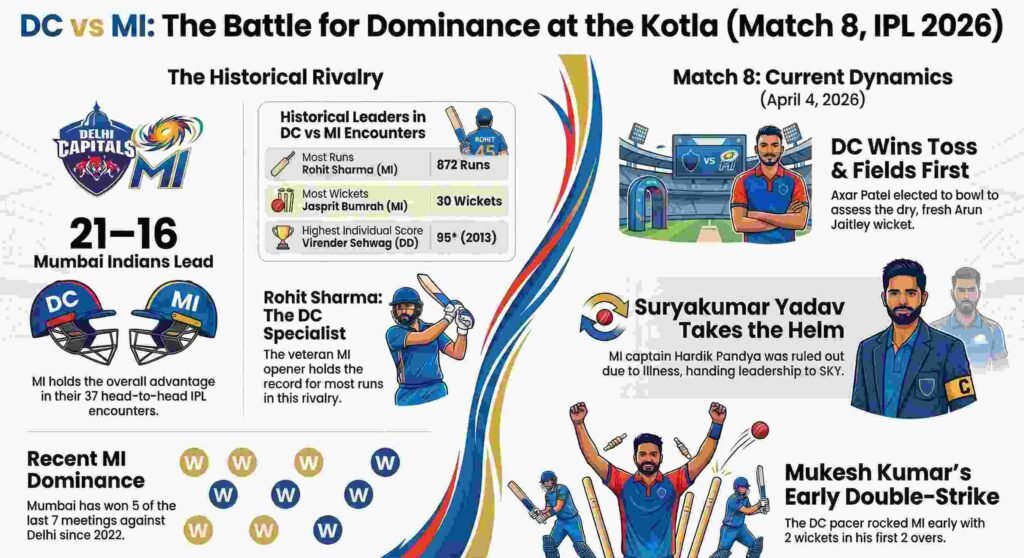
The Delhi Drama: 5 Most Impactful Takeaways from the DC vs MI IPL 2026 Showdown The Mumbai Indians arrived at the Arun Jaitley Stadium riding the high of Match 2, where they finally dismantled their 13-season opening-match jinx. However, Match 8 proved that T20 momentum is notoriously non-linear, especially when subjected to the oppressive "Delhi heat" of the season's first afternoon kick-off. While Mumbai sought to consolidate their position, a tactically brave Delhi Capitals side exploited the conditions and personnel shifts to provide a stark reality check to the five-time champions. 1. The Captaincy Curveball: Structural Shifts in Hardik’s Absence The tactical landscape shifted minutes before the toss when it was confirmed that Hardik Pandya was ruled out due to illness. While not a long-term injury concern, losing a primary seam-bowling all-rounder and middle-order linchpin created a significant structural vacuum. Stand-in captain Suryakumar Yadav (SKY) was forced into an immediate rebalancing act, handing an MI debut to Mitchell Santner to fortify the spin department, while bringing in Deepak Chahar to bolster the powerplay threat and Corbin Bosch to replace Trent Boult. Suryakumar Yadav addressed the leadership transition and team morale at the toss: "Hardik Pandya is unwell, so he is not playing. There is a lot of positivity in the camp after winning the first game in 13 years. We are happy to bat first as the toss is irrelevant. It doesn't matter if we bat or bowl first. We will try to put runs on the board." 2. The 148-Run Hangover: Non-Linearity in Opening Stands In Match 2 against KKR, Rohit Sharma and Ryan Rickelton looked invincible, forging a record-breaking 148-run partnership that suggested a new era of MI dominance. However, the "middle-over squeeze" started early in Delhi. The volatility of the format was laid bare as the same duo was dismantled before the Powerplay could even find its rhythm. For a strategist, this serves as a reminder that "form" is often venue-dependent; the carry of the Wankhede is a world away from the tactical grind required at the Arun Jaitley Stadium. Fixture Opening Partnership Performance MI vs KKR (Match 2) 148 Runs MI vs DC (Match 8) 18 Runs 3. The Mukesh Kumar Masterclass: Technical Precision at 114.7 kph While the pitch report hinted at a "balanced surface" favoring spinners, it was the seam-bowling discipline of Mukesh Kumar that provided the "ideal start" for Delhi. Mukesh exploited the early bounce and carry to produce a decisive double-strike in the third over, essentially breaking the back of the Mumbai top order before the spinners could even be sighted. * Over 2.3: Mukesh Kumar delivers a good length ball on the off-stump line; Ryan Rickelton (9) attempts to go down the ground but only finds the outer half of the bat, resulting in a simple catch for Axar Patel at mid-on. * Over 2.5: Mukesh produces a tactical gem—a knuckle ball clocked at 114.7 kph. Tilak Varma (0) is completely outfoxed by the lack of pace, chipping a leading edge directly back to the bowler for a clinical caught-and-bowled. 4. Youth Over Experience: The Badani Intervention Delhi’s campaign is increasingly defined by a "youth first" philosophy that prioritized Sameer Rizvi and Tristan Stubbs over veteran overseas assets. This strategy was forged in the fires of their opener against LSG; chasing 142, DC had crumbled to a disastrous 26/4. It was then that Head Coach Hemang Badani made a season-defining intervention, promoting Stubbs ahead of David Miller to join Rizvi. Rizvi’s subsequent "blinder" of 70 off 47 balls justified the gamble. The source context emphasizes the weight of this coaching decision: "Their unbeaten stand spared Delhi's blushes. David Miller was supposed to join Rizvi after the fall of the fourth wicket, but then Delhi head coach Hemang Badani intervened and asked Stubbs to go in instead. The rest, as they say, is history." 5. The Venue Paradox: Overcoming the "Home" Jinx Historically, Delhi has been a fortress made of sand for the Capitals, with 29 losses against just 25 wins at the Arun Jaitley Stadium. Strategically, DC has often struggled to read their own tracks, frequently being outplayed by visiting spin units. However, in this encounter, Axar Patel’s side displayed a rare level of "tactical bravery." By electing to bowl first to assess the fresh wicket’s behavior, they utilized the early carry for the pacers and the afternoon heat to wear down a Mumbai side featuring four 2026 T20 World Cup winners (Hardik, SKY, Tilak, and Bumrah). Conclusion: Can the Underdogs Sustain the Heat? Beating the "mighty" Mumbai Indians is more than just a victory; it is a statement of intent for a franchise perpetually in search of its first title. While Mumbai’s depth will likely see them recover, Delhi has proven that tactical discipline and empowering youth can nullify star-studded opposition. The lingering question for the season remains: is Axar Patel’s "happy-go-lucky" leadership the specific ingredient required to navigate the high-pressure death-over volatility of the IPL? Final Takeaway: Delhi’s utilization of early seam carry and Hemang Badani’s tactical promotion of youth over experience has effectively disrupted the established hierarchy of the 2026 season.

1. The Captaincy Curveball: Structural Shifts in Hardik’s Absence

The tactical landscape shifted minutes before the toss when it was confirmed that Hardik Pandya was ruled out due to illness. While not a long-term injury concern, losing a primary seam-bowling all-rounder and middle-order linchpin created a significant structural vacuum. Stand-in captain Suryakumar Yadav (SKY) was forced into an immediate rebalancing act, handing an MI debut to Mitchell Santner to fortify the spin department, while bringing in Deepak Chahar to bolster the powerplay threat and Corbin Bosch to replace Trent Boult.

Suryakumar Yadav addressed the leadership transition and team morale at the toss:

“Hardik Pandya is unwell, so he is not playing. There is a lot of positivity in the camp after winning the first game in 13 years. We are happy to bat first as the toss is irrelevant. It doesn’t matter if we bat or bowl first. We will try to put runs on the board.”

2. The 148-Run Hangover: Non-Linearity in Opening Stands

In Match 2 against KKR, Rohit Sharma and Ryan Rickelton looked invincible, forging a record-breaking 148-run partnership that suggested a new era of MI dominance. However, the “middle-over squeeze” started early in Delhi. The volatility of the format was laid bare as the same duo was dismantled before the Powerplay could even find its rhythm. For a strategist, this serves as a reminder that “form” is often venue-dependent; the carry of the Wankhede is a world away from the tactical grind required at the Arun Jaitley Stadium.

FixtureOpening Partnership Performance
MI vs KKR (Match 2)148 Runs
MI vs DC (Match 8)18 Runs

3. The Mukesh Kumar Masterclass: Technical Precision at 114.7 kph

While the pitch report hinted at a “balanced surface” favoring spinners, it was the seam-bowling discipline of Mukesh Kumar that provided the “ideal start” for Delhi. Mukesh exploited the early bounce and carry to produce a decisive double-strike in the third over, essentially breaking the back of the Mumbai top order before the spinners could even be sighted.

  • Over 2.3: Mukesh Kumar delivers a good length ball on the off-stump line; Ryan Rickelton (9) attempts to go down the ground but only finds the outer half of the bat, resulting in a simple catch for Axar Patel at mid-on.
  • Over 2.5: Mukesh produces a tactical gem—a knuckle ball clocked at 114.7 kph. Tilak Varma (0) is completely outfoxed by the lack of pace, chipping a leading edge directly back to the bowler for a clinical caught-and-bowled.

4. Youth Over Experience: The Badani Intervention

Delhi’s campaign is increasingly defined by a “youth first” philosophy that prioritized Sameer Rizvi and Tristan Stubbs over veteran overseas assets. This strategy was forged in the fires of their opener against LSG; chasing 142, DC had crumbled to a disastrous 26/4. It was then that Head Coach Hemang Badani made a season-defining intervention, promoting Stubbs ahead of David Miller to join Rizvi. Rizvi’s subsequent “blinder” of 70 off 47 balls justified the gamble.

The source context emphasizes the weight of this coaching decision:

“Their unbeaten stand spared Delhi’s blushes. David Miller was supposed to join Rizvi after the fall of the fourth wicket, but then Delhi head coach Hemang Badani intervened and asked Stubbs to go in instead. The rest, as they say, is history.”

5. The Venue Paradox: Overcoming the “Home” Jinx

Historically, Delhi has been a fortress made of sand for the Capitals, with 29 losses against just 25 wins at the Arun Jaitley Stadium. Strategically, DC has often struggled to read their own tracks, frequently being outplayed by visiting spin units. However, in this encounter, Axar Patel’s side displayed a rare level of “tactical bravery.” By electing to bowl first to assess the fresh wicket’s behavior, they utilized the early carry for the pacers and the afternoon heat to wear down a Mumbai side featuring four 2026 T20 World Cup winners (Hardik, SKY, Tilak, and Bumrah).

Conclusion: Can the Underdogs Sustain the Heat?

Beating the “mighty” Mumbai Indians is more than just a victory; it is a statement of intent for a franchise perpetually in search of its first title. While Mumbai’s depth will likely see them recover, Delhi has proven that tactical discipline and empowering youth can nullify star-studded opposition. The lingering question for the season remains: is Axar Patel’s “happy-go-lucky” leadership the specific ingredient required to navigate the high-pressure death-over volatility of the IPL?

Scroll to Top