
- Introduction: A Saturday That Rewrote the Record Books
For the modern cricket enthusiast, the Indian Premier League has reached a stage where the record books are written in pencil, not ink. We are currently facing a relatable, albeit exhausting, dilemma: how do you quantify “greatness” when a “historic performance” is rendered obsolete before the highlights package even hits social media?
Saturday, April 25, 2026, was the day the manual for T20 defending was tossed into the Jaipur dust. It was a day of dual-match chaos that saw over 1,000 runs scored across two venues. In the afternoon, we witnessed the highest successful chase in T20 history as the Punjab Kings (PBKS) hunted down 265 against Delhi Capitals—a match punctuated by KL Rahul’s staggering 152*, the highest individual score by an Indian in the IPL. Yet, by the time the Sunrisers Hyderabad (SRH) and Rajasthan Royals (RR) finished their heavyweight bout in the evening, even Rahul’s masterclass felt like a distant memory. This was the day the “safe total” officially went to the morgue.
- The 15-Year-Old Centurion: Vaibhav Sooryavanshi’s Bittersweet Milestone
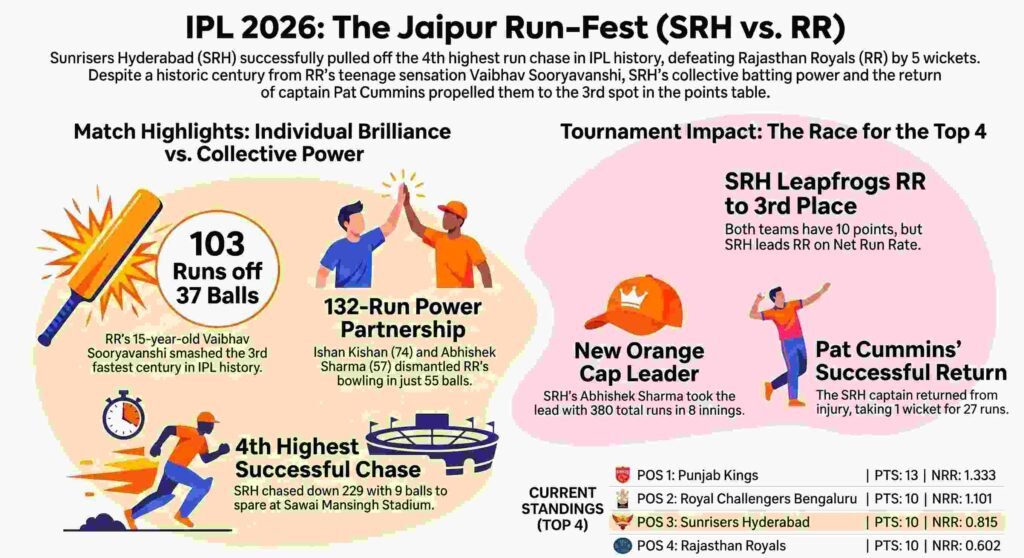
The evening’s primary narrative belonged to a boy who shouldn’t, by any traditional logic, be dominating a man’s league. At just 15, Vaibhav Sooryavanshi produced an innings of startling violence, hammering 103 runs off 37 balls. His century, reached in a blistering 36 deliveries with a six off Sakib Hussain, stands as the third-fastest in IPL history.
Operating at a stratospheric strike rate of 278.37, Sooryavanshi’s knock was a study in instinctive aggression. However, in a match that highlighted the fine margins of modern T20, even a prodigy needs a slice of luck; he was dropped on 32 by Aniket Verma off Eshan Malinga. That lapse cost SRH dearly in the short term, but the “counter-intuitive” reality of the 2026 season is that a 100-run individual contribution no longer secures the points. Despite Sooryavanshi’s 12 sixes and a 112-run stand with Dhruv Jurel, his milestone ended in the heartbreak of defeat.
“If we get the opportunity from the first ball, we should back our game – and that’s exactly what happened.” — Vaibhav Sooryavanshi
- The Death of the “Safe” Total: Chasing 229 Like a Routine Task
In Jaipur, Rajasthan Royals posted 228/6—a stadium record at the Sawai Mansingh. In any other era, the game would have been over at the innings break. Instead, the “Orange Army” treated the chase like a routine Tuesday afternoon drill, overhauling the target with 9 balls to spare.
This performance cemented the day as a watershed moment for batting depth. While the Royals relied heavily on a singular teenage supernova, SRH utilized a collective, relentless assault. It was a shared responsibility: Ishan Kishan’s 74, Abhishek Sharma’s 57, and Nitish Kumar Reddy’s 36. By completing the 4th highest successful run chase in IPL history, SRH proved that in 2026, the only thing more dangerous than a centurion is a lineup where everyone strikes at 200+.
- The Captain’s Conundrum: Pat Cummins and the Power of Abundance
While the fireworks belonged to the youngsters, the tactical story of the night was the return of the $20-crore man, Pat Cummins. Recovered from a back injury, Cummins was the lone island of discipline in a sea of runs, finishing with exceptional figures of 4-0-27-1.
The fascinating “Captain’s Conundrum” here was the role of Ishan Kishan. Having led the side through seven matches and securing four wins in Cummins’ absence, Kishan was relieved of his leadership duties just before this clash. The result? A liberated Kishan played his best innings of the season, a Player of the Match performance of 74 off 31 (SR 238.71). It seems that for SRH, the power of abundance applies to leadership as much as batting. Cummins, ever the diplomat, was quick to recognize the transition.
“Ishan… led them beautifully in his absence.” — Pat Cummins
Reflecting on the absurd scores of the day, Cummins jokingly suggested that with totals this high, bowlers might need to give up and start working on their batting instead.
- When Fielding Fails: The Hidden Cost of Dropped Chances
If the manual for defending has been burned, the manual for fielding has become the most valuable book in the shed. Rajasthan’s defeat wasn’t a failure of skill with the ball, but a collapse of composure in the field.
The impactful takeaways from this match are found in the grass. Abhishek Sharma was handed two lifelines—first by Shimron Hetmyer and then by Ravindra Jadeja. He made the Royals pay a terminal price, anchoring a 132-run partnership with Kishan that effectively broke the chase’s back. Later, Brijesh Sharma dropped Nitish Kumar Reddy on 14 off Jofra Archer, ensuring the momentum never shifted back to the Men in Pink. RR captain Riyan Parag’s post-match assessment was a somber reminder of these lapses.
“You cannot afford to give quality batters second chances and admits they could have been better in the field.” — Riyan Parag
- The Net Run Rate Leapfrog: A New Order in the Top Four
The fallout of April 25 has reshaped the top of the table. While Punjab Kings maintain their “vice grip” at No. 1 following their record-breaking afternoon, the real movement happened at No. 3. SRH and RR are now deadlocked at 10 points each, but the clinical nature of Hyderabad’s chase allowed them to leapfrog the Royals on Net Run Rate.
Updated Top 4 Standings (Post RR vs SRH)
| Rank | Team | Points | NRR |
| 1 | Punjab Kings | 13 | 1.333 |
| 2 | RCB | 10 | 1.101 |
| 3 | SRH | 10 | 0.815 |
| 4 | RR | 10 | 0.602 |
- Conclusion: Is 250 the New Par Score?
The events of this historic double-header signal a permanent shift in the T20 landscape. The Orange Cap race is now a sprint between hyper-aggressive openers, with Abhishek Sharma (380 runs) leading the charge, pursued closely by the 15-year-old Sooryavanshi (357 runs).
When we look back at the 2026 season, April 25 will be remembered as the day the equilibrium was shattered. If a 15-year-old can strike a century at a 278 SR and a target of 265 can be chased down with over an over to spare, we must ask: In an era where 250 feels fragile and the boundary ropes feel closer than ever, has the balance between bat and ball finally been broken forever?
❓ తరచుగా అడిగే ప్రశ్నలు (FAQs)
ఈ వార్త లేదా కథనంలో ముఖ్యమైన అంశం ఏమిటి?
The Day Defense Died: Sooryavanshi’s Century and the 1,000-Run Saturday that Changed the IPL గురించిన పూర్తి సమాచారం మరియు తాజా ముఖ్యాంశాలు ఈ కథనంలో సమగ్రంగా వివరించబడ్డాయి.
ఈ తాజా పరిణామం ఎందుకు ప్రాధాన్యత సంతరించుకుంది?
ప్రజా ప్రయోజనాలు, సంబంధిత వర్గాలు మరియు ప్రస్తుత పరిస్థితుల దృష్ట్యా ఈ పరిణామం అత్యంత కీలకమైనదిగా మారింది.
ఈ అంశంపై అధికారిక వివరాలు మరియు తాజా అప్డేట్స్ ఎక్కడ తెలుసుకోవచ్చు?
సంబంధిత అధికారిక వర్గాలు వెల్లడించే తదుపరి సమాచారం మరియు ప్రత్యక్ష అప్డేట్స్ కోసం మా వెబ్సైట్ను నిరంతరం ఫాలో అవ్వండి.