In the high-stakes arena of Indian “event cinema,” the release of Dhurandhar: The Revenge is not merely a theatrical debut; it is a calculated rebellion against the TikTok-era attention span. Following the seismic ₹1300 crore global haul of its predecessor, Aditya Dhar’s sequel arrives under a microscope of intense industry scrutiny. The following data points delineate a shift in the Indian theatrical model, moving away from volume-based success toward a high-yield, premium-event strategy that challenges the very boundaries of audience endurance.
The Four-Hour Gauntlet: A Masterclass in Yield Optimization
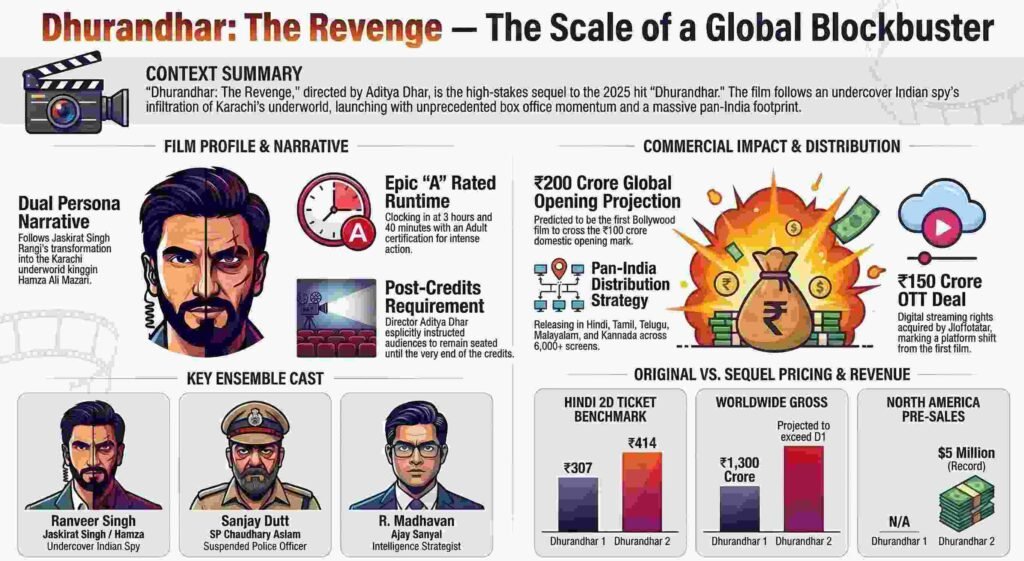
While the modern viewer is conditioned for sub-60-second content, Dhurandhar: The Revenge demands a gargantuan 3 hours and 49 minutes (229.6 minutes) of undivided attention. This is 16 minutes longer than Part 1, but the “Lead Analyst” perspective reveals this isn’t just about indulgent storytelling—it’s about the economics of the “theatrical window.”
By extending the runtime, the production has effectively forced a 40% reduction in daily show counts, dropping inventory from the standard five rotations to just three. To compensate for the loss in show volume, the makers have aggressively leveraged their “event” status to command premium pricing. We are seeing a massive jump in Average Ticket Price (ATP), rising from Part 1’s ₹307 benchmark to a staggering ₹414 for the sequel.
“A sequel can outgross the original without matching its footfalls. That becomes possible the moment the ticket yield rises faster than admissions fall.” — Boxoffy Analysis
This strategy proves that in 2026, distributor share is no longer just a game of counting heads (footfalls), but of optimizing the revenue extracted from every single seat.
The Certification Conflict: The High Stakes of the ‘A’ Rating
The Central Board of Film Certification (CBFC) has officially granted the sequel an ‘A’ rating, despite conflicting earlier reports from The Times of India suggesting a “U/A 16+” classification. This transition is a significant strategic risk. By moving into ‘A’ territory to accommodate visceral visuals—including hammer strikes to the head, beheadings, and eye-smashing—Dhar is potentially alienating the “family” demographic that fueled the first film’s ₹1300 crore success.
However, from a cultural strategy standpoint, this shift is a deliberate move to harden the brand. The protagonist, Jaskirat Singh Rangi, has fully shed his undercover skin to embrace the “darker identity” of Karachi underworld figure Hamza Ali Mazari (known as “Sher-e-Baloch”). This narrative evolution facilitates a gritty, psychological face-off against the mysterious antagonist “Bade Sahab,” signaling that the franchise has matured into a sophisticated geopolitical thriller rather than a standard masala entertainer.
Breaking the Bank: Ancillary Revenue and Pre-Sale Dominance
Dhurandhar: The Revenge is harvesting the “Business of Trust” built by Part 1, setting records before a single review could influence the market. The financial footprint of this release is staggering:
- Global Opening: Trade pundits are locked in on a ₹200 crore gross worldwide opening day prediction.
- The Paid Preview Record: The film’s paid previews alone grossed a record-breaking ₹42.71 crore, shattering the previous mark held by OG.
- BookMyShow Surge: Over 14 lakh tickets were sold in advance on the platform, an all-time high for Bollywood.
- The North American Milestone: The film raked in $5 million in pre-sales in North America, becoming the first Indian film in history to reach this milestone.
- The JioHotstar Consolidation: In a move that signals a power shift in the Reliance ecosystem, the digital rights were sold to JioHotstar for ₹150 crore. This migration from Netflix to a domestic powerhouse platform consolidates ancillary revenue within a vertically integrated media giant.
The ‘Dhar-Verse’: Geopolitics and the Shared Universe
Aditya Dhar is utilizing the “Shared Universe” trope to keep audiences “clueless but curious.” The sequel isn’t just a continuation; it’s an expansion of what insiders are calling the “Dhar-Verse.” Concrete links are already emerging:
- The URI Connection: Yami Gautam appears in a pivotal hospital sequence, heavily rumored to link the narrative back to Dhar’s URI: The Surgical Strike.
- Historical Anchors: The narrative uses the 1999 Kandahar Hijack as a foundational pillar, grounding the fiction in brutal reality.
- Antagonist Depth: Beyond Bade Sahab, the introduction of Danish Pandor as Uzair Baloch and the return of Akshaye Khanna’s Rehman Dakait in flashbacks suggest a complex, interconnected web of operatives and terrorists that rewards long-term viewer investment.
The Director’s Golden Rule: Stay for the Credits
In an emotional note addressed to his “extraordinary Dhurandhar family,” Aditya Dhar has made a specific plea that mimics the engagement strategies of the Marvel Cinematic Universe.
“Don’t leave your seats until the credits have stopped rolling. We’ve put our hearts into this so you can experience every twist exactly the way it’s meant to be felt.” — Aditya Dhar
This post-credits sequence is more than a tease for Dhurandhar 3; it is a tool to protect the film’s “surprises” from the immediate spoiler-cycle of social media, forcing the audience to experience the climax in the communal darkness of a theater.
Conclusion: The Mustaqbil of Indian Cinema
As Dhurandhar: The Revenge hits 6,000 screens with 10,000 shows, it does so with a cleared path. The postponement of Yash’s Toxic due to geopolitical conflicts has given Ranveer Singh a clear release window, allowing the film to dominate the theatrical landscape. The cultural impact is already visible: the film’s 24-hour show cycle has famously pushed the 30-year record of Dilwale Dulhania Le Jayenge to a new time slot at the iconic Maratha Mandir.
Ranveer Singh himself noted that this film defines the “mustaqbil” (future) of Indian cinema. It is a future defined by premium yields, longer runtimes, and interconnected storytelling.
But a vital question remains for the industry: Is a four-hour runtime a necessary evolution for the “epic” storytelling required to bring audiences back to theaters, or is the industry pushing the limits of patience in an age where the 60-second clip is king? Your time—all 229 minutes of it—is the ultimate currency.