The $3.4 Trillion Hammer: Why the Coming “Super” El Niño Could Rewrite History
Overview of the Phenomenon
Scientists and the European Centre for Medium-Range Weather Forecasts (ECMWF) predict that El Niño conditions will begin in June 2026 and strengthen by August.
Definition: An El Niño is the abnormal warming of waters in the Pacific Ocean. It is classified as a “Super El Niño” when sea surface temperatures rise $2.5^{\circ}\text{C}$ above average.
Historical Context: While major events occurred in 1982-83, 1997-98, and 2015-16, this upcoming event is projected to be the strongest in 100 years.
Probability of Intensity
The ECMWF provided the following likelihoods for August 2026:
Moderate El Niño: 98% probability.
Strong El Niño: 80% probability.
Super El Niño: 22% probability.
Global and Local Impacts
The article highlights four major consequences of this climate shift:
Extreme Temperatures: Record-breaking heatwaves are expected globally, leading to scorched summers.
Rainfall Disruptions: Severe weather imbalances will occur, with some regions facing torrential floods while others suffer extreme drought.
Cyclonic Activity: While hurricane intensity may decrease in the Atlantic, storms are expected to become more severe in the Pacific, Hawaii, and West Asia.
Specific Risks for India: The post specifically warns that Central and Northern India are at high risk for drought due to a significant reduction in monsoon rainfall.
Affected Global Regions
In addition to India, the following areas are expected to face severe drought conditions:
Asia: Indonesia and the Philippines.
Americas: Northern Brazil and Central America.
Others: Central Africa, Australia, and the South Pacific.
The Pacific Ocean is the thermal engine of the global climate, but as we approach the 2026/2027 cycle, it is behaving more like a sledgehammer. While the public often views El Niño as a transient season of erratic weather, macroeconomic analysis reveals a far more predatory reality: a systemic shock that leaves deep “macroeconomic scarring” on the global growth trajectory. The projected “Super El Niño” of 2026/2027 is not merely a forecast of humidity and heat; it is a multi-trillion-dollar liability that threatens to destabilize global supply chains and infrastructure.
The following analysis synthesizes the latest climate physics and economic data to reveal why this coming event could be the most disruptive in a century.
The Rise of the “Super” Event (2026–2027)
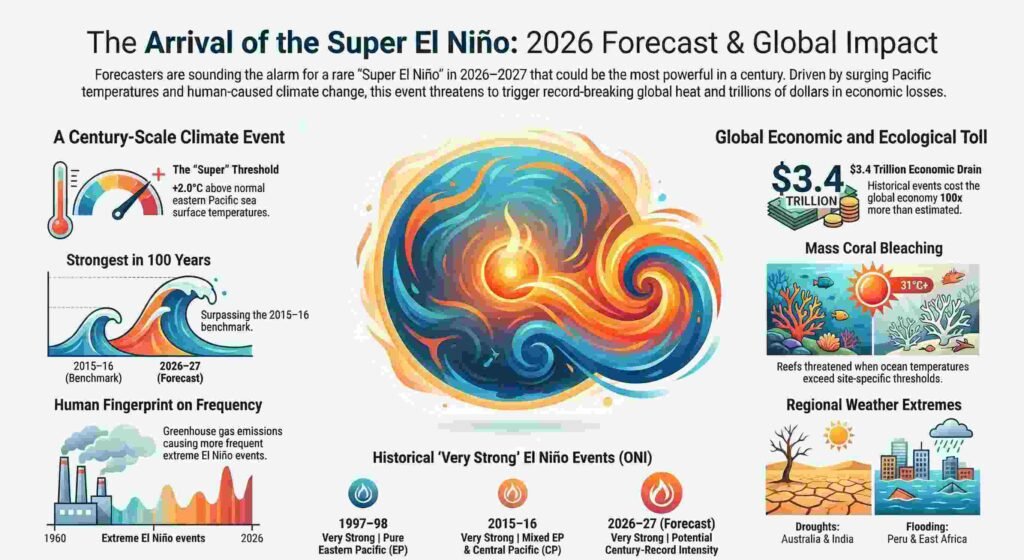
In climatological terms, a “Super El Niño” is defined by a rigorous intensity threshold: sea surface temperatures (SST) in the equatorial Pacific must surge at least 2.0°C above the long-term average. While standard events occur every three to five years, these “Very Strong” variants are rare, high-magnitude anomalies that fundamentally rewrite atmospheric rules.
Current projections suggest the 2026/2027 event may not only match but exceed the 2015/2016 benchmark, potentially becoming the most powerful event in 100 years. This surge is driven by an unprecedented rate of ocean warming that shows no signs of atmospheric equilibrium.
“Ocean temperatures could surge more than 2°C above normal, unleashing a chain reaction in the atmosphere.”
The Hidden Macroeconomic Price Tag: $3.4 Trillion
For decades, economists like Kaimar Mohaddes of the University of Cambridge posited that El Niño could have “growth-enhancing” effects for northern economies, suggesting that milder winters in the U.S. and Europe might provide a net benefit. However, recent research from Dartmouth scientists Christopher Callahan and Justin Mankin has effectively dismantled this theory.
By analyzing global GDP from 1960 to 2019, Callahan and Mankin found that the “scarring”—the persistent growth trajectory suppression that follows an event—is 100 times higher than previously modeled. Their data reveals a staggering $3.4 trillion in global losses directly attributable to El Niño cycles. As climate change increases the thermal intensity of these events, the bill is projected to hit $84 trillion by the end of the century. The “benefits” in specific regions are statistically drowned out by systemic losses in agriculture, water systems, and productivity.
A Tale of Two Physics: Why No Two El Niños Are Alike
A critical error in previous risk modeling was the assumption that all “extreme” El Niños are identical. Science now distinguishes between Eastern Pacific (EP) and Central Pacific (CP) dynamics, a distinction that explains why the 1997/1998 and 2015/2016 events produced vastly different outcomes.
1997/1998 (Pure EP Type): This was a “canonical” event. Warming was concentrated along the South American coast, driven by basin-wide thermocline variations—the transition layer between warm surface water and cold deep water.
2015/2016 (Mixed Type): This event was the strongest mixed-type El Niño on record. It was characterized by “subtropical forcing” associated with the North Pacific Oscillation (NPO) and the Pacific Meridional Mode (PMM).
In 2015/2016, the interaction with the NPO and PMM caused SST anomalies to linger near the International Date Line during the decaying phase rather than retreating to the coast. This “Mixed” physics created a counter-intuitive result: while the 1997/1998 event brought a deluge to the Western U.S., the 2015/2016 event resulted in near-normal rainfall. The lingering central Pacific warmth excited a different wave train, creating an anomalous atmospheric ridge that blocked winter storms from shifting south.
The Coral Reef “Hot Spot” Crisis
The thermal intensity of the 2026/2027 event poses an existential threat to marine ecosystems, specifically the Andaman reefs in the Indian Ocean. To track this, scientists employ the “Hot Spot” method, a precise technical index calculated as:
Hot Spot = Weekly average SST – Monthly Mean Maximum Climatology
If the Hot Spot anomaly remains above 1°C for four consecutive weeks, mass bleaching becomes a statistical certainty. For Indian reefs, the critical threshold is approximately 31°C. Because of an “atmospheric teleconnection”—an atmospheric bridge where the Walker Circulation is altered by Pacific warming—the Indian Ocean experiences a thermal lag of 4 to 6 months.
As the Walker Circulation shifts, it brings enhanced subsidence and clear sky conditions to the Eastern Indian Ocean. The impact on the Andaman reefs is uniquely catastrophic because this El Niño-induced heat arrives exactly during the region’s climatological maxima in its seasonal heating cycle, pushing the ecosystem past its biological breaking point.
The Climate Change Multiplier
Global warming has fundamentally altered the baseline for the El Niño-Southern Oscillation (ENSO). Climate change does not merely sit alongside El Niño; it acts as a force multiplier. Because the planet’s baseline temperature is higher, every new El Niño begins from a position of elevated thermal energy, making each “Super” event more destructive than its predecessor.
The World Meteorological Organization now estimates a 98% chance that at least one year before 2027 will become the warmest on record, eclipsing the 2016 peak. This interaction is the primary driver behind the “off the charts” temperatures and the increasing frequency of mass bleaching events that threaten global food security.
Conclusion: A 2027 Outlook
As we look toward 2027, the global economy faces a period of extreme climatological volatility. The “Super” event is expected to manifest in stark geographic disparities: while Quebec may face anomalously cold conditions, sweltering heat and oppressive humidity are forecasted for much of North America and Europe.
Strategic risks are high: dangerous droughts are projected for Australia, India, and the Caribbean, potentially crippling agricultural output. Conversely, significant flood risks loom for Peru, East Africa, and the Middle East, while heightened cyclone activity is expected to churn across the Pacific. These are not isolated weather events; they are components of a $3.4 trillion systemic shock.
As these “once-in-a-decade” super events become the new standard for the 21st century, the central question for policymakers and investors remains: Is the global economy truly prepared to pay an $84 trillion climate bill?