The arrival of Dhurandhar: The Revenge has done more than just break box office records; it has effectively dismantled the long-standing dogmas of the Bollywood trade. While its 2025 predecessor laid a formidable foundation, the sequel has emerged as a sprawling cultural reset that defies every “safe” rule of commercial filmmaking.
Traditional industry wisdom has long suggested that excessive runtimes and restrictive “Adults Only” certificates are the twin deaths of a mass-market blockbuster. Yet, this espionage epic has flipped the script, proving that an audience’s appetite for uncompromising, long-form storytelling is far greater than the industry had dared to imagine.
We are witnessing the definitive “reset button” for Indian cinema. This is a moment where the “standard” template has been discarded in favor of a visceral, immersive experience that demands—and receives—the audience’s total surrender.
The Runtime Paradox: Why 229 Minutes Didn’t Deter the Masses
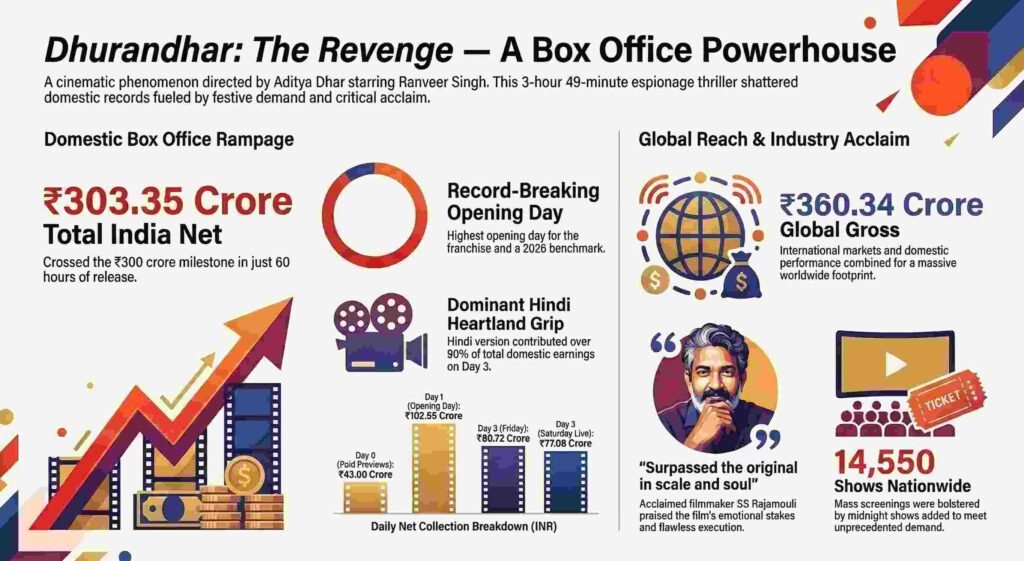
The traditional fear of audience fatigue has been rendered obsolete by a staggering 229-minute runtime that refuses to let go of its viewers. Despite a length of 3 hours and 49 minutes that would usually cripple daily show counts, the film has maintained an “iron grip” on the domestic market.
Major multiplex chains have been forced to innovate, adding midnight screenings to satisfy a seemingly bottomless rush for tickets. This performance suggests that the modern theater-goer no longer values brevity over depth, choosing instead to inhabit a well-constructed world for as long as a director demands.
“It takes guts to make and release a film 4 hours long. The audience is glued to the seat till the last frame. Aditya Dhar, you hit it out of the park.” — SS Rajamouli
The “Adults Only” Blockbuster: When Maturity Meets Mass Appeal
The ‘A’ certificate, once viewed as box office poison for “mass” entertainers, has been transformed here into a coveted badge of cinematic authenticity. Even with 21 CBFC-mandated modifications—including a truncated beheading sequence and muted profanity—the film’s “angrier and louder” texture has acted as a magnet rather than a deterrent.
This maturity is anchored by Ranveer Singh’s dual-role masterclass as both Hamza and Jaskirat Singh Rangi. By leaning into the grit of the Karachi underworld infiltration, the film signals a shift where adult-oriented content is finally being treated with the scale usually reserved for family-friendly fare.
The Arithmetic of a Revolution: Numbers That Defy Logic
The financial trajectory of this sequel is nothing short of a blitzkrieg, beginning with a record-shattering Rs 43 crore in paid previews on March 18. Following a historic Day 1 opening of Rs 102.55 crore, the film achieved the rare feat of crossing the Rs 200 crore net mark within just 48 hours.
By the conclusion of Day 3, the global gross soared to Rs 360.34 crore, comfortably eclipsing the lifetime India collections of previous genre benchmarks like Sikandar, The Raja Saab, and Fighter. The momentum was particularly potent in the South; despite initial technical glitches, the Telugu version (netting Rs 4.18 crore on Day 3) notably outperformed the Tamil market.
This sustained surge was perfectly timed with the festive window of Ugadi and Gudi Padwa. While the film is currently trailing the record set by War, its trajectory suggests it is on a collision course with the all-time highest echelons of Indian cinema.
Scale vs. Soul: Why “The Revenge” Surpassed the Original
Director Aditya Dhar has achieved the rare feat of amplifying spectacle without sacrificing the narrative’s heartbeat, earning comparisons to global titans like Christopher Nolan and Steven Spielberg. While the first film established the world, The Revenge dives into the psychological shadows of Jaskirat’s past to unearth a “soul” that is rare in the spy-thriller genre.
Industry legends have pointed to specific moments of technical and emotional brilliance, such as the widely praised sequence with the sister in the shed. It is this balance of high-octane action and “heart-wrenching” stakes that has led figures like Ram Gopal Varma to label the film a structural reset for the entire industry.
“I loved Dhurandhar-1, but The Revenge surpassed the original in both scale and soul. The writing, casting, technical execution, music, world design and direction are flawless.” — SS Rajamouli
Beyond the Screen: Viral Nostalgia and Off-Screen Drama
The “Dhurandhar mania” has spilled over into the digital ether, fueled by a 12-year-old viral clip of Rakesh Bedi that sparked an unexpected wave of digital nostalgia. This cultural gravitational pull is so strong that even the legendary Maratha Mandir had to shift its 30-year staple, Dilwale Dulhania Le Jayenge, to a new timing to accommodate the sequel.
However, the path to glory was paved with “Bollywood’s biggest off-screen drama,” involving various protests, regional bans, and significant ticket price surges. These hurdles have only seemed to heighten the frenzy, turning the act of seeing the film into a defiant cultural event.
Conclusion: The Future of the Indian Epic
Dhurandhar: The Revenge represents the definitive conclusion to Aditya Dhar’s two-part saga, proving that Indian audiences are hungry for grand-scale, mature narratives. By shattering the barriers of runtime and certification, the film has redefined what it means to be a “blockbuster” in the modern age.
The question now remains for the rest of the industry: will other filmmakers be emboldened to follow this uncompromising path, or will they continue to fear the very elements that made this film a revolution?