
1. Introduction: The Madness Returns to Form
The 2026 NCAA Tournament opened with the collective sound of brackets being fed into paper shredders. If your sheet is currently hemorrhaging red ink, you aren’t alone; you’re just a witness to a fundamental shift in the collegiate hierarchy. Thursday’s opening round proved that in an era defined by the transfer portal and the immediate impact of elite freshmen, seed numbers have devolved into a mere formality.
The gap between the blue bloods and the mid-major upstarts has never been thinner, largely because talent is no longer concentrated in the traditional Top 10. Consider the “lateral” movement in the portal: Robert Wright III’s jump from Baylor to BYU isn’t a step down; it’s a strategic repositioning that brings All-Big 12 talent to a program previously viewed as a second-tier destination. This dispersion of elite skill has turned the First Round into a gauntlet where historical prestige is frequently outmatched by veteran savvy and “one-and-done” brilliance.
2. The Seven-Foot Solution: Matas Vokietaitis and the “Paint Feast”
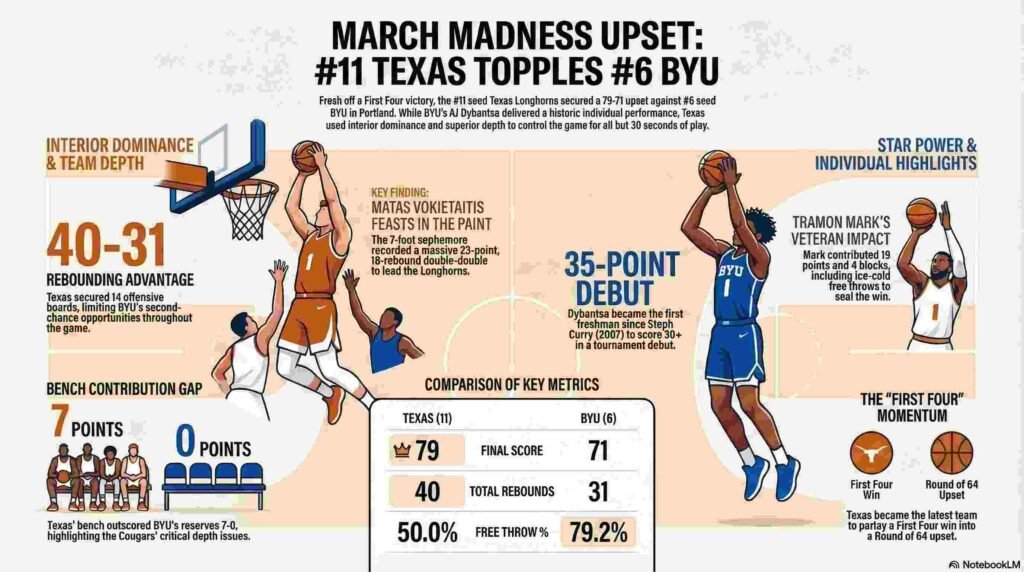
While the pre-game chatter centered on perimeter play, the (11) Texas upset of (6) BYU was a brutal reminder that size still matters in March. Texas center Matas Vokietaitis provided a masterclass in exploiting a strategic mismatch, using his seven-foot frame to bully a BYU frontcourt that lacked the length to contest him. Vokietaitis was a force of nature, recording a double-double (15 points, 11 rebounds) by halftime and finishing with a monstrous 23 points and 16 rebounds.
The Longhorns utilized this interior dominance to secure a +9 rebounding margin (40-31), effectively choking BYU’s transition game. Texas head coach Sean Miller acknowledged the difficulty of containing the Cougars’ perimeter talent, but he knew where the game would actually be won.
“I don’t think we can [stop him],” Miller joked mid-game regarding BYU’s star forward AJ Dybantsa.
Miller’s self-deprecation was a calculated deflection. While Texas couldn’t stop Dybantsa on the wing, BYU had no answer for the Lithuania native in the trenches. However, despite the “paint feast,” a significant red flag emerged for the Longhorns: Vokietaitis struggled mightily at the charity stripe, shooting a dismal 3-of-11. This inefficiency allowed BYU to hang around, trimming a 17-point lead down to just four in the closing minutes. If Texas wants to survive the Round of 32, their big man cannot afford to leave eight points on the floor.
3. The Dybantsa Paradox: A Historic Debut in a Season-Ending Loss
It is a rare March phenomenon when the most compelling story of a game is found in the losing locker room. AJ Dybantsa’s tournament debut was a masterpiece of individual brilliance that ultimately highlighted BYU’s fatal flaw: a lack of depth. The projected No. 1 overall NBA Draft pick exploded for 35 points, becoming the first freshman to drop 30+ in an NCAA Tournament debut since Stephen Curry did so for Davidson against Maryland in 2007.
The “Dybantsa Paradox” is that he was nearly perfect, yet his team was fundamentally flawed. He shot 11-of-25 from the floor and an impeccable 12-of-12 from the free-throw line. Alongside Robert Wright III, Dybantsa formed the highest-scoring duo in BYU history since the legendary Jimmer Fredette and Jackson Emery era. But a masterpiece requires a canvas, and BYU’s bench offered nothing, being outscored 7-0 by the Texas reserves. Dybantsa’s 15-point personal run nearly saved the Cougars, but even a generational talent can’t overcome a 17-point deficit when he’s the only one providing the gravity.
4. The 19-Point Resurrection: VCU’s Record-Shattering Comeback
In a tournament defined by chaos, (11) VCU’s 82-78 overtime victory over (6) North Carolina stands as the definitive institutional collapse. The Rams pulled off the largest comeback in Round of 64 history, trailing by as many as 19 points in the second half.
The tragedy for the Tar Heels is that they stopped doing exactly what had built the lead. UNC’s Henri Veesaar had been dominating the interior with 17 points and seven rebounds, fueling a first half where UNC held a 10-0 edge in points off turnovers. Then, the execution vanished. UNC shot a frigid 8-of-15 from the free-throw line across the second half and overtime. The meltdown peaked when the Tar Heels failed to inbound the ball with 28.6 seconds left, leading to a five-second call because they inexplicably didn’t use their final timeout. VCU’s Terrence Hill Jr. capitalized on the panic, finishing with a career-high 34 points and driving the stake through a UNC team that had simply forgotten how to win.
5. From “Logo 3s” to the First Deuce: High Point’s Folk Hero
Every March needs a folk hero, and Chase Johnston fits the bill perfectly. The (12) High Point seventh-year senior—a specialist wearing jersey #99—became a household name by leading his team to an 83-82 stunner over (5) Wisconsin.
The visual was peak Ringer aesthetic: a player in the highest possible jersey number pulling up for “logo 3s” to erase an eight-point deficit. Yet, the beauty of Johnston’s performance was the irony of the finish. Known exclusively as a long-range assassin, Johnston won the game on a breakaway layup—his first two-point basket of the entire season. It was a poetic encapsulation of the “anyone can be a hero” ethos; the man who lived by the triple finally survived by the deuce.
6. The Great Nebraska Thaw: Unlocking More Than Just Fridges
For (4) Nebraska, the 76-47 demolition of (13) Troy wasn’t just a win; it was an exorcism. Until Thursday, Nebraska held the dubious distinction of being the only power conference program never to have won an NCAA Tournament game, carrying a haunting 0-8 all-time record.
The weight of that history was measurable in Lincoln and Omaha, specifically in the form of “Bud Light fridges” installed in local bars, programmed to remain locked until the Huskers finally tasted tournament success. When the final buzzer sounded on the 29-point blowout, the literal and metaphorical “thaw” began. The click of those fridge doors opening signaled a program finally stepping out from the shadow of its own history and into the modern era of competitive relevance.
7. The “Cakewalk” Warning: Duke’s Near-Disaster
The #1 overall seed Duke Blue Devils survived a 71-65 scare against (16) Siena, but the box score hides a psychological red flag. Duke trailed by 11 at the half, appearing disinterested and lethargic against the MAAC champions.
“We thought it was going to be a cakewalk going into this game,” Duke forward Maliq Brown admitted to CBS Sports’ Tracy Wolfson at halftime.
That admission should terrify the Cameron Crazies. Duke nearly became the third #1 seed to fall to a #16 because they treated a tournament game like a walkthrough. The game was only salvaged when the Boozer brothers—specifically Cam Boozer—flipped the physical switch. Duke’s second-half surge was fueled by a dominant 12-0 advantage in second-chance points, a stat that proves they only won once they decided to actually work. If that “cakewalk” mentality returns in the Round of 32 against TCU, the Blue Devils’ stay in the bracket will be a short one.
8. Conclusion: The New Hierarchy of March
The opening round of 2026 has officially buried the era of the “safe” high seed. We are witnessing a new hierarchy where strategic transfer portal acquisitions like Robert Wright III and generational freshmen like AJ Dybantsa have effectively leveled the playing field.
Are we seeing the end of the “traditional powerhouse” era? When a #11 seed can out-resource a #6, and a #12 can stun a Big Ten mainstay, the answer leans toward yes. The double-digit seed is no longer a Cinderella story; they are a calculated, high-talent threat. As we move into the weekend, the primary takeaway is simple: resilience and individual star power are currently outperforming historical prestige. The bracket isn’t just busted—it’s being rebuilt for a new age.