
For the 10.68 lakh students registered under the Rajasthan Board of Secondary Education (RBSE), the arrival of the Class 10 results remains the state’s most significant “relatable curiosity.” Historically, this season was defined by a high-stakes “exam fever,” where success was measured in narrow decimal points and families hovered over local newsstands. However, the 2026 results represent something far more profound: a data-driven transition from a pressure-cooker environment to a modernized academic framework.
This year’s evaluation was an administrative feat of immense scale. To ensure accuracy and speed, Secretary Gajendra Singh Rathore oversaw a massive operation involving 30,915 teachers working across 33 central evaluation centers. This physical reality—thousands of educators meticulously grading papers in record time—underscores the board’s shift away from the logistical bottlenecks of the past.
We are witnessing a board that is finally prioritizing student well-being and long-term academic health. By moving toward sophisticated grading scales and aggressive evaluation timelines, Rajasthan is signaling its intent to kill the “all-or-nothing” culture. As we analyze this year’s outcomes, it is clear that the traditional high-stakes model is being replaced by a more transparent, flexible meritocracy.
The “E2” Floor and the Nine-Point Safety Net
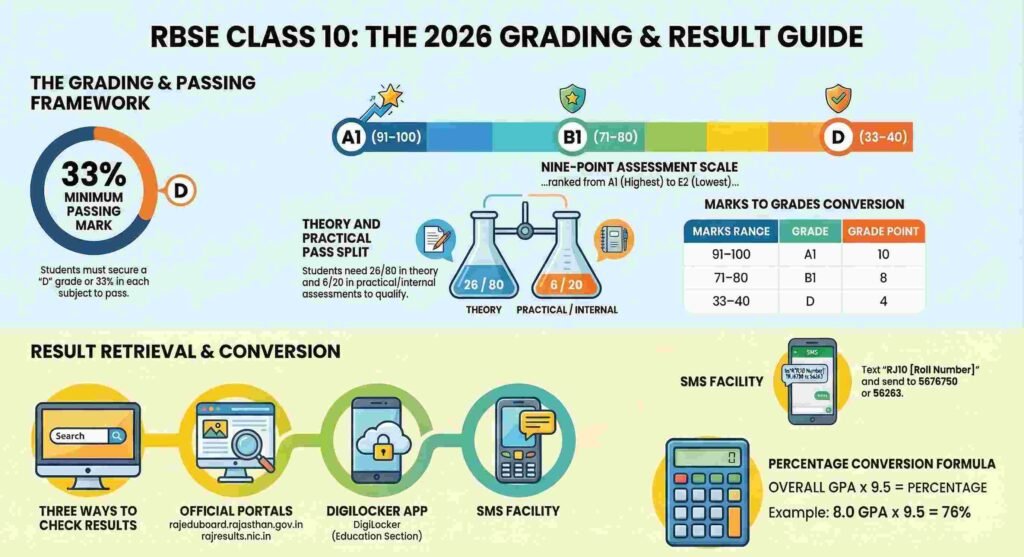
The 2026 results are governed by a refined nine-point grading system ranging from A1 (91-100 marks) to E2 (0-20 marks). This hierarchy is designed to provide a more accurate reflection of a student’s performance range. Under this system, ‘D’ (33-40 marks) serves as the critical minimum pass grade. However, for parents and students, there is a vital “theory floor” to keep in mind: while 33% is the total qualifying mark, students must hit a minimum of 26 out of 80 on the theory paper specifically to pass.
This shift toward “Grade Points” is a deliberate attempt to mitigate the psychological burden on adolescents. By grouping students into broader bands, the board recognizes that the difference between an 81 and an 85 is often statistically insignificant in terms of actual knowledge, yet historically caused immense stress.
“The RBSE grade system 2026 implements a stress-reducing methodology that lessens the competition among students. The small dissimilarities between marks result in excessive student tension… The grading approach enables students to develop conceptual knowledge instead of memorizing or rote learning.”
This methodology prioritizes “conceptual knowledge” over the rote learning model. By focusing on overall performance across theory, practicals, and internal assessments, the board encourages a holistic view of intelligence rather than rewarding the memorization of textbooks.
The “Magic” 9.5 Formula for Success
To maintain a bridge between the new grading system and traditional metrics required for higher education, the RBSE employs a standardized mathematical conversion. The transition from Grade Point Average (GPA) to a percentage is achieved through a specific formula: Percentage = GPA X 9.5.
The GPA is derived by averaging the grade points across the core subject list: English, Hindi, Mathematics, Science, and Social Science. For example, a student who achieves 8 Grade points in English, 8 in Hindi, 9 in Mathematics, 6 in Science, and 9 in Social Science would have a total of 40 grade points. Dividing this by the five subjects results in a GPA of 8. Using the 9.5 multiplier, their equivalent percentage stands at 76%. This standardized multiplier is crucial for transparency, ensuring Rajasthan’s students remain competitive when applying to national institutions that still utilize percentage-based cut-offs.
The Great Acceleration—Why March is the New May
One of the most striking features of the 2026 cycle is the unprecedented speed of result delivery. In 2025, students waited until late May to receive their scorecards. In a dramatic shift, the 2026 results arrived on March 24. This acceleration, spearheaded by Secretary Gajendra Singh Rathore, involved the streamlined evaluation of 175 different subjects.
This is not merely an administrative triumph; it is a strategic “dry run” for a massive 2027 directive. Starting next year, Rajasthan will transition to holding board exams twice a year, tentatively scheduled for February and May. By proving the board can evaluate over a million students and release results by March, the RBSE has validated the feasibility of the upcoming biannual model, which aims to distribute the academic load and reduce the “one-shot” anxiety that has plagued Indian education for decades.
The Gender Performance Gap Persists
The momentum of education in Rajasthan continues to be driven by its female students. While the state expands access, the performance data reveals a consistent edge for girls that suggests a deep-rooted academic discipline.
Looking at the established trends from the 2025 statistics, girls achieved a pass rate of 94.08%, notably ahead of the 93.16% recorded by boys. This gap of nearly 1% is more than a statistic; it reflects a powerful social shift. Despite the various hurdles girls may face in different parts of the state, they are setting the benchmark for success in the Class 10 examinations, maintaining an educational momentum that outpaces their male counterparts.
The End of the Physical Wait—DigiLocker and SMS Dominance
The era of crowding around school notice boards has effectively ended. The RBSE has embraced a “digital-first” delivery model, providing three primary avenues for students to access their results instantly:
- Official Portals: Primary access remains through
rajresults.nic.inandrajeduboard.rajasthan.gov.in. - DigiLocker: Students can download a digitally valid, government-verified marksheet by searching for “Board of Secondary Education, Rajasthan” within the app.
- SMS Service: For those in areas with limited internet, the board provides an offline facility. By texting “RJ10 [Roll Number]” (ensure there is a space after RJ10) to 5676750 or 56263, students receive their marks directly.
It is important for parents to note that the online result is “provisional.” While it is valid for immediate planning and stream selection in Class 11, schools will provide the original hard copy for final records and official verification at a later date.
A Glimpse into 2027 and Beyond
The 2026 RBSE 10th Result is a snapshot of a system in flux. By integrating technology, hitting the “theory floor” requirements, and accelerating evaluation via 33 central centers, Rajasthan is positioning its students for a more flexible future. The groundwork laid this year—specifically the March 24 release—is the foundation for the 2027 model of biannual testing in February and May.