
The air inside the 132,000-capacity Narendra Modi Stadium in Ahmedabad on March 8, 2026, carried a specific kind of technical volatility. It was the culmination of a month-long experiment—a 20-team expansion that many feared would dilute the elite product, but which instead triggered a seismic redistribution of cricket’s global hierarchy. As the host nation secured its destiny under the floodlights, the 2026 ICC Men’s T20 World Cup transcended sport to become a masterclass in soft power, economic strategy, and the high-stakes theater of global politics.
From the technical precision of India’s clinical dominance to the “Associate Revolution” that shattered long-standing statistical ceilings, here are the five strategic takeaways that have redefined the landscape of world cricket.
1. The Clinical Hegemony: India’s Triple Crown and the Host Curse
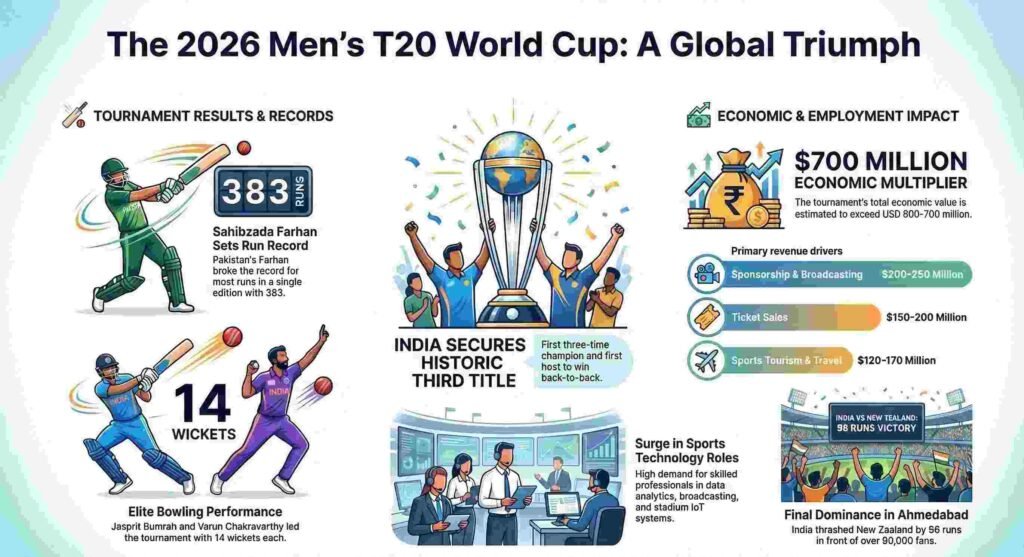
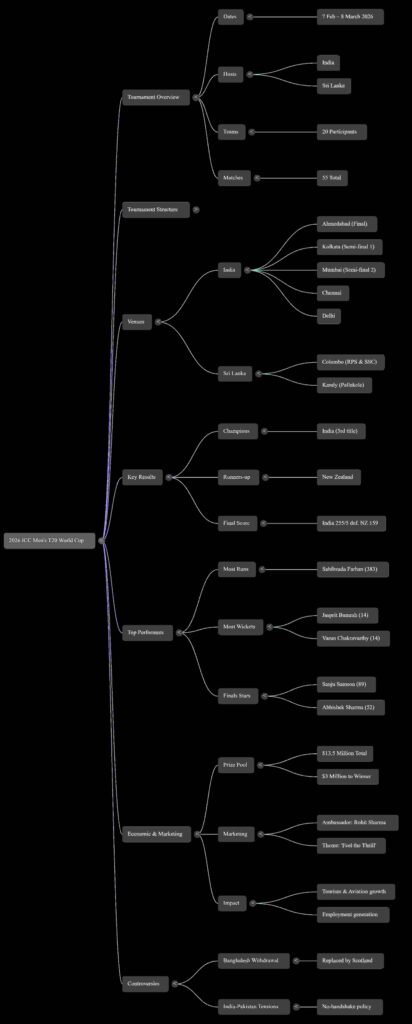
For two decades, the “Host Curse” was a persistent ghost in the T20 World Cup machine. India did more than just exorcise it; they dismantled the narrative with a 96-run demolition of New Zealand in the final. This clinical victory secured a “Triple Crown” of historic milestones that cements India’s commercial and competitive hegemony:
- The Trophied Dynasty: India is now the first nation to possess three T20 World Cup titles (2007, 2024, 2026).
- The Successful Defense: They stand as the first team to win back-to-back championships, validating their high-risk, high-reward tactical framework.
- The Home Soil Breakthrough: They are the first host nation to lift the trophy in front of a home crowd.
While a Super 8 loss to South Africa snapped a record-breaking 12-match winning streak, the Indian side’s ability to recalibrate for the knockout stages demonstrated a rare psychological resilience. Captain Suryakumar Yadav’s post-match reflections summarized this shift from individual brilliance to a systemic “brand” of performance.
“This win is for India,” Yadav remarked. “The message was to play the same brand of cricket and not change the approach because of the occasion.”
2. The Associate Uprising: Italy’s Milestone and Canada’s “Proof of Concept”
The 20-team expansion was often critiqued as a commercial gamble, but 2026 provided the “proof of concept” the ICC desperately needed. The most significant cultural tremor came from Italy, making their tournament debut and securing a stunning 10-wicket victory over Nepal. Crucially, this represented Italy’s first-ever World Cup match victory across any format—a watershed moment for European cricket.
Equally transformative was the emergence of Canada’s Yuvraj Samra. At just 19 years old, Samra’s 110-run blitz against New Zealand—supported by a 116-run partnership with Dilpreet Bajwa—saw him become the first Associate player and the youngest player in history to score a T20 World Cup century. This wasn’t just a statistical anomaly; it was a strategic indicator that the gap between the “Big Three” and the Associate nations is narrowing as emerging markets professionalize their talent pipelines.
3. Statistical Volatility: Sahibzada Farhan and the Hyper-Aggressive Era
The 2026 tournament signaled the end of the “anchored” innings. We have entered an era of hyper-aggression where long-standing records are no longer safe. Pakistan’s Sahibzada Farhan delivered a statistical masterclass, amassing 383 runs to surpass Virat Kohli’s 2014 record for the most runs in a single edition. Farhan’s efficiency was unprecedented, becoming the first player to record two centuries in a single tournament, punishing Namibia and Sri Lanka with clinical intent.
This trend toward technical volatility reached its zenith in Semi-Final 1. New Zealand’s Finn Allen dismantled the South African attack with a 33-ball century—the fastest in the history of the tournament. This shift toward high-velocity batting suggests that technical defensive play is being deprioritized in favor of maximum aerial frequency, fundamentally altering how teams must structure their bowling rosters.
4. The Geopolitical Frost: The “No-Handshake” World Cup
Elite sports rarely exist in a vacuum, and the 2026 tournament was shadowed by a deep geopolitical frost. The tournament’s integrity was tested early by the withdrawal of Bangladesh, who cited security concerns regarding matches in India. Their replacement by Scotland was a logistical pivot, but the real tension was felt in the diplomatic tightrope of India–Pakistan relations.
The “no-handshake” policy, a carry-over from the 2025 Asia Cup and the 2025 India–Pakistan conflict, was strictly observed during the marquee clash in Colombo. Indian captain Suryakumar Yadav and Pakistani captain Salman Ali Agha did not engage in the traditional handshake at the toss or after the match—a significant breach of standard ICC protocol that reflected the grim realities of South Asian politics. For the Cultural Commentator, it served as a stark reminder that even in a “unified” ICC event, the pitch is often a secondary theater for government-level drama.
5. The $700 Million Economic Multiplier
Beyond the boundaries, the 2026 tournament functioned as a sophisticated strategic instrument of economic development for South Asia. The event acted as a massive economic multiplier, generating a projected total value of 600–700 million. The impact was felt across a sophisticated cross-section of industries:
- Aviation: Projected revenues of 200–250 million for regional airlines due to unprecedented surges in passenger traffic.
- Fiscal Contributions: Direct tax revenues of 60–90 million flowing into the coffers of India and Sri Lanka.
- The Knowledge Economy: The tournament directly employed 80–120 sports technology professionals. Perhaps more importantly, it validated the rise of interdisciplinary professional tracks like the B.Tech in Sports Technology and MBA in Sports Management, proving that the “business of cricket” is now a primary driver of high-skilled employment.
Conclusion: The Legacy of 2026
The legacy of the 2026 T20 World Cup will not be found in the scorecards alone. It will be found in the $700 million capital influx and the realization that Associate nations are no longer merely “participating”—they are competing. India’s “Triple Crown” confirms their status as the sport’s commercial and competitive sun, but the exploits of Italy and Canada suggest that the rest of the world is finally learning to harness the same heat.
As we look toward 2028, the central question remains: Is the traditional hierarchy finally collapsing under the weight of this $700 million global expansion, or was 2026 a beautifully orchestrated anomaly? Given the technical shifts in batting and the professionalization of the Associate tier, the era of “Big Three” total immunity may finally be coming to an end.