
I. Introduction: The Night Hollywood Rewrote the Script
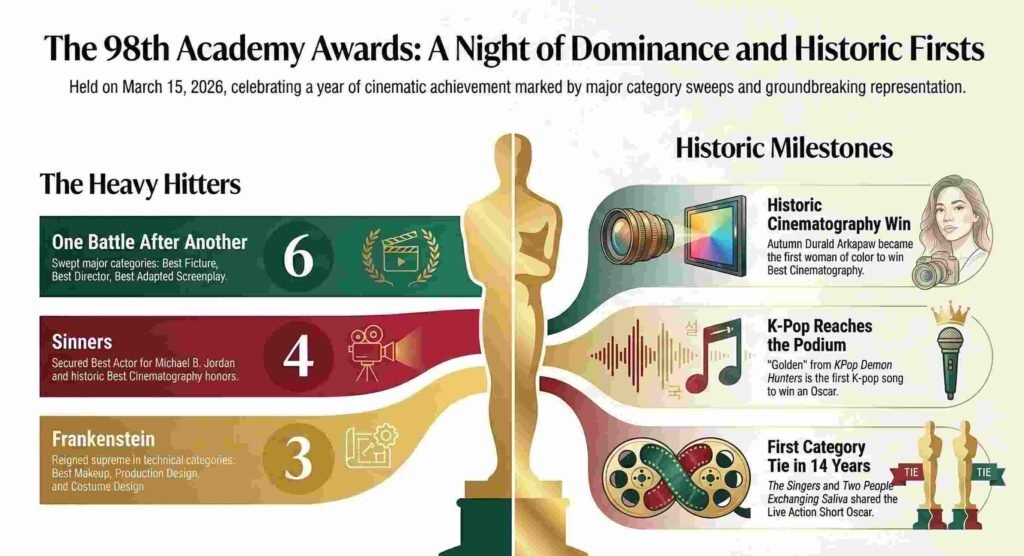
On March 15, 2026, the Dolby Theatre didn’t just host an awards ceremony; it staged a cultural reckoning. While the evening was ostensibly a coronation for Paul Thomas Anderson—whose “black comedy action-thriller” One Battle After Another eventually swept six categories—the statuettes felt like secondary characters. The real narrative of the 98th Academy Awards was written in the margins of historic “firsts” and a brand of radical honesty that felt entirely new for the often-stuffy Academy.
The evening was presided over by a returning Conan O’Brien, who set a surreal tone early by channeling the night’s eventual Best Supporting Actress, Amy Madigan. Donning a wig and the garish, smeared cosmetics of Madigan’s character “Aunt Gladys” from Weapons, O’Brien’s lanky frame danced through scenes of the year’s top films—an absurd Irish jig outside the juke joint of Sinners that signaled this would be a night where high art and populist energy finally collided.

II. The Glass Ceiling in the Lens: Autumn Durald Arkapaw’s Historic Win
The most profound professional milestone of the night occurred in the Cinematography category, a field that has historically served as one of the industry’s most stubborn glass ceilings. Autumn Durald Arkapaw made history as the first woman—and the first woman of color—to win the Oscar for her masterful work on Ryan Coogler’s vampire blockbuster, Sinners.
The victory was as much a human moment as a professional one. In a scene that immediately went viral, director Ryan Coogler hoisted Arkapaw’s young child into his arms, carrying him to the front of the theater so the boy could see his mother take the stage. It was a gesture of communal support that mirrored Arkapaw’s own speech, where she asked the women in the room to stand and share in the light.
“I really want all the women in this room to stand up, because I feel like I don’t get here without you guys.”
III. A New Voice for the Next Generation: K-Pop Claims Its Seat at the Table
In a 2-for-2 sweep that confirmed the Academy is finally tuning into the global frequency, the Netflix phenomenon KPop Demon Hunters claimed both Best Animated Feature and Best Original Song for the chart-topping “Golden.” It was a historic arrival; never before had a K-pop song been honored with a golden statuette.
The weight of the moment was carried by director Maggie Kang, whose emotional acceptance speech addressed the “longing” of past generations for such representation. By the time the animated characters Rumi, Mira, and Zoey were projected onto the screen to “accept” their own honorary trophy, the shift in the room was palpable.
“But it is here, and that means that the next generations don’t have to go longing. This is for Korea and for Koreans everywhere.”
IV. The “Housekeeping Mess”: Paul Thomas Anderson’s Bittersweet Triumph
After decades of near-misses and “always a bridesmaid” narratives, Paul Thomas Anderson finally secured his first-ever Oscars, sweeping Best Picture, Best Director, and Best Adapted Screenplay. Yet, the man known for his dark wit didn’t offer a traditional victory lap. Instead, PTA utilized the platform of his Adapted Screenplay win to offer a somber, paternal apology that felt remarkably vulnerable for the “black comedy” veteran.
Dedicating his director’s win to the late producer Adam Somner, Anderson pivoted to his own family when discussing the world’s current geopolitical and environmental state. His win for One Battle After Another—a film that probes the circular, often violent nature of history—provided the perfect, if somber, backdrop for his message.
“I wrote this movie for my kids to say sorry for the housekeeping mess that we left in this world we’re handing off to them.”
V. The Unprecedented Tie: A Rare Statistical Anomaly
The ceremony provided a rare shock to the system when a tie was announced for Best Live Action Short Film, the first in 14 years and only the seventh in the Academy’s century-long history. However, the historic moment was dampened by what many are calling the night’s “unclassy” low point: as the winners attempted to speak, the Academy’s heavy-handed choreography saw the microphone physically retracted into the stage floor and the lights dimmed mid-sentence.
- Winning Films: The Singers and Two People Exchanging Saliva
- The “Indian Connect”: Two People Exchanging Saliva provided a rare moment of celebration for the Indian film community, even as its makers were ushered off-stage.
- Last Tie Recorded: 2012 (Best Sound Editing between Skyfall and Zero Dark Thirty).
VI. The Marty Supreme Mystery: The Power of the Snub
For every sweep, there is a vacuum. The ping-pong drama Marty Supreme entered the evening with nine nominations and the heavy weight of frontrunner status for Timothée Chalamet. In a stunning upset, the film left with zero awards. This momentum shift cleared a path for Michael B. Jordan’s historic win for Sinners.
Jordan, becoming only the sixth Black actor to win a lead role Oscar, displayed the technical discipline the Academy has begun to crave, famously wearing shoes several sizes too small to capture the physical discomfort of his character, Stack. In a poignant speech, he positioned himself as a link in a chain, explicitly naming those who paved his way: Sidney Poitier, Denzel Washington, Halle Berry, Jamie Foxx, Forest Whitaker, and Will Smith.
VII. Conclusion: Looking Toward the YouTube Era
As we close the book on the 98th Oscars, the ceremony felt like a bridge between eras. It was a night defined as much by political urgency—symbolized by Javier Bardem’s “Free Palestine” plea and co-presenter Priyanka Chopra Jonas’s supportive nod—as it was by technical blunders, like the red carpet identifying Kirsten Dunst as Kathy Bates.
As the Academy prepares for its high-stakes move to YouTube in 2029 (complete with the “unskippable ads” Conan mocked in a brilliant Sterling K. Brown skit), we are left with a central question. Did the historic wins for Autumn Durald Arkapaw and KPop Demon Hunters truly change the industry standards, or were they merely a temporary synchronicity with a global voice that the world has already been listening to? If the “housekeeping mess” PTA spoke of is to be cleaned, perhaps Hollywood has finally found the right hands for the job.
❓ తరచుగా అడిగే ప్రశ్నలు (FAQs)
ఈ వార్త లేదా కథనంలో ముఖ్యమైన అంశం ఏమిటి?
Why PTA’s Bittersweet Triumph and the Rise of K-Pop Redefined Hollywood’s Conscience గురించిన పూర్తి సమాచారం మరియు తాజా ముఖ్యాంశాలు ఈ కథనంలో సమగ్రంగా వివరించబడ్డాయి.
ఈ తాజా పరిణామం ఎందుకు ప్రాధాన్యత సంతరించుకుంది?
ప్రజా ప్రయోజనాలు, సంబంధిత వర్గాలు మరియు ప్రస్తుత పరిస్థితుల దృష్ట్యా ఈ పరిణామం అత్యంత కీలకమైనదిగా మారింది.
ఈ అంశంపై అధికారిక వివరాలు మరియు తాజా అప్డేట్స్ ఎక్కడ తెలుసుకోవచ్చు?
సంబంధిత అధికారిక వర్గాలు వెల్లడించే తదుపరి సమాచారం మరియు ప్రత్యక్ష అప్డేట్స్ కోసం మా వెబ్సైట్ను నిరంతరం ఫాలో అవ్వండి.