
1. Introduction: The Equality Paradox
As we observe International Women’s Day (IWD) 2026, we are navigating a global “Equality Paradox.” Never has the goal of parity been so visible or the tools for achieving it so sophisticated, yet never has the progress we’ve secured been at greater risk of a systemic roll-back.
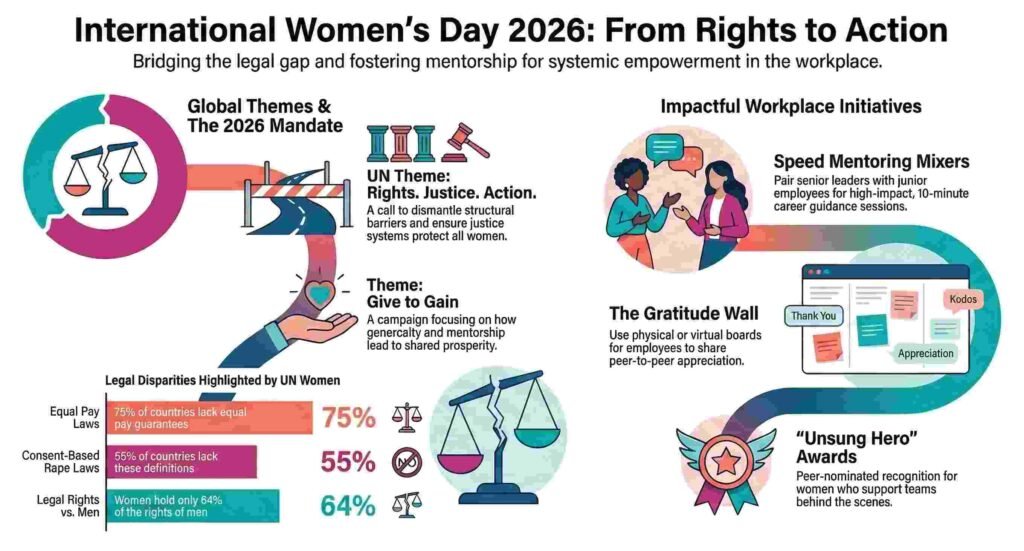
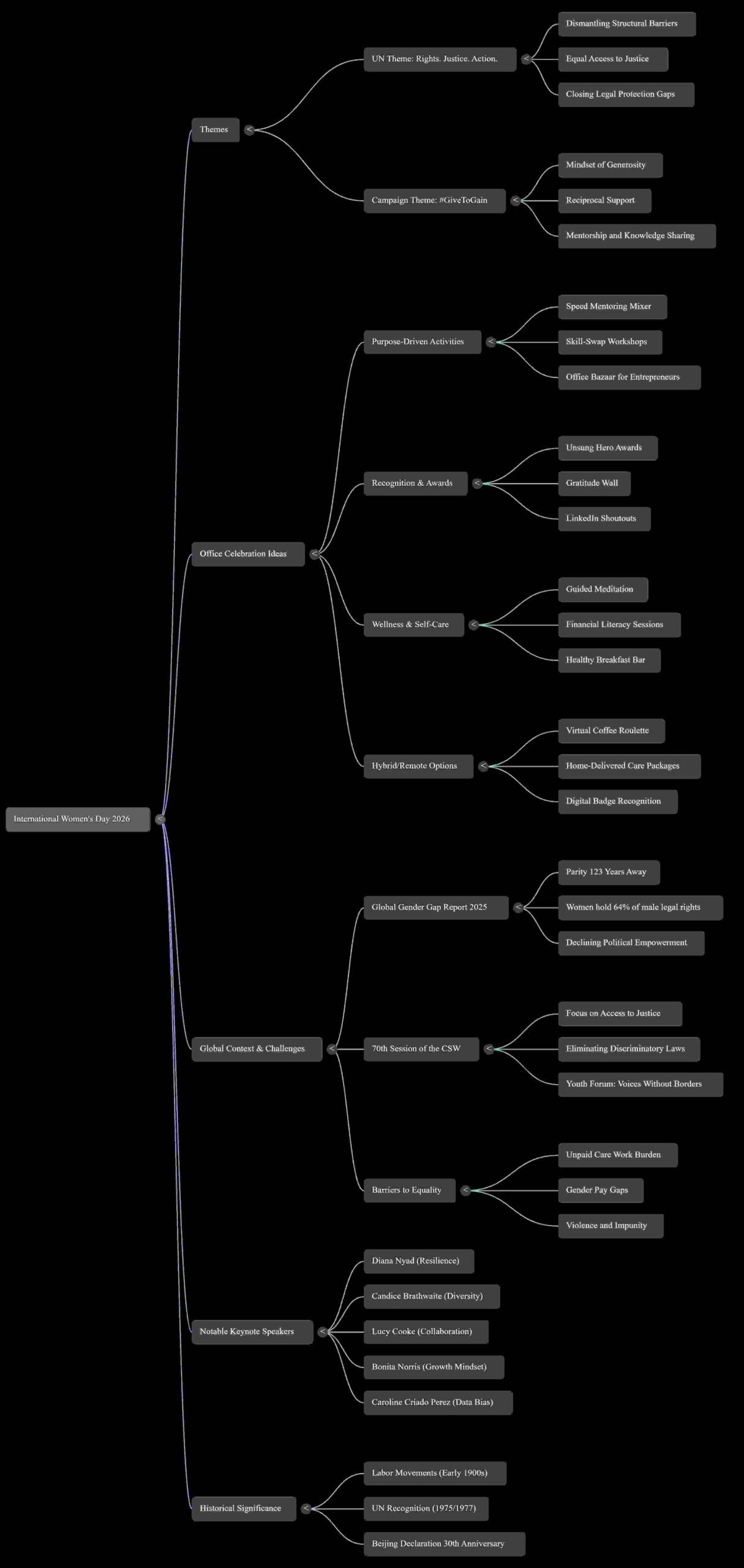
The data suggests a global breach of contract: women currently hold only 64% of the legal rights afforded to men. This isn’t just a gap; it is a structural failure. To meet this moment, 2026 is defined by two interlocking frameworks. On one side, the United Nations’ urgent mandate for “Rights. Justice. Action.” puts the global legal system on trial. On the other, the campaign theme “Give to Gain” champions a model of radical reciprocity. Together, they move the needle from performative empowerment toward hard infrastructure and legal accountability.
2. The 286-Year Waiting Room: Why “Justice” is the 2026 Priority
In 2026, the global community has recognized that rights existing only on paper are essentially invisible. The UN’s pivot to “Justice” reflects a sobering reality: at the current rate of legal reform, it will take an estimated 286 years to close the protection gap between genders.
The 2026 “Justice Deficits” reveal a world where the rule of law often stops at the door of the domestic or the digital:
- The Pay Deficit: 3 in 4 countries still lack legislation guaranteeing equal pay for work of equal value.
- The Consent Deficit: Nearly 45% of countries lack a consent-based definition of rape, leaving survivors to navigate archaic legal standards.
- The Protection Deficit: Legal loopholes still permit child marriage in numerous jurisdictions, effectively foreclosing the futures of millions of girls.
“Justice is the critical bridge between rights on paper and rights in practice. Women’s rights mean nothing if we cannot defend them.” — UN Women, 2026
3. “Give to Gain”: The Power of Radical Reciprocity
The 2026 campaign theme, “Give to Gain,” signals a radical departure from the “lean in” individualist narratives of the last decade. It shifts the focus from “fixing the woman” to “multiplying the collective.” This philosophy of intentional multiplication posits that sharing time, visibility, and resources is not a subtraction of power, but the creation of an interconnected infrastructure of success.
This is a move toward shared prosperity—the idea that society flourishes only when women do. It’s an recognition that generosity is a strategic fuel for progress, creating a cycle where one woman’s advancement provides the scaffolding for the next.
“It’s a simple but powerful truth: generosity fuels progress. When we share time, knowledge, opportunity or support, we don’t lose anything. We amplify what comes next, and when women flourish, society does too.” — The PHA Group, 2026
4. The “Yes-Worthy” Bias: Rethinking the 2% Funding Wall
Perhaps the most incisive cultural critique of 2026 is the TruthWorks – “Dressed for the Yes” campaign. It addresses the “2% wall”—the fact that all-female founding teams receive a mere 2% of global venture capital funding.
The campaign exposed the performative nature of investor criteria through a biting parody of “bro-energy” culture. Female founders recreated stereotypical startup announcement photos, mimicking the specific wide-stanced poses, casual hoodies, and tech-vest aesthetic that signal “potential” to the venture community. The visual satire made the point clear: the problem isn’t the lack of female talent or how women pitch. The problem is a systemic bias that defines “yes-worthy” based on a mirror image of the current gatekeepers.
5. Stains and Scaffolding: Breaking the Final Taboos
In 2026, corporate impact is being measured by its willingness to tackle physical and structural barriers rather than just spreading “awareness.”
- Menstrual Justice: The Arsenal x Persil “Every Stain Should Be Part of the Game” initiative directly challenged the double standard of athletic endurance. It highlighted how a “scraped knee” is celebrated as a badge of effort, while menstrual blood—a sign of a healthy biological process—is treated with a shame that drives young girls out of sports.
- Professional Scaffolding: Addressing the fact that only 2% of tradespeople are women, B&Q’s “Do the lift thing” campaign moved beyond creative messaging. The brand backed its stance with a £1 million investment in trade apprenticeships for carpentry, plumbing, and decorating. This represents a shift toward providing the actual “lift”—the financial and structural support required to enter male-dominated sectors.
6. From “Bread and Peace” to Digital Frontiers
To grasp the urgency of 2026, we must look to the radical roots of IWD. On February 23, 1917 (Julian calendar), which corresponds to March 8 in the Gregorian calendar, women textile workers in Russia sparked a revolution with their strike for “Bread and Peace.”
Today, the revolution has moved to the digital frontier, where the “textile strike” of the modern age is a fight against technology-facilitated violence. A primary threat in 2026 is AI deepfake abuse. Our current justice systems are failing to keep pace with these digital threats, creating a landscape of impunity. When platforms and laws fail to protect women from digital violations, it represents a significant roll-back of rights, proving that our legal infrastructure is struggling to secure dignity in the age of automation.
7. Conclusion: A Final Thought for the Sunday of IWD 2026
Falling on a Sunday, International Women’s Day 2026 offers a moment for reflective pause before the global community convenes for the 70th Session of the Commission on the Status of Women (CSW70). We should view CSW70 not just as a forum, but as a global breach-of-contract hearing. It is a defining test of whether nations will finally deliver on their legal promises or allow injustice to persist for another two centuries.
The “Give to Gain” cycle reminds us that progress is built on the choice to “stand up, show up, and speak up.” As we look toward the start of CSW70 on Monday, the question remains: how will you contribute to the cycle of intentional multiplication?