
The moments leading up to 11 AM on April 7, 2026, were defined by a quiet, high-stakes tension in households across Meghalaya. For more than 48,000 students, the culmination of years of hard work rested on a single click of the “submit” button—a moment where time seemingly stands still as the screen loads. This year, the Meghalaya Board of School Education (MBOSE) released a set of results that reflects not just academic achievement, but a significant evolution in student performance and digital transparency.
The Gender Performance Pivot: Boys Lead the Way
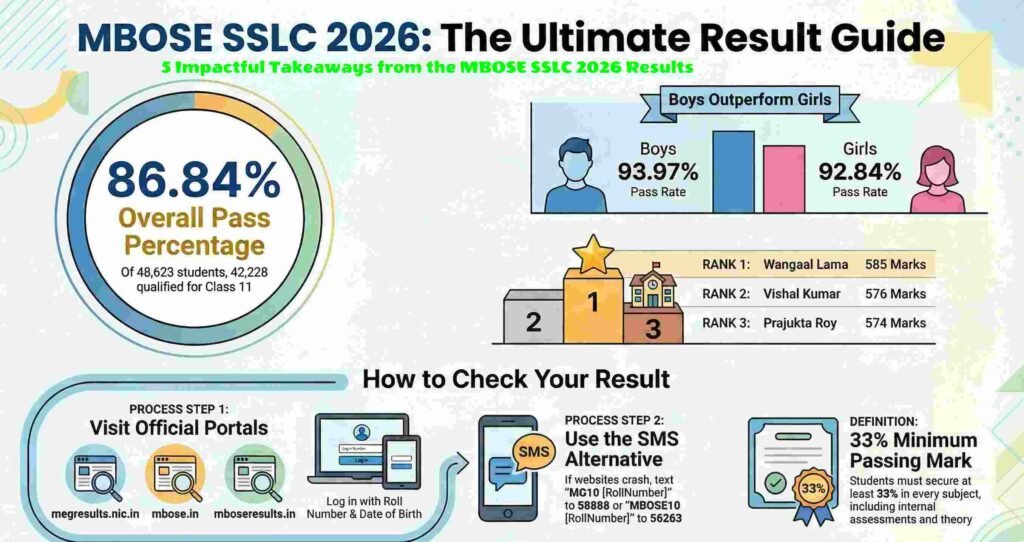
In a fascinating departure from recent national trends where girls often secure the highest pass percentages, the 2026 MBOSE SSLC results showed a strong surge in performance among male candidates. According to the Board’s data, boys achieved a pass percentage of 93.97%, slightly outperforming girls, who recorded a highly commendable 92.84%.
While the state average remains strong, it is worth looking at the “Regular 1” student category to see the true height of this year’s success. In this primary cohort, the pass percentage soared to 94.87%, with boys reaching 95.32% and girls at 94.55%. This suggests that while the overall pass rate saw a very slight dip from the previous year’s 87.10%, the core group of students is performing at an elite, highly competitive level.
“The overall pass percentage in MBOSE SSLC 2026 exam is 86.84%. A total of 42228 candidates passed the exam.”
The Topper’s Journey: Wangaal Lama’s Milestone
The 2026 merit list was exceptionally crowded, proving that the margin for excellence has narrowed. Out of the thousands who sat for the exam, 25 exceptional students secured positions within the prestigious “Top 20” merit list. Leading the state is Wangaal Lama from Gorkha Pathshala Higher Secondary School, Shillong, who claimed Rank 1 with an extraordinary 585 marks.
The top of the leaderboard demonstrates how every single mark counted this year:
- Rank 1: Wangaal Lama (585 marks)
- Rank 2: Vishal Kumar (576 marks)
- Rank 3: Prinita Das (575 marks) and Prajukta Roy (574 marks)
Note: In a unique grouping for the 2026 session, both Prinita Das and Prajukta Roy have been recognized within the Rank 3 bracket, despite their one-point difference, highlighting the Board’s recognition of these top-tier achievements.
The “Digital-First” Reality: Stress-Free Fallbacks
As is common when nearly 50,000 families try to access data simultaneously, official portals like mbose.in, mboseresults.in, and megresults.nic.in can face heavy traffic. To support students during these high-pressure moments, MBOSE has leaned into a 100% digital transparency model. No results were displayed physically at the offices in Tura or Shillong, but the Board provided reliable, stress-free alternatives for those struggling with web lag:
- SMS Service: You can receive your scores instantly by texting your roll number. Send “MG10 [roll number]” to 58888 or “MBOSE10 [roll number]” to 56263.
- DigiLocker: Beyond just viewing marks, students are encouraged to use DigiLocker. These digital versions of the marksheet are not just for viewing; they are valid for admissions and official purposes, providing a vital bridge while waiting for physical copies.
Decoding the 33% Threshold: More Than Just a Number
For students looking toward Class 11, understanding the “Double Threshold” is essential. To successfully clear the SSLC 2026 exam, the Board requires a precise balance of performance across theory and internal assessments. It is not enough to simply have a high total; students must meet specific minimums:
- Theory Papers: A minimum of 33%, which translates to at least 26 out of 80 marks.
- Internal Assessments: A minimum of 33% of the 20-mark assessment, meaning students must secure at least 7 marks.
- Subject Minimum: Crucially, students must also secure at least 30% in every individual subject.
This granular approach ensures that students are well-rounded and ready for the rigors of higher secondary education. Failing to meet the minimum in even one of these components can block the path to Class 11.
“This digital marksheet is provisional and will remain valid until the physical certificates are provided by the respective schools.”
The “Result Booklet” Advantage: Seeing the Big Picture
For parents and educators, the release of the “MBOSE SSLC Result Booklet 2026” is as important as the individual scorecards. This PDF serves as a comprehensive roadmap of the state’s academic health. It provides district-wise statistics—allowing a look at how East Khasi Hills compares to West Garo Hills—and lists subject-wise highest marks.
By analyzing this data, schools can identify which subjects proved most challenging for the Class of 2026 and where teaching strategies are yielding the best results. It turns raw numbers into actionable insights for the next generation of learners.
Conclusion: Beyond the Marks
The MBOSE SSLC 2026 results are a vital milestone, but as any mentor will tell you, they are a beginning, not an end. While the marksheet is “provisional” for immediate admission into Science, Commerce, or Arts streams, the discipline and resilience students built during this journey are permanent.
With the digital shift now complete and gender performance gaps closing, how will the Class of 2026 redefine success in their next academic chapter?